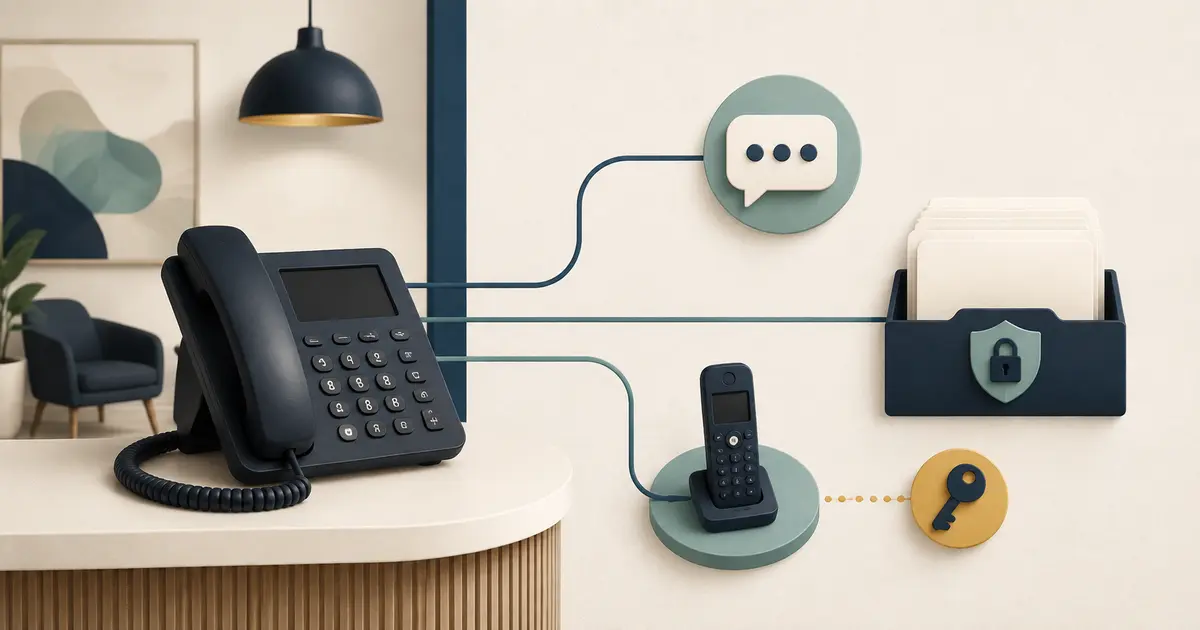
Define dental office phone responsibilities before the first public call arrives. Name who answers, who serves as backup, what each role may say or complete, where different requests go, how follow-up is documented, and who reviews failures. A job title alone is not a phone workflow.
The goal is not to predict every possible conversation. It is to give the team a reliable first response and a clear next owner for the calls the practice can expect at opening.
Build a responsibility map, not a list of duties
A useful responsibility map answers six questions for each call type:
- Who answers first?
- What minimum information should that person collect?
- What may that person answer or complete?
- What must be handed to another role?
- Who is the backup?
- What proves the request is complete?
This is more precise than writing “receptionist handles phones.” The U.S. Bureau of Labor Statistics lists answering phones, taking messages, forwarding calls, scheduling, greeting visitors, entering information, and maintaining records among common receptionist duties. In a dental practice, each task still needs practice-specific authority, training, and access. See the BLS overview of receptionist responsibilities.
Start with the work, then assign the role. A small practice may give several responsibilities to one employee. A larger office may divide them among scheduling, insurance, records, clinical, and management roles. Either structure can work if ownership is explicit.
Assign the seven phone responsibilities
1. Primary call owner
This person answers the main line during the assigned period, uses the approved greeting, identifies the general reason for the call, and either completes an authorized routine step or creates a handoff.
Define:
- staffed hours;
- expected answer interval;
- what happens while the employee is helping someone in person;
- how holds are used;
- which line or queue the employee watches;
- the backup trigger;
- the end-of-shift reconciliation step.
The primary owner should not be responsible for every decision that begins on the phone.
2. Backup and overflow owner
The backup takes calls when the primary person is absent, already on a call, or handling a protected in-person task. The backup may be another employee, a rotating role, centralized coverage, voicemail, or an answering service.
Write the trigger precisely. “When busy” is not enough. Use a condition the team can observe or test, such as a simultaneous call, a no-answer interval, a lunch schedule, or a staffing exception.
If calls will be forwarded, verify the actual phone provider, ring timing, caller-ID behavior, voicemail order, fallback, and disable process. The new-practice answering-service setup checklist covers that technical preparation.
3. Scheduling owner
The scheduling owner controls actions that change the appointment book.
Specify who may:
- offer available times;
- create a new appointment;
- move or cancel an appointment;
- confirm a waitlist change;
- apply a late-arrival or cancellation policy;
- make an exception;
- communicate when a request is only pending.
Someone who lacks verified access or authority should record the request and preference without saying the appointment is booked, moved, or canceled.
4. Clinical-message owner
Front-desk staff can capture a callback number and a general reason for a clinical question. They should not diagnose, recommend treatment, or decide clinical urgency unless the person is operating within an authorized clinical role and the practice's approved process.
Define:
- which role receives clinical messages;
- what broad information the front desk collects;
- the practice-approved path for urgent concerns;
- when the handoff is acknowledged;
- what the caller is told about the next step;
- the backup when the clinical owner is unavailable.
Keep life-threatening emergency instructions and dental after-hours directions separate and approved by the practice. The article on handling urgent dental calls without clinical decisions explains the front-desk boundary.
5. Insurance and financial owner
Callers may ask whether the practice accepts a plan, what a procedure costs, what insurance will pay, or whether a balance can be adjusted. Those questions do not all have the same owner.
Define who may:
- state the practice's approved general participation language;
- collect plan information;
- verify individual benefits;
- explain an estimate;
- discuss an account;
- approve an adjustment or payment arrangement;
- accept a payment through an authorized process.
A general office fact is different from a conclusion about one patient's benefits or final cost. The first call owner should not guess to avoid a handoff.
6. Records and privacy owner
Records requests, release questions, subpoenas, access requests, and identity-verification issues need a designated process. The person answering the main line can identify the request and provide the approved starting step. The records or privacy owner decides and completes the authorized response.
Write:
- the approved intake route;
- identity-verification requirements;
- where documents may be sent;
- who can approve a release;
- the expected acknowledgment language;
- the escalation path for unusual requests.
Do not send patient information through a convenient channel merely because the caller asks.
7. Complaint and manager owner
Not every dissatisfied caller needs the dentist immediately, but every complaint needs an accountable next step.
The first call owner can:
- listen without arguing;
- capture facts and the requested outcome;
- avoid admitting fault or making an unauthorized promise;
- state who will review the concern;
- route it to the designated manager.
The manager or owner investigates, coordinates the response, and documents the resolution under the practice's policy.
The ADA describes office managers as overseeing daily operations, communications, staff, compliance, and finances. Use the ADA dental office manager role overview as a starting point, not as a substitute for a practice-specific job description.
Create a phone-responsibility matrix
Put the assignments in one table the team can use during training and launch.
| Call type | First responder may | Final owner | Backup | Completion evidence |
|---|---|---|---|---|
| Basic office information | Use approved current facts | Primary call owner | Backup call owner | Question answered or request created |
| New-patient inquiry | Collect minimum contact and request details | Authorized scheduling role | Manager-designated backup | Next step recorded accurately |
| Appointment request | Record requested action and preference | Scheduling owner | Scheduling backup | Schedule action confirmed by authorized staff |
| Clinical question | Capture callback number and general reason | Clinical-message owner | Practice-approved clinical backup | Handoff acknowledged and resolved under policy |
| Insurance question | Capture the plan-related question | Benefits owner | Financial backup | Verified answer or next step documented |
| Fee or account question | Use only approved general language | Financial owner | Manager | Authorized explanation or follow-up completed |
| Records request | Provide the approved starting route | Records/privacy owner | Owner-designated backup | Request processed under policy |
| Complaint | Listen, document facts, and route | Office manager or owner | Named alternate | Review and response documented |
| Vendor or non-patient call | Capture company, caller, and purpose | Assigned business role | Manager | Routed, declined, or closed |
| Wrong number or spam | End safely and record only when needed | Call owner | — | No follow-up required |
Replace generic titles with the actual role names used by the practice. Add a phone or internal destination only after access and privacy have been reviewed.
Separate scripts from authority
A script helps the employee say the approved message consistently. It does not grant permission to make the underlying decision.
The ADA recommends a standard greeting, scripts for frequent phone topics, and role-playing common scenarios. Review the ADA prospective-patient call guidance, then adapt it to the practice's policies.
For every script, add an authority note:
| Script purpose | Authority note |
|---|---|
| Greeting | Anyone assigned to answer may use it |
| Office hours and location | Use only the approved current source |
| Appointment request | Capture preference; confirmation requires scheduling authority |
| Insurance participation | State approved general language; benefits require verification |
| Price question | Use approved general information; final estimate requires authorized review |
| Clinical question | Capture and route; do not answer clinically |
| Complaint | Listen and hand off; do not promise the outcome |
| Records request | Explain the approved starting step; do not release information |
This prevents a polished script from quietly expanding a new employee's responsibilities.
Define the minimum phone record
Decide what the practice needs to continue a routine call without collecting an entire registration packet.
For many requests, the minimum is:
- caller name;
- confirmed callback number;
- intended location;
- new or existing patient status, if relevant and known;
- broad reason for calling;
- requested next step or timing preference;
- expectation given to the caller;
- source and time received;
- assigned owner;
- current status.
The new-patient call-intake guide explains how to collect a usable pre-opening inquiry without promising an appointment or confirming benefits.
Use one working request, not a voicemail plus an email plus a sticky note plus an internal chat. Alerts should direct the owner to the request rather than create another copy.
Set handoff rules
A handoff is complete only when the next owner can act.
Define:
- the required request fields;
- the destination;
- the expected acknowledgment time;
- what the caller was told;
- the backup if the owner does not acknowledge;
- how corrections and duplicates are handled;
- what status closes the item.
Avoid “I told someone” as a status. Use a small set such as New, Assigned, Waiting, and Complete, with one named owner.
The first responder remains responsible for routing the request correctly. The final owner becomes responsible after acknowledgment. Write that transfer point down.
Plan coverage by time and condition
Create a full week, not only an opening-hours schedule.
| Period or condition | Primary route | Backup route | Queue review owner |
|---|---|---|---|
| Before opening | Approved closed-office path | Voicemail or tested fallback | First opening employee |
| Normal staffed hours | Primary call owner | Backup/overflow owner | Office manager |
| Lunch | Named lunch route | Tested fallback | First post-lunch owner |
| Simultaneous call | Busy or overflow rule | Voicemail fallback | Assigned call owner |
| No answer | Timed no-answer route | Voicemail fallback | Assigned call owner |
| After hours | Approved after-hours route | Tested fallback | Opening owner |
| Phone or internet outage | Contingency route | Documented alternate | Manager |
| Employee absence | Scheduled backup | Manager-designated alternate | Manager |
Do not assume the phone system provides a specific condition. Confirm each function with the provider and test it from an outside number.
Apply privacy and access by responsibility
Employees need access that matches their work, not every system “just in case.”
HHS's Security Rule summary describes workforce authorization, role-appropriate information access, security training, incident procedures, and contingency planning for regulated electronic information. Review the HHS Security Rule summary with the advisors responsible for the practice.
For each phone role, decide:
- which systems it can access;
- which patient information it can see;
- whether it can edit or only create a request;
- what appears in notification previews;
- which device and location may be used;
- how access is approved and removed;
- what happens during an outage;
- who reviews access periodically.
External answering, transcription, hosting, or messaging vendors may create additional contract and safeguard obligations. Review the actual information flow rather than relying on a product label.
Write the daily operating rhythm
Before the phones open
- Confirm the primary and backup call owners.
- Verify that the normal route is active.
- Review unresolved requests from the prior period.
- Confirm known staffing or schedule exceptions.
- Check that approved office information is current.
During the day
- Keep one visible request queue.
- Assign each new handoff.
- Correct wrong routing without creating duplicate requests.
- Escalate only under the written rule.
- Protect the employee helping a patient in person from avoidable interruptions.
At lunch and shift changes
- Reconcile unassigned requests.
- Confirm the next route and owner.
- Transfer open items explicitly.
- Test restoration when a temporary route ends.
Before closing
- Assign every open request.
- Activate or confirm the approved closed-office route.
- Identify the first reviewer for the next opening.
- Record any routing or access failure for manager review.
Test responsibilities before launch
Run role-play and actual test calls before publishing the number widely.
Use scenarios such as:
- a new patient asks whether the office is accepting patients;
- a caller wants a specific appointment time;
- an existing patient asks to move an appointment;
- a caller asks what insurance will pay;
- a caller asks for a final fee;
- a patient has a clinical question;
- a caller requests records;
- an upset caller asks for the dentist;
- two calls arrive close together;
- the primary employee is absent;
- the normal destination does not answer;
- the office is closed.
For every scenario, verify:
- what the caller hears;
- what the first responder records;
- whether the responder stays within authority;
- where the request arrives;
- who acknowledges it;
- what fallback occurs;
- how the request closes.
Test from an outside number. A staff discussion cannot reveal caller-ID changes, forwarding loops, voicemail timing, or a dead fallback.
Review after opening
For the first month, review the phone workflow at least weekly. Use actual failures and workload, not assumptions.
Track:
- calls staff did not answer;
- usable requests;
- requests missing a callback number or owner;
- time to assignment;
- routing corrections;
- duplicate requests;
- callers given an inaccurate expectation;
- calls that reached the wrong location or role;
- unassigned items at lunch and closing;
- outage and fallback performance.
Change one rule at a time when possible. Record the owner, reason, effective date, and test result so the team is not following different versions.
Pre-opening phone responsibility checklist
- [ ] Primary call owner and staffed hours are named.
- [ ] Backup triggers and owners are named.
- [ ] Scheduling authority is documented.
- [ ] Clinical-message and urgent-concern paths are approved.
- [ ] Insurance, financial, records, and complaint owners are assigned.
- [ ] Scripts include authority boundaries.
- [ ] Minimum request fields and statuses are defined.
- [ ] One request queue and acknowledgment rule are selected.
- [ ] Weekly coverage, outage, and absence routes are written.
- [ ] Role access and notification content are reviewed.
- [ ] Test calls pass from the caller and staff sides.
- [ ] Opening, lunch, closing, and weekly review routines are assigned.
Clear dental receptionist phone duties begin with an owner, a limit, and a handoff. Defining those responsibilities before opening gives a new practice a safer way to answer routine questions, protect decisions that belong to authorized staff, and keep every request from becoming “someone else's call.”