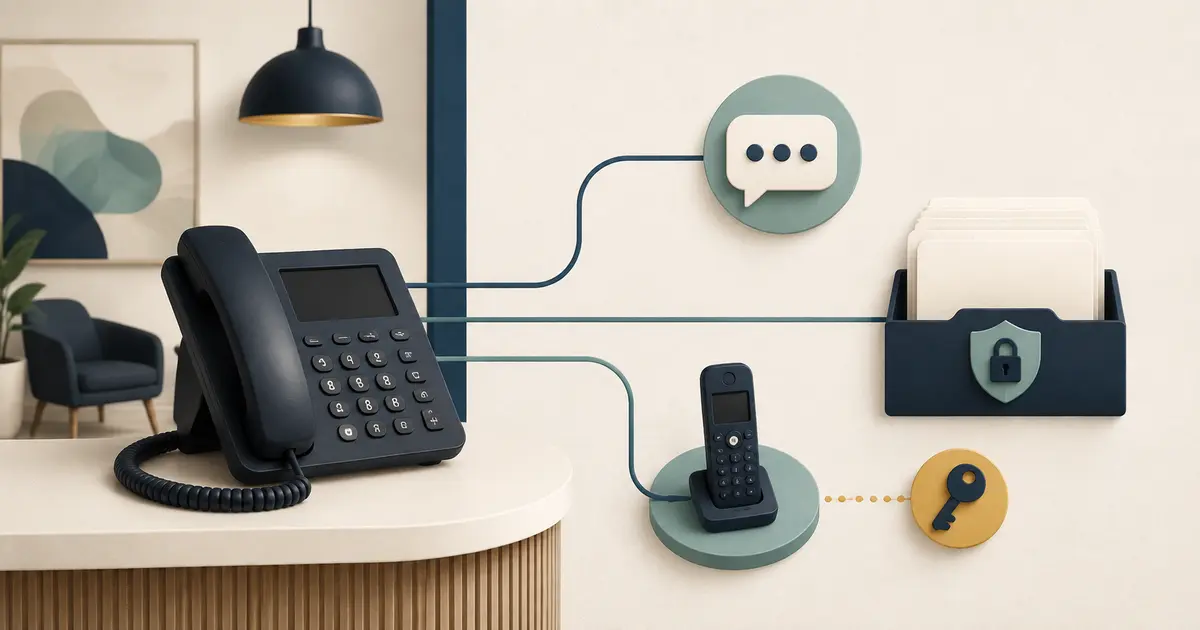
After-hours new-patient calls at a dental practice need an honest capture and handoff process. The caller should learn whether the office is closed, what information can be provided, whether the request is unconfirmed, and when staff will review it.
Build the workflow before advertising evening or weekend availability.
Decide what “after-hours coverage” means
Separate:
- call answered;
- general office questions answered;
- request captured;
- staff callback available;
- on-call clinician available;
- appointment confirmed;
- care available.
These are not interchangeable. Do not advertise 24/7 scheduling or emergency care merely because a service answers the phone.
The 24/7 answering service guide explains how to evaluate coverage claims.
Approve the office facts
Before opening, publish one controlled source for:
- practice name and location;
- posted opening date and hours;
- public phone number;
- general services approved for public description;
- new-patient request process;
- accepted inquiry channels;
- language and accessibility options;
- payment and benefit wording;
- clinician-approved urgent instructions;
- callback expectation only if operationally supported.
Mark tentative facts as unavailable rather than letting an answering system guess.
Capture a minimal new-patient request
Collect only what staff need to follow up:
- caller name as provided;
- reliable callback number;
- preferred contact method;
- general reason for calling in the caller's words;
- preferred location when applicable;
- broad timing preference if useful;
- language or accessibility request;
- source of the inquiry if approved;
- time received;
- owner and due rule.
Do not collect a full health history, diagnose, verify benefits, or promise a time. The new-patient intake guide provides a pre-opening call checklist.
State the request status
Use direct language:
“I can capture your request for the office team. The practice is currently closed, and no appointment is confirmed. Staff will review the request during the next monitored period.”
Include a response time only when the practice can meet it consistently. Avoid “we'll call right away” or “your time is reserved.”
If the practice has not opened yet, state the planned opening status accurately and provide the approved next step.
Design urgent-message escalation
New callers may describe pain, swelling, trauma, bleeding, fever, or another concern. A general answering workflow should not assess severity or recommend treatment. Use clinician- and counsel-approved language and routing.
Document the primary contact, backup, acknowledgment rule, retry, final fallback, and failed-notification queue. Test the path before publishing it.
The urgent-call handoff guide keeps clinical authority with qualified people.
Reconcile every morning
At opening, one owner should review:
- all new requests;
- duplicate calls or texts;
- missing callback information;
- failed notifications;
- urgent-path records;
- language or accessibility needs;
- wrong numbers;
- requests with no owner;
- records past the due rule.
Staff then verify identity as required, review real availability, communicate the next step, and update the authoritative schedule only through the approved process.
Connect marketing to operational capacity
If ads, directories, mailers, or local listings encourage calls outside business hours, test whether the practice can return the resulting requests. Record the source when reliable, but do not sacrifice caller service to interrogation about marketing.
Pause or adjust campaigns when the queue consistently exceeds safe follow-up capacity. Capturing more requests without ownership can worsen the experience.
The call attribution guide explains how to measure source without claiming causation.
Protect privacy
Limit voicemail, text, and notification previews. HHS permits patient communication with reasonable safeguards and advises limiting details in messages. A prospective caller may use a shared phone, so do not assume privacy.
If a vendor handles protected health information on behalf of the practice, determine business associate and contract requirements. Review recordings, transcripts, retention, support access, and deletion.
Test the whole path
Use fictional callers for:
- routine new-patient inquiry;
- call before the announced opening date;
- weekend call;
- duplicate call and text;
- request for same-day care;
- benefit question;
- caller asking for a specific clinician;
- language or relay request;
- unclear callback number;
- failed on-call notification;
- wrong location;
- provider outage.
Score factual accuracy, request completeness, prohibited claims, escalation, and next-day usability.
Keep Missed Calls Dental accurate
Missed Calls Dental can answer eligible forwarded missed calls and capture requests for front desk follow-up. It does not book appointments, access a practice management system, verify benefits, diagnose, or triage. Phone forwarding and voicemail behavior depend on the practice's provider and configuration.
The after-hours appointment request workflow should also document the front desk's receiving side.
An effective pre-opening plan makes after-hours access modest and dependable. It turns a call into an owned request without claiming that the office has already done more than it has.
Create the opening-week readiness board
List every evening and weekend dependency: published hours, phone provider, forwarding route, greeting, answering service or voicemail, notification channel, staff owner, clinical escalation contacts, new-patient intake form, accessibility path, and morning reconciliation. Assign a person and test date to each.
Use staged activation. First test internal and fictional calls. Then enable the route without advertising it and observe the handoff. Only after the practice can reconcile requests should marketing listings and campaigns send meaningful volume to the number.
Review the caller-facing wording across the website, directory profiles, voicemail, AI or answering script, and text acknowledgments. They should agree on whether the practice is open, which hours are monitored, and whether requests are unconfirmed. Remove placeholder promises such as “someone is always available” unless the entire service path supports them.
Prepare an opening-day exception plan. If the schedule is not ready, the phone port is delayed, or a clinician contact changes, staff need approved temporary wording and a safe route. Mark the temporary configuration with an expiration date and retest when the final dependency arrives.
During the first week, record request volume by period, missing information, wrong routes, failed notifications, staff callback completion, and caller confusion. Meet daily to fix one root cause while preserving the documented boundary. Avoid expanding intake questions to compensate for staff follow-up delays.
At the end of the week, archive the test evidence and update the permanent runbook. The practice should know exactly what an after-hours caller experiences and which employee accepts the request the next monitored day.
Approve a daily reconciliation report
The report should show calls offered, answered, abandoned, sent to voicemail, captured as requests, delivered to staff, acknowledged, contacted, and closed. Keep raw counts and list unresolved exceptions. Do not label an answered call or sent notification as a completed patient outcome.
Assign one owner to sign off after each morning review. That person confirms duplicates were merged, urgent-path messages were acknowledged, failed notifications were recovered, and every new-patient request has a next step. A backup signs off when the primary owner is absent.
Review the report weekly during the first month. If call volume repeatedly arrives outside the planned hours, update staffing or public wording. If requests lack usable details, refine the approved fields. If staff cannot return them within the stated window, change the promise before increasing marketing.
Keep the report privacy-conscious. Managers need operational states and exception categories, not unnecessary health details. Preserve the underlying source only in the approved system for authorized review.