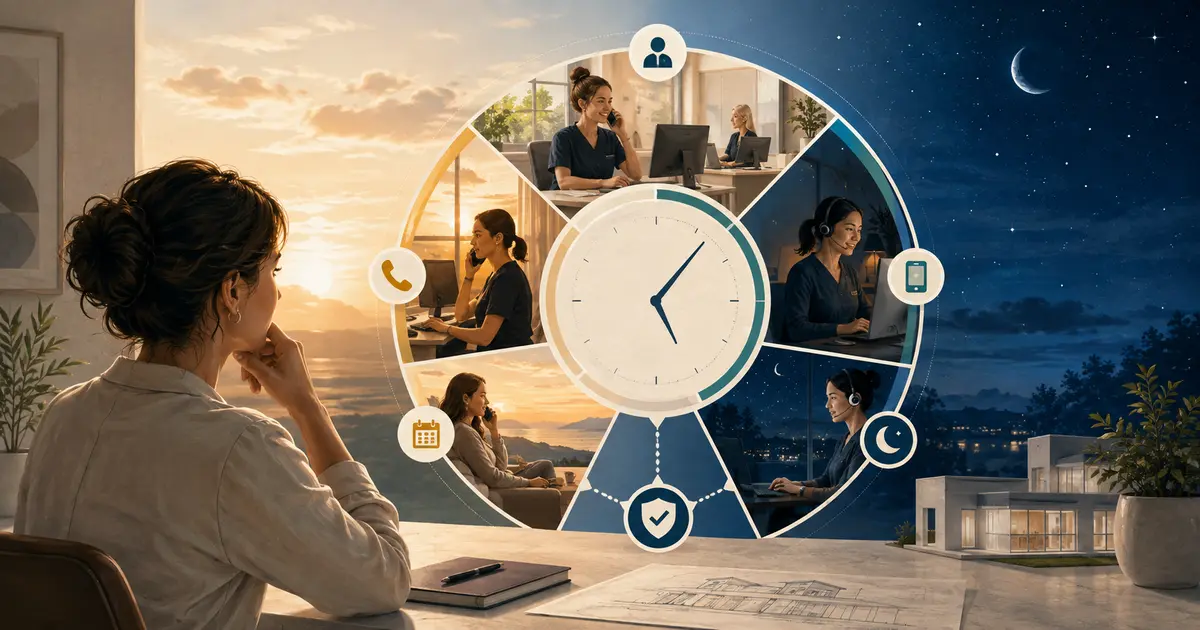
A 24/7 dental answering service can give callers an interactive path at any hour, but a new practice should not use one undifferentiated script around the clock. Define open-hours overflow, evening, overnight, weekend, holiday, and outage conditions separately. For each window, specify what the service may say and collect, who receives the request, what urgent statements trigger, when staff follow up, and what happens if the service is unavailable.
“24/7” describes availability, not capability. It does not automatically mean appointment booking, clinical triage, insurance verification, live human staff, guaranteed response time, or uninterrupted service.
Decide whether round-the-clock coverage solves a real problem
Before opening, estimate when callers are likely to need the practice and what outcome is useful outside normal hours.
Possible goals include:
- capture new-patient inquiries after work hours;
- provide approved office hours, location, and service information;
- record an existing patient's callback request;
- create a next-business-day scheduling request;
- support callers during lunch or simultaneous-call overflow;
- provide the practice's approved after-hours instruction;
- maintain a request path during limited phone failures.
Do not buy full-week coverage merely because it sounds comprehensive. If almost all useful calls occur during a two-hour evening window, a narrower plan may be easier to operate and less expensive.
Write the desired result:
“Outside staffed hours, callers can identify the practice, hear approved office information, leave a general request and callback number, and receive an accurate expectation for staff review. The service does not make clinical or scheduling decisions.”
Divide the week into coverage modes
Use a mode table:
| Mode | Trigger | Service may | Staff handoff |
|---|---|---|---|
| Open-hours overflow | Queue or no-answer threshold | Capture request after staff-first route | Same-shift callback owner |
| Lunch | Scheduled route | Explain temporary coverage and capture request | Assigned lunch coverage employee |
| Evening | Office closes | Share approved facts and collect request | Next-business-day queue |
| Overnight | Defined late window | Narrow request capture and approved urgent instruction | On-call or morning process |
| Weekend/holiday | Calendar schedule | Accurate closure message and approved options | Named return-date owner |
| Outage | Incident lead activates | Temporary instructions and controlled request log | Incident process |
Keep modes in the phone system, service configuration, and staff runbook aligned. A holiday change should not overwrite the ordinary after-hours greeting permanently.
The after-hours dental answering guide explains how to compare voicemail, live service, and AI coverage. This planning guide focuses on making round-the-clock service safe for a new practice.
Define the approved call scope
A 24-hour dental answering service may handle:
- practice identification;
- hours and location;
- services described accurately;
- general insurance-participation wording approved by the office;
- caller name and callback information;
- new or existing patient status when relevant;
- general reason for contact;
- preferred callback window;
- request routing by location or category.
Keep a separate prohibited list:
- no diagnosis or treatment advice;
- no clinical triage unless a qualified, separately authorized clinical service is actually contracted;
- no promise of appointment availability;
- no claim that an appointment is booked, canceled, or changed without verified completion;
- no individual insurance-benefit confirmation;
- no unverified fee quote;
- no payment collection without a separately approved workflow;
- no promise that the dentist will call within an invented time;
- no pretending an AI system is human.
If the vendor sells broader features, enable only what the practice has reviewed, contracted, configured, and tested.
Build an after-hours request script
Opening:
“Thank you for calling Green Valley Dental. Our office is currently closed. I can share approved office information and record a request for the team.”
Appointment request:
“I can record your request and preferred time. No appointment is scheduled until the office reviews current availability and confirms it with you.”
Insurance question:
“I can share the office's approved general participation information. Your individual eligibility, benefits, and expected responsibility require verification by the practice.”
Clinical statement:
“I cannot provide clinical advice. I can record your concern and follow the office's approved after-hours process.”
Life-threatening emergency instruction:
“If you believe you may have a life-threatening emergency, call 911 or seek emergency care.”
Use the exact wording approved for the practice and jurisdiction. The ADA recommends that closed-office messages clearly direct life-threatening emergencies to 911 and provide the approved path for dental emergencies and patients of record. Review the ADA emergency-treatment guidance.
Do not confuse answering with clinical triage
An answering agent can hear a concern, collect contact details, and follow a predetermined escalation instruction. Clinical triage requires appropriate professional judgment, protocol, licensure, and accountability.
Ask the vendor:
- Who handles urgent statements?
- What training and credentials does that role have?
- Is the service only relaying a message?
- Which script determines the next step?
- Who is on call for the dental practice?
- What happens when the on-call person does not answer?
- Is the caller told an accurate expectation?
- Are events documented for the practice?
If the service is not a clinical triage service, say so in the contract, configuration, training, and patient-facing script. Do not let the term “emergency answering” imply a capability that does not exist.
Choose AI, live human, or hybrid coverage deliberately
AI answering
Can provide consistent scripted request capture and approved office facts when configured and available. Review disclosure, boundaries, conversation quality, exceptions, data handling, and failure behavior.
Live answering service
Can provide a human conversation and handle flexible language within training and authority. Review operator staffing, hold times, script consistency, privacy, escalation, and pricing.
Hybrid
May use staff first, AI for selected overflow, and a separate on-call or human path for defined exceptions. Hybrid coverage can fit complex needs but creates more routes to configure, test, and reconcile.
Compare the same call scope. A live service with limited message taking and an AI system with office-knowledge answers are not identical merely because both are available all day.
The AI versus traditional answering-service guide provides a structured comparison.
Keep the practice's main number and route under control
Many practices can keep the published number and use conditional forwarding. Verify with the actual phone provider:
- no-answer, busy, unavailable, and scheduled forwarding;
- original caller-ID preservation;
- ring and timeout behavior;
- voicemail order;
- holiday schedules;
- destination failure behavior;
- forwarding charges;
- emergency calling behavior;
- owner-controlled rollback.
Do not route every call to the service before the front desk is trained unless that is the intentional model. A staff-first route may preserve in-office relationships while using 24/7 coverage only when employees cannot answer.
Test from outside numbers during open hours, after closing, overnight, and on a scheduled holiday. The existing-number guide explains why the main number can remain published even when selected calls forward elsewhere.
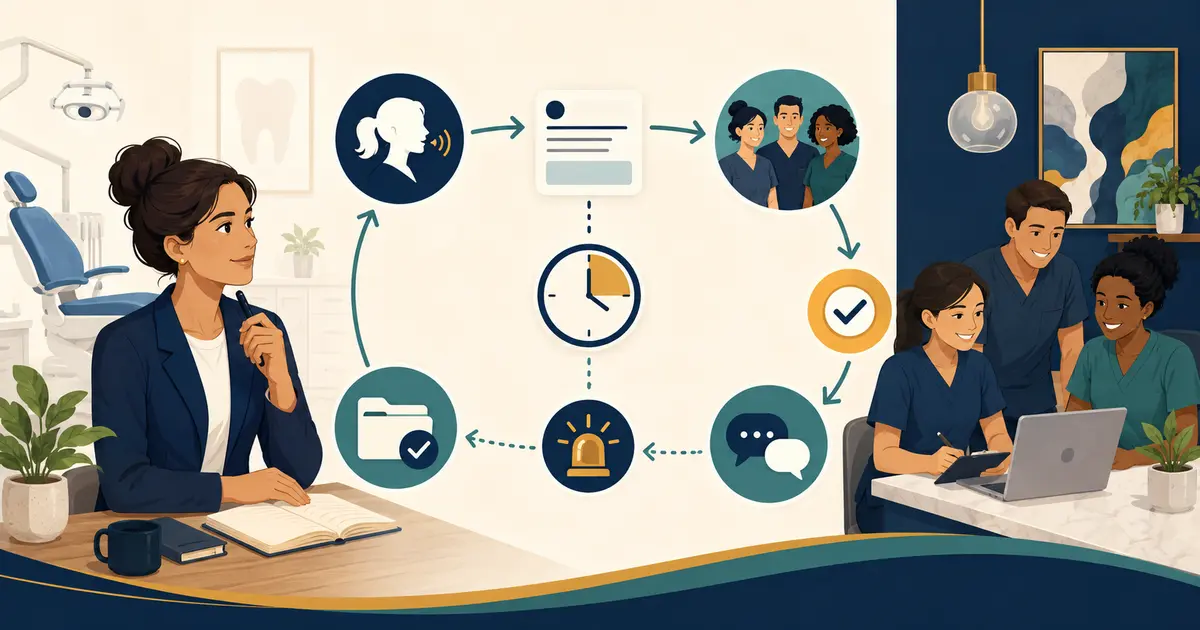
Make every overnight request visible
The morning team should not search separate voicemail, vendor email, text alert, and dashboard lists.
Each request needs:
- source and time;
- caller and confirmed callback number;
- location;
- general reason;
- mode that handled the call;
- approved information provided;
- current owner;
- pending, handled, or blocked status;
- next action;
- response expectation;
- outcome.
Assign the first morning review to a named person. Use a backup when that person is absent. Set an escalation for overnight work still unacknowledged after the office opens.
If a patient calls twice overnight, link the calls. If the caller reaches an on-call person, suppress a redundant morning message unless follow-up remains necessary.
Set response expectations by time window
Do not promise the same response at 2 p.m. and 2 a.m.
Examples:
- Open-hours overflow: “A front desk team member will review this during today's office hours.”
- Evening: “The office will review this when it reopens tomorrow.”
- Weekend: “The office reopens Monday at 8 a.m. and will review requests through its normal process.”
- Holiday: “The office reopens Tuesday at 8 a.m.”
Use exact dates around holidays to avoid ambiguity. If the practice has an approved on-call route for patients of record, explain it accurately without guaranteeing an answer time the dentist has not accepted.
Review privacy and security
Round-the-clock service can create recordings, transcripts, summaries, notifications, and vendor access outside the office's direct observation.
Map:
- every vendor and subcontractor;
- information collected;
- storage location and retention;
- staff, operator, support, and administrator access;
- recordings and transcripts;
- notification content;
- mobile-device access;
- export and deletion;
- incident response;
- account termination.
HHS says a cloud provider that creates, receives, maintains, or transmits ePHI on behalf of a covered entity generally requires an appropriate business associate agreement, and the practice must still conduct its own risk analysis. Review the HHS cloud-computing guidance with qualified advisors.
The AI receptionist privacy checklist offers detailed due-diligence questions for AI-based coverage.
Compare complete 24-hour cost
Request a quote for the actual schedule and call scope. Include:
- base subscription;
- included calls or minutes;
- overage rate and rounding;
- nighttime, weekend, or holiday fees;
- operator, transfer, bilingual, or on-call charges;
- numbers and telecom fees;
- locations;
- setup and script changes;
- messaging;
- integrations;
- staff review time;
- contract term and cancellation.
Compare full 24/7 service with narrower options:
- evenings only;
- after-hours plus weekends;
- staff-first overflow;
- voicemail plus owned callback;
- AI capture plus a separate clinical on-call process.
The least expensive package is not necessarily the smallest base fee. Calculate a normal month, a busy month, and a routing-error month in which more calls reach coverage than intended.
Create a failure and outage path
Ask what callers hear when the answering destination is unavailable. Define:
- controlled fallback greeting;
- voicemail destination;
- provider alert;
- manager notification;
- request recovery;
- route disablement;
- restoration tests.
A second answering destination is not a full disaster-recovery plan if it depends on the same carrier, internet service, or configuration. Connect the service to the dental office phone outage plan.
Do not advertise “always available” without acknowledging service and carrier dependencies. Use “24/7 coverage when configured and available” or the vendor's precise supported language.
Test every mode before opening
Use fictional information and outside phones.
Test:
- open-hours staff-first call;
- busy or no-answer overflow;
- evening request;
- overnight request;
- weekend call;
- holiday schedule;
- appointment request;
- insurance or price question;
- clinical statement;
- life-threatening emergency wording;
- wrong number or spam;
- simultaneous calls;
- on-call escalation failure;
- answering-destination outage;
- route disablement and restoration.
For each call, compare the approved script with what occurred, the request record, notification, owner, and status. A demonstration on the vendor's test number is not acceptance testing for the practice's route.
24-hour dental answering checklist
Before launch, confirm:
- [ ] full-week coverage addresses a measured need;
- [ ] open, overflow, lunch, evening, overnight, weekend, holiday, and outage modes are separate;
- [ ] approved and prohibited call actions are written;
- [ ] answering is not misrepresented as clinical triage or automatic booking;
- [ ] AI, live, or hybrid coverage matches the desired call scope;
- [ ] the phone provider's forwarding, caller ID, voicemail, fees, and rollback are verified;
- [ ] every request reaches one owned queue;
- [ ] response expectations match each time window;
- [ ] privacy, vendors, access, retention, and incidents are reviewed;
- [ ] normal, busy, and routing-error costs are calculated;
- [ ] service failure has a controlled fallback;
- [ ] every mode and restoration path passed outside-call testing.
A 24 hour dental answering service is useful when it creates an accurate bridge between the caller and the next authorized employee. The practice still owns the script, clinical boundaries, schedule status, data handling, response expectation, and final patient follow-up at every hour of the week.