A dental new patient intake answering service should help a future practice collect a usable request before the front desk is fully staffed. It should not perform a full clinical registration, promise an appointment, confirm insurance benefits, or invent an opening date the owner has not approved.
Before the first public call, define a minimal intake: who is calling, how the office can return the call, what the person generally needs, which location is relevant, and what days or times the caller prefers. Then send that request to one named owner with an accurate statement about what will happen next.
This narrow workflow gives prospective patients a professional response while the new practice is still finalizing staffing, schedules, systems, and policies.
Decide what stage the practice is actually in
“Before opening” can mean very different things. The office may be several months from seeing patients, waiting on a final inspection, training staff, accepting future appointment requests, or already scheduling a limited opening calendar.
Write the current stage in one sentence and approve what callers may be told.
Examples:
- The practice is preparing to open but is not yet offering appointment times.
- The practice is collecting new-patient requests for staff follow-up.
- The opening date is approved, but the visit schedule is not yet available.
- A trained scheduling team is available during limited hours.
Do not let a website launch, phone-number activation, or answering-service setup become an accidental promise that the office is open. The caller experience must match the actual operational stage.
Separate request intake from patient registration
Pre-opening call intake should be smaller than a complete patient-registration process.
The first call usually needs enough information to continue the conversation, not a full medical or dental history. Keep the initial fields limited.
| Intake field | Purpose | Boundary |
|---|---|---|
| Preferred name | Identifies the request | Confirm spelling when unclear |
| Callback number | Gives staff a usable follow-up path | Read it back; do not rely only on caller ID |
| New-patient inquiry | Routes the request | Do not infer an established patient relationship |
| General reason for calling | Helps staff prepare | Use neutral caller language; do not diagnose |
| Preferred days or time ranges | Gives staff a starting point | Preference is not availability |
| Intended location | Routes multi-location requests | Ask rather than infer from area code |
| Open question | Preserves what staff must answer | Do not guess or promise |
Avoid collecting detailed symptoms, medications, treatment history, payment-card information, or complete insurance data merely because the phone channel can store it. Those details belong in the practice's approved registration and clinical workflows when they are actually needed.
The published new-patient phone call checklist covers the staffed-office conversation in more detail. A pre-opening workflow should be deliberately narrower.
Build one approved pre-opening information sheet
The answering channel needs a controlled source of facts. If a detail is not approved, the correct response is to record the question for staff.
Include only confirmed information such as:
- public practice name;
- location address, if it is ready to share;
- main phone number and callback number;
- approved opening-stage statement;
- hours when staff can review requests;
- general services the practice is prepared to discuss publicly;
- languages available;
- accessibility information;
- general payment-method information;
- carefully approved insurance-participation language;
- the practice-approved urgent and emergency instructions;
- questions that must always go to the owner or front desk.
Assign one person to approve changes. Opening dates, hours, insurance participation, services, and staffing can change quickly during launch. A stale answer can create more damage than saying the office will follow up.
Choose how calls reach the intake path
Map the number a prospective patient will dial and the exact route that follows.
Possible paths include:
- a new main practice number that routes directly to pre-opening coverage;
- the future main number with scheduled forwarding during limited staffed hours;
- a campaign number used only for pre-opening marketing;
- voicemail with a structured request prompt;
- an answering service that creates a front-desk request;
- a hybrid path with interactive coverage and a voicemail fallback.
If the practice intends to keep its published office number after opening, plan the transition now. Confirm the actual phone provider's forwarding options, caller-ID behavior, voicemail timing, and rollback steps. The new-practice answering-service setup checklist provides the complete phone-path and test plan.
Do not publish a number until someone owns the requests it can receive.
Write the intake script before choosing software
A script defines the workflow independently of the tool. Keep it short enough to use consistently.
Opening
“Thank you for calling [Practice Name]. We are preparing to open and are currently collecting new-patient requests for our office team to review.”
Change the opening only when the practice's status changes. If the office is not ready to accept requests, say so clearly and provide the approved next step.
General request
“May I ask what you would like the dental office to help with?”
Record the answer in neutral language. Do not turn the description into a diagnosis or treatment category.
Callback details
“What name and callback number should the office team use?”
Then read the number back.
Timing preference
“Are there days or time ranges that generally work best for you?”
Follow with:
“I’ll include that preference in your request. The office will review its schedule and follow up; no appointment has been confirmed yet.”
Unknown question
“I don’t have an approved answer for that yet. I’ll include your question for the office team.”
This is safer and more useful than an improvised answer about insurance, fees, services, opening dates, or availability.
Set honest expectations about opening and follow-up
The closing statement must reflect the real staffing plan.
Use a pattern such as:
“Your request has been recorded for [Practice Name]. A team member will review it and follow up using [callback number]. No appointment has been confirmed yet.”
Do not promise “within an hour,” “tomorrow morning,” or “before opening day” unless the practice can meet that commitment across weekends, holidays, absences, and launch delays.
If a confirmed opening date changes, update every caller-facing source together: phone greeting, answering script, website, business listings, email templates, and internal information sheet.
Keep insurance and price questions within scope
Prospective patients often ask whether the practice accepts a plan or what a visit will cost. Pre-opening staff may not yet have complete contracts, fee schedules, or benefit-verification processes.
Define approved responses for three situations:
- Confirmed general fact: Share only the current practice-approved statement.
- Individual benefit question: Record the question for authorized staff; do not confirm coverage or out-of-pocket cost.
- Unknown or changing status: State that the information is not yet confirmed and that the office will follow up.
Do not use “we take your insurance” as a substitute for an individual benefits review. Do not quote a final treatment price before the practice's authorized process has enough information.
Create a separate urgent-concern path
A pre-opening inquiry may include pain, swelling, bleeding, trauma, or another concern. The answering channel should not diagnose, rank severity, recommend treatment, or decide that the caller can wait until the new practice opens.
The practice owner must approve:
- the exact instruction for life-threatening emergencies;
- whether the not-yet-open practice has an on-call resource;
- what the channel says when the practice cannot provide urgent care;
- what contact details are collected;
- where the urgent handoff goes, if any;
- what the answering channel must never say;
- who reviews the wording with clinical and legal advisors.
Keep this path separate from routine appointment-interest requests. Do not imply that an unopened practice is available for emergency treatment when it is not.
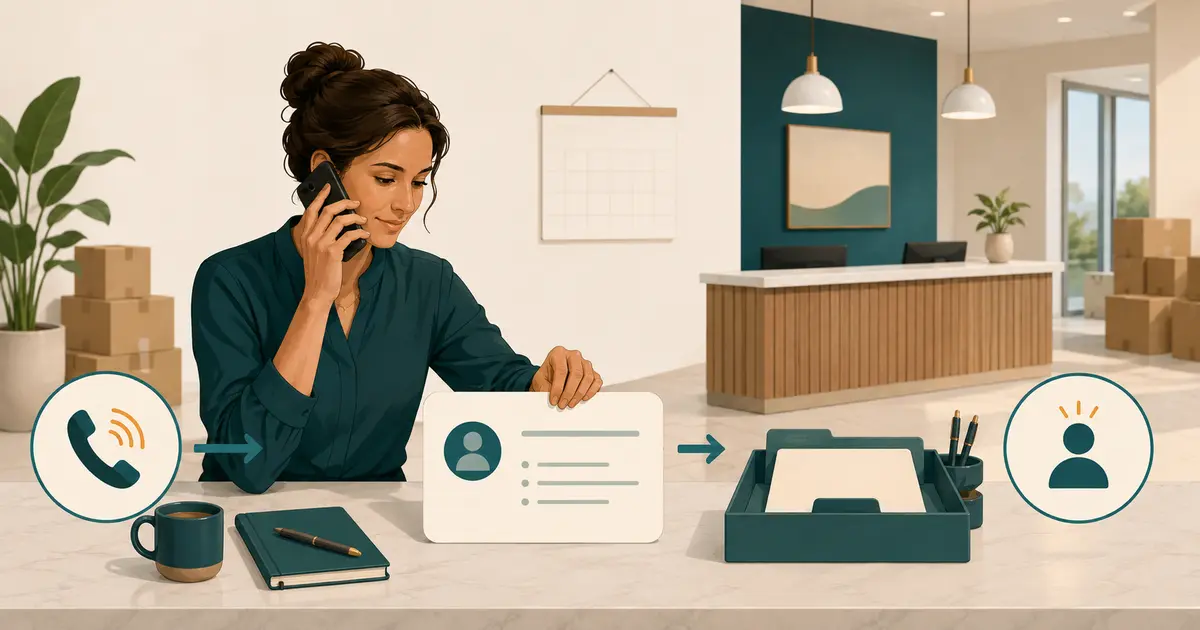
Put every request in one owned queue
A pre-opening inbox can become cluttered quickly because ownership is still forming. Choose one request location before marketing begins.
Each handoff should show:
- caller name;
- confirmed callback number;
- general request;
- new-patient inquiry status;
- location, if applicable;
- timing preferences;
- open questions;
- time received;
- expectation given to the caller;
- primary owner;
- current next step.
Use ordinary work labels such as New, Assigned, Waiting for caller, and Complete. The team needs to know what to do, not how the phone provider processed the call.
Assign a primary and backup owner for each day. A future office manager can own the queue before receptionists start, but the role must include a review schedule and a handoff plan once staff join.
Protect information from the first call
New practices should establish access and retention rules before real requests accumulate.
Decide:
- where the complete request is stored;
- what appears in email or mobile alerts;
- who receives an account;
- whether audio, transcripts, or summaries are created;
- how temporary contractors lose access;
- how long records are retained;
- how records can be exported or deleted;
- which vendors create, receive, maintain, or transmit protected health information.
HHS explains that applicable vendors handling protected health information on behalf of a covered entity may be business associates and that covered entities and business associates use written agreements to define permitted uses and safeguards. Review the HHS business associate guidance with qualified advisors for the practice's circumstances.
Do not scatter full request details across personal email, text threads, spreadsheets, and vendor portals. One controlled queue with limited alerts is easier to secure and operate.
Train for the questions the practice cannot answer yet
Pre-opening calls reveal missing decisions. Track questions without turning every question into an immediate policy.
Common launch-stage questions may cover:
- opening date;
- appointment availability;
- insurance participation;
- pricing;
- services;
- provider schedules;
- accessibility;
- records transfer;
- financing;
- urgent care;
- directions and parking.
For each question, use one of three states:
- Approved answer — the information sheet contains a current response.
- Staff follow-up — the caller's question is assigned to a person.
- Not available yet — the channel gives an honest status without promising a decision date.
Review the question log weekly. Update the controlled information sheet only after the owner approves the answer.
Test the pre-opening call path
Run calls from outside numbers before the phone number appears publicly.
| Test call | Pass condition |
|---|---|
| Caller asks when the practice opens | Only the approved current status is shared |
| Caller requests a cleaning appointment | Request and preferences are captured; no booking is promised |
| Caller asks about insurance | Approved general language is used; individual benefits are not confirmed |
| Caller asks for a price | No unverified final price or treatment estimate is given |
| Caller asks an unknown service question | Question goes to staff without guessing |
| Caller corrects a phone number | Final handoff contains the corrected number |
| Caller is unsure which location to use | Channel asks rather than infers |
| Caller describes an urgent concern | Practice-approved path is used without non-clinical triage |
| Primary owner is absent | Backup owner receives and can complete the request |
| Coverage destination is unavailable | Documented fallback prevents silent loss |
Compare the caller's words with the final handoff. Verify the name, number, request, preferences, open question, timestamp, expectation, and owner.
The ADA's guidance on phone calls from prospective patients emphasizes consistent handling and useful intake information. Adapt the specific process to your future practice, staffing, and applicable requirements.
Transition the workflow on opening day
The pre-opening intake should not continue unchanged after the office begins normal operations.
Before opening:
- replace the pre-opening greeting with the approved open-office greeting;
- update hours and holiday rules;
- confirm the staffed scheduling process;
- reassign queue ownership to the operating team;
- remove temporary users;
- review every unresolved pre-opening request;
- retest office-hours, busy, no-answer, and after-hours paths;
- keep a rollback plan for launch-day phone problems.
Do not lose prospective-patient requests during the transition. Close, reassign, or carry forward each item visibly.
Pre-opening intake checklist
Before accepting new-patient inquiries, confirm that:
- [ ] the practice's actual opening stage is written and approved;
- [ ] the public phone number and routing path are verified;
- [ ] the minimal intake fields are defined;
- [ ] detailed clinical and registration information is deferred;
- [ ] appointment preferences are not described as availability;
- [ ] insurance and price responses stay within approved boundaries;
- [ ] unknown questions go to a named staff owner;
- [ ] urgent concerns use a separate practice-approved path;
- [ ] every request reaches one controlled queue;
- [ ] primary and backup owners are assigned;
- [ ] access, retention, and vendor responsibilities are reviewed;
- [ ] external test calls match the resulting handoffs;
- [ ] the opening-day transition is documented;
- [ ] no caller-facing source contains a stale opening promise.
A strong dental patient intake phone service does not try to finish every future office process during the first call. It captures the information needed for a truthful next step and gives the new practice a clean, owned place to continue.