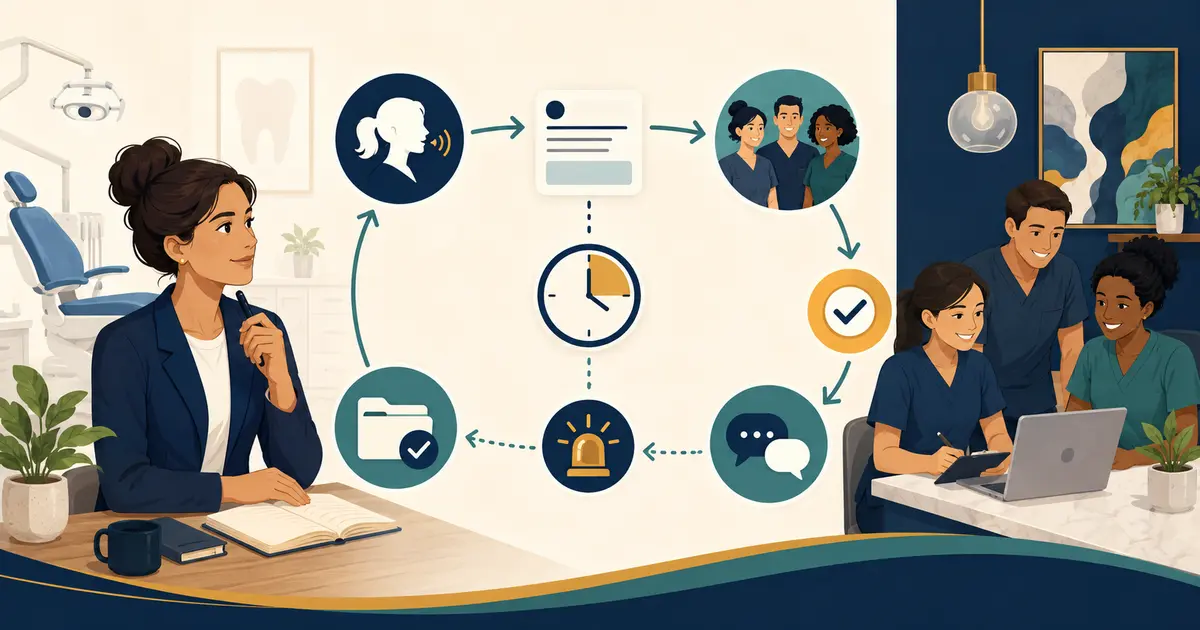
A dental answering service for a private practice should be planned as part of the opening phone workflow, not added after calls begin falling through. Decide which calls the service will receive, what it may collect and say, where each request appears, who follows up, how much the full workflow costs, and what happens when the service or office phone system is unavailable.
For a small practice, the goal is usually focused coverage: protect calls during predictable gaps while keeping the owner and front desk in control. An answering service should not become an undefined substitute for staffing, scheduling authority, clinical judgment, or the practice's phone provider.
Decide what problem the service must solve
Name the specific coverage gap before comparing vendors. Common opening scenarios include:
- the owner is treating patients while one employee handles the front desk;
- calls arrive before the office is fully staffed;
- lunch coverage is inconsistent;
- two callers arrive at once;
- a new-patient campaign creates short bursts of volume;
- the office wants a defined after-hours request path;
- the phone or internet service may fail;
- the practice needs temporary coverage during hiring or leave.
Different problems call for different routes. A busy-line overflow service needs fast handoff during office hours. An after-hours service needs approved office facts, a clear next-business-day expectation, and a safe process for urgent statements. An outage backup needs an independent trigger and staff communication plan.
Write the desired outcome in one sentence. For example:
“When the front desk does not answer within the approved ring window, the service will collect the caller's general request and callback information, then place a clearly assigned item in the practice queue for staff review.”
That statement is more useful than “never miss a call.” It defines the event, service action, handoff, and owner without promising that every caller will stay on the line or become a patient.
Choose the coverage window before choosing the technology
A dental answering service for a small practice can cover all calls, selected conditions, or only selected hours. Map the week in 30- or 60-minute blocks and mark when a trained employee can genuinely answer.
Consider:
| Coverage condition | Primary owner | Service role | Return-to-office rule |
|---|---|---|---|
| Open and staff available | Front desk | No role or late overflow | Normal route stays active |
| Staff already on a call | Front desk, then overflow | Capture request after threshold | Staff clears queue |
| Lunch or team meeting | Named rotating employee or service | Time-limited coverage | Route resets at stated time |
| Closed evening | Answering service | Approved greeting and request capture | Next-business-day owner assigned |
| Weekend or holiday | Defined on-call/office process | Approved closed-office path | Holiday schedule expires automatically |
| Phone-system outage | Backup owner | Alternate route if available | Test and document restoration |
Avoid a single “24/7” toggle without rules. The same greeting, information, and escalation process may not fit a Tuesday morning, a holiday evening, and an office outage.
The lunch-hour coverage playbook explains how to assign narrow daytime coverage. The after-hours answering guide covers closed-office expectations and handoffs.
Keep the published number and routing decision separate
Many practices can keep their main published number and forward selected calls to a separate answering destination. But forwarding behavior depends on the actual phone provider and configuration.
Before signing an answering-service contract, ask the phone provider to confirm:
- no-answer, busy, unavailable, and scheduled forwarding options;
- the ring or timeout threshold;
- whether original caller ID is preserved;
- whether voicemail answers before forwarding;
- how holiday schedules work;
- what happens when the forwarding destination is unavailable;
- whether forwarding changes create per-minute or other charges;
- how to disable the route immediately;
- how emergency calling works for office devices and softphones.
Do not rely on a vendor's generic “works with your current number” statement. Test the exact office line and plan. The call-forwarding setup guide provides an acceptance sequence for caller ID, voicemail order, failure behavior, and rollback.
If a practice uses a new tracking number for a campaign, make its purpose obvious to staff. Decide where it is published, how long it remains active, who owns the resulting requests, and what happens after the campaign ends.
Define what the service may collect
Use the minimum information required for the next action. A practical request record might include:
- caller name when provided;
- confirmed callback number;
- intended location;
- whether the caller is a new or existing patient when relevant;
- general reason for calling;
- preferred callback window;
- staff owner and current status.
Do not ask for a full health history on an initial phone call. Do not collect detailed symptoms merely because the script has an empty field. Clinical information should move to an authorized clinical process, not be interpreted by an answering agent.
The ADA notes that a phone call may be a prospective patient's first communication with the practice and recommends a consistent greeting and scripts for common topics. Review the ADA patient-intake phone guidance when building the office's own script.
Create separate paths for:
- appointment requests;
- cancellations or rescheduling requests;
- billing or insurance questions;
- prescription or clinical questions;
- complaints;
- urgent or emergency statements;
- wrong numbers and vendor calls.
“Separate path” does not mean the answering service makes the decision. It means the agent collects only what is authorized, gives the approved instruction, and sends the request to the correct role.
State what the service must not promise
Before opening, write a prohibited-claims list and include it in training and testing.
Unless the workflow has verified authority and current access, the service should not:
- say an appointment is booked, canceled, or moved;
- promise that a particular time, provider, or treatment is available;
- confirm individual insurance coverage or benefits;
- quote an unverified treatment fee;
- diagnose, provide clinical advice, or decide medical urgency;
- collect payment;
- tell the caller a manager or dentist will respond by an invented deadline;
- claim to replace the front desk or the phone system;
- pretend an AI system is a human employee.
Use pending language:
“I can record your request for the scheduling team. No appointment has been scheduled yet. The office will review the request and contact you through its normal process.”
For urgent statements, use the practice's approved instructions and escalation plan. An answering service is not automatically a clinical triage service simply because it is available after hours.
Build the handoff before building the greeting
An excellent greeting cannot rescue an unowned queue. Decide where requests land and how employees prove that each one was handled.
Require these fields:
| Handoff field | Why it matters |
|---|---|
| Source and time | Shows how and when the request arrived |
| Caller and callback details | Gives staff a verified return path |
| General request | Lets staff prepare without collecting excess detail |
| Location | Prevents multi-location misrouting |
| Priority or routing category | Supports the office's approved workflow |
| Assigned owner | Prevents “everyone thought someone else called” |
| Response expectation | Keeps staff from inventing deadlines |
| Outcome | Distinguishes reached, pending, booked, declined, and blocked work |
Decide how duplicates are handled. A patient may call the main number, leave a voicemail, submit a web form, and call the coverage number. The practice should combine related requests and stop parallel outreach.
For the first month, the owner or manager should review open items at fixed times each day. A small office may not need a large CRM, but it does need one visible source of truth for unfinished call work.
Review privacy and security with the actual workflow
Ask which companies create, receive, maintain, or transmit caller information. Review the service, subcontractors, storage, staff access, notifications, exports, retention, deletion, and incident-response process.
HHS says a cloud provider that creates, receives, maintains, or transmits ePHI on behalf of a covered entity generally requires an appropriate business associate agreement, and the covered entity must still conduct its own risk analysis. Review the HHS cloud-computing guidance with qualified advisors.
The contract and configuration should answer:
- whether a business associate agreement is required and which entity signs it;
- what information may be used or disclosed;
- who can access the practice account;
- whether recordings or transcripts are created;
- how long each record type is kept;
- how support access works;
- what appears in email or text notifications;
- how incidents are reported;
- how data is exported or destroyed at termination.
The dental AI privacy and security checklist provides a more detailed review for AI-based services. Do not assume that a human answering service avoids privacy and security questions; it still needs appropriate contracts, access control, training, and data handling.
Compare the complete cost, not only the monthly headline
Request a written quote that uses your expected coverage pattern. Include:
- subscription or base fee;
- included calls, minutes, messages, or usage;
- overage method;
- billing increments and rounding;
- after-hours, holiday, bilingual, transfer, or on-call fees;
- setup, script, number, or integration fees;
- phone-provider forwarding charges;
- optional text or notification charges;
- contract term, minimum, renewal, and cancellation conditions;
- staff time to review and return requests;
- cost of unused all-hours coverage if you need only narrow overflow.
Compare the same scenario across vendors. One quote may price by minute, another by call, and another by outcome or plan tier. Convert each into a realistic month with ordinary, busy, and outage cases. Do not invent conversion value to make the service appear profitable.
Also price the alternative: scheduled staff coverage, voicemail plus callback ownership, a rotating backup employee, or a narrower service window. The right answer may be a hybrid rather than the largest answering plan.
Test the service before the first patient call
Run every test with fictional information and from outside phone numbers. Include:
- a normal new-patient inquiry;
- an existing-patient callback request;
- a cancellation request;
- an insurance or price question;
- a clinical statement that requires handoff;
- an urgent statement under the approved office process;
- a caller who refuses to provide a name;
- a wrong number;
- two simultaneous calls;
- a call when the destination service is unavailable;
- a call during a holiday schedule;
- a test after forwarding is disabled.
For each test, record:
- what the caller heard;
- how long the call rang or waited;
- what the agent said;
- what information was collected;
- where the request appeared;
- whether the right employee was notified;
- whether the request status was visible;
- whether the route returned to normal.
Do not open the practice with an untested route because the vendor demonstration worked on its own number.
Create a launch and fallback runbook
Keep a one-page operating sheet where staff can reach it without searching vendor documentation.
Include:
- active coverage hours and conditions;
- service and phone-provider support contacts;
- account owner and backup administrator;
- route-on and route-off steps;
- approved greeting version;
- request queue and notification path;
- staff ownership by request type;
- outage or service-failure fallback;
- privacy or security incident contact;
- daily review times;
- first-week and first-month review dates.
If the service fails, callers should reach a known fallback such as a controlled voicemail or alternate number, and staff should know how to retrieve and reconcile requests. Do not create a complicated routing chain that nobody can reverse during an outage.
Private-practice opening checklist
Before activating a dental answering service for a private practice, confirm:
- [ ] the exact coverage problem and success condition are written;
- [ ] staffed, overflow, lunch, after-hours, holiday, and outage routes are defined;
- [ ] the phone provider confirmed the required forwarding behavior;
- [ ] caller ID, voicemail order, failure behavior, and rollback passed testing;
- [ ] the service collects only information needed for the next action;
- [ ] appointment, insurance, fee, clinical, and urgency boundaries are explicit;
- [ ] every request has one queue, owner, status, and outcome;
- [ ] privacy, security, contracts, retention, and incidents were reviewed;
- [ ] the written quote includes usage, overage, setup, forwarding, and staff costs;
- [ ] normal, edge, simultaneous-call, holiday, and outage tests passed;
- [ ] staff can enable, disable, and recover the route;
- [ ] the owner scheduled post-launch reviews and has authority to change the plan.
The best dental answering service for a small practice is not automatically the one with the longest feature list or widest coverage. It is the service that fits a clearly defined gap, follows the practice's rules, produces an owned handoff, survives realistic tests, and can be changed or disabled without losing control of the office phone workflow.