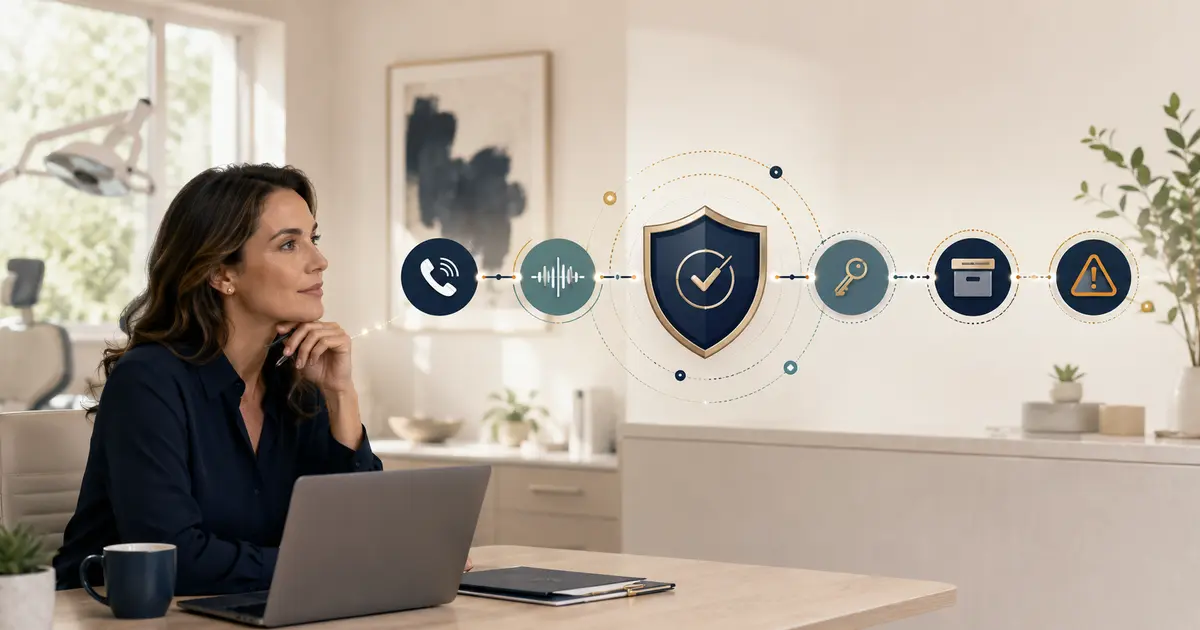
Dental office phone scam prevention works best when staff have permission to slow the call down. Scammers manufacture urgency, borrow a trusted name, and ask the employee to bypass the normal path. A familiar caller ID does not prove identity because displayed numbers can be spoofed.
The front desk needs a short response it can use while patients are waiting: pause, verify through an independent channel, and escalate.
Recognize requests that require a pause
Stop the transaction when a caller asks for:
- gift cards, cryptocurrency, wire transfers, or an unusual payment method;
- passwords, one-time codes, recovery links, or security answers;
- remote access to a workstation or phone system;
- a change to vendor banking or payroll details;
- patient or employee information outside the normal request process;
- immediate secrecy or an exception “authorized by the doctor”;
- a software installation from an unsolicited support call.
The warning sign is the combination of pressure and a request to leave the approved workflow—not the caller's accent, tone, or apparent phone number.
Use the pause-verify-escalate script
Staff can say:
“I can't complete that request from an incoming call. I'll verify it through our approved contact information and ask the responsible manager to respond.”
Then end or hold the interaction according to office policy. Find the organization or colleague in the practice's controlled directory, contract, or known website. Do not call a number supplied by the suspicious caller, click a link they send, or use caller ID as the verification source.
The receptionist training plan can turn this response into a scored practice exercise. The phone and voicemail privacy guide helps staff keep disclosure separate from identity claims.
Match controls to common scenarios
| Scenario | Safe action |
|---|---|
| “Utility company” threatens immediate shutoff | Use the account statement's contact route; manager reviews |
| “Software support” requests remote access | Open a case through the contracted vendor portal |
| “Doctor” requests a secret purchase | Verify through a known internal channel and purchasing policy |
| “Bank” asks for a one-time code | End the call and contact the bank through the known account route |
| “Patient representative” demands records | Use the practice's identity, authority, and records procedure |
No front-desk employee should be expected to decide whether an unfamiliar technical claim is real while on the call.
Protect payment and account changes
Require two-person review for new payment destinations, bank-detail changes, administrator recovery changes, number ports, and remote-access approvals. Preserve the original request and compare it to the contract or known account record.
Use unique user accounts and role-based access. Shared passwords make it difficult to contain an incident or determine what changed. The patient communication policy guide can define which channels are approved for each request type.
Record and report the incident
Capture the number displayed, time, claimed identity, request, channel, and action taken without collecting extra sensitive information. Notify the practice's incident owner. If credentials were disclosed or access was granted, change containment priority: disconnect the session, contact the legitimate provider, preserve logs, reset affected credentials through approved routes, and follow the practice's incident procedure.
Report suspected fraud through the appropriate provider and government channel. Do not call the suspected scammer back to investigate.
Drill the playbook quarterly
Use synthetic scenarios and score whether the employee paused, used an independent contact route, protected information, recorded the event, and escalated to the named owner. Include a convincing caller ID and a request that mentions a real vendor; the drill should test the process, not trivia.
Review the directory after staff changes and vendor renewals. A verification list is useful only when it is current and office-controlled.
Missed Calls Dental boundary
Missed Calls Dental can support approved call capture and handoffs but does not authenticate every caller, authorize payments, provide remote IT support, diagnose, or change appointments. The practice owns verification and incident response. SMS is separate and readiness-gated.
Noah Carter is an editorial pen name. This article was reviewed for accuracy and alignment with Missed Calls Dental product information.