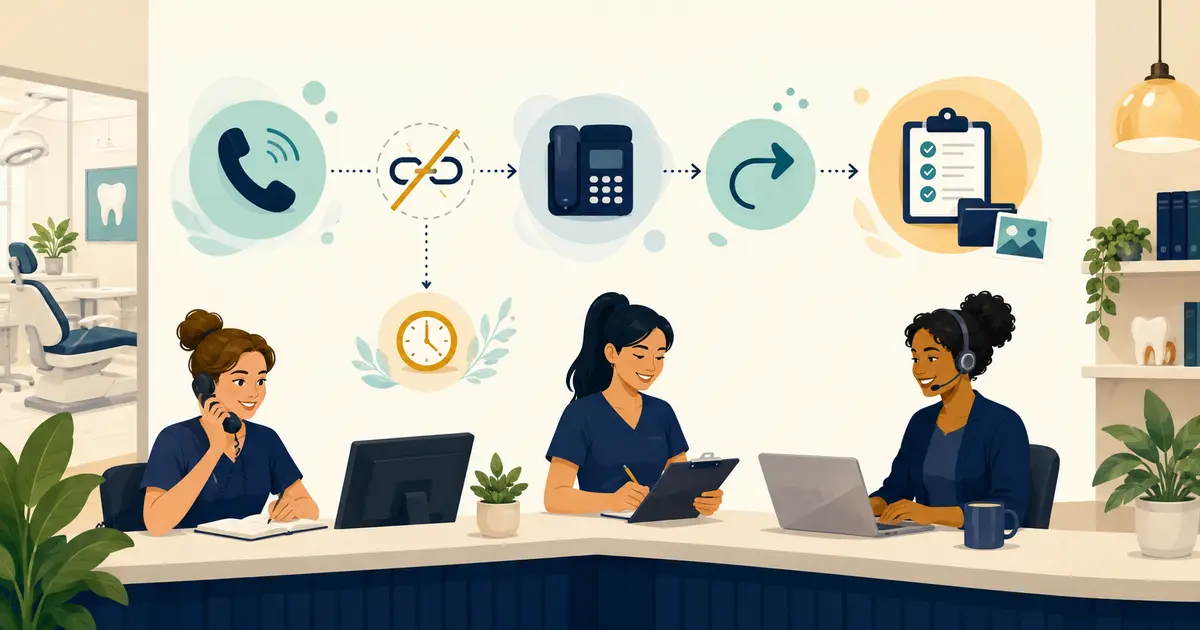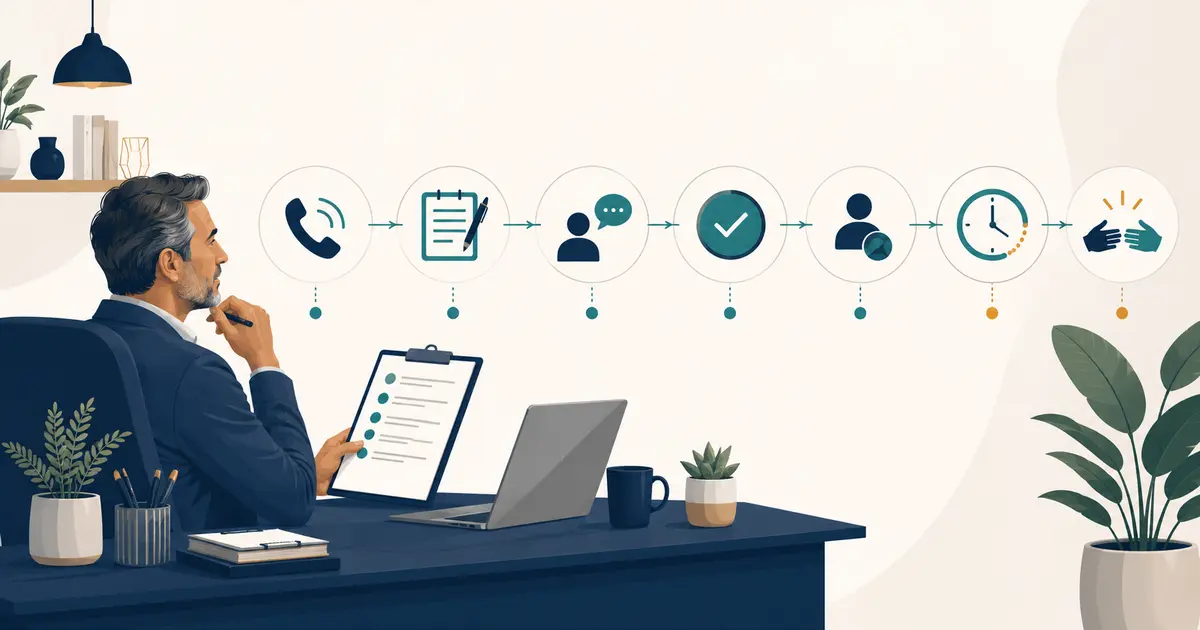
To train a dental receptionist for phone work, give the employee written standards, model each call type, rehearse with role-play, observe supervised live calls, and coach from specific behaviors and outcomes. Training should cover greetings, discovery questions, holds, callbacks, schedule authority, privacy, clinical handoff, complaints, documentation, phone-system use, and recovery when the answer is not known.
A script alone is not a training plan. The employee must understand the purpose of the wording, know which decisions remain outside the role, and practice moving from a caller's unexpected answer back to a safe next step.
Define the receptionist's phone responsibilities
Start with a role map. For each call type, state what the receptionist may complete, what may be explained, and what requires handoff.
| Call type | Receptionist may | Must hand off or verify |
|---|---|---|
| New-patient inquiry | Welcome caller, collect approved intake, explain verified office facts | Clinical advice, unverified fee or benefit claims |
| Appointment request | Review or record request under assigned schedule authority | Promise a time not saved in the schedule |
| Cancellation or rescheduling | Follow the approved process and state current status | Policy exception or clinical consequence |
| Insurance question | Share verified participation or office-process information | Individual eligibility, benefits, or payment estimate without verification |
| Clinical concern | Collect minimum contact and general reason | Diagnosis, treatment advice, medical urgency decision |
| Complaint | Listen, document facts, explain handoff | Legal, financial, clinical, or disciplinary conclusion |
| Billing question | Route or explain authorized account facts | Waive a balance or promise an adjustment without authority |
The phone-responsibility guide provides a fuller pre-opening ownership model. Adapt it to the actual staff, systems, and permissions.
Build a four-stage learning path
Stage 1: explain and demonstrate
Review the call standard and show a model call. Explain why each step exists. Let the employee see the phone controls, request queue, schedule, knowledge source, and handoff path.
Stage 2: guided role-play
The trainee handles scripted scenarios while the coach pauses, rewinds, and repeats. Start with predictable calls, then add ambiguity, interruptions, and incomplete information.
Stage 3: supervised live calls
The trainee answers real calls with an experienced employee immediately available. Define which call types the trainee may take and how to ask for help without exposing patient information.
Stage 4: independent work with review
The employee takes the assigned queue while the manager reviews outcomes, open callbacks, documentation, and exceptions at scheduled intervals.
Do not move an employee to independent work because a calendar week ended. Move when the required behaviors are reliable for the call types assigned.
The ADA recommends consistent greetings, scripts for frequent topics, and role-playing different telephone scenarios. See the ADA patient-intake phone guidance.
Train a complete call structure
Use the same six-part structure across common calls.
1. Open
“Thank you for calling Green Valley Dental. This is Jordan. How may I help you?”
The employee should identify the practice and self, speak at a measured pace, and invite the caller's reason.
2. Listen
Do not interrupt the first sentence with a checklist. Listen for the caller's goal, location, and whether the request belongs to scheduling, clinical, financial, or another role.
3. Clarify
Use one question at a time:
“Are you requesting a new appointment or calling about one already scheduled?”
“Which office are you trying to reach?”
4. Act within authority
Complete the task when the receptionist has verified authority and information. Otherwise create a pending request and assign it.
5. Confirm status
State what has and has not happened:
“Your request has been sent to the scheduling team. No appointment has been changed yet.”
6. Close
Repeat the owner, next step, and approved expectation. Thank the caller without adding an unsupported promise.
Practice greetings, holds, transfers, and callbacks
Hold
“May I place you on a brief hold while I verify that information, or would you prefer a callback?”
Train the employee to ask, estimate honestly, return with an update, and convert an uncertain wait into a callback.
Transfer
“The billing team can review that question. May I place you on a brief hold while I confirm someone is available?”
Use a warm transfer when practical. If the destination does not answer, return to the caller rather than sending them into an unknown voicemail.
Callback
“I can ask Taylor to review this and return your call by [approved window]. May I confirm the best number?”
The callback must have a visible owner and status. Teach the employee to document it before answering the next call.
The dental office call queue rules explain how these choices work when several calls arrive together.
Teach the difference between a request and a completed action
Many phone errors come from status language.
Train these pairs:
| Pending | Completed |
|---|---|
| “I recorded your appointment request.” | “Your appointment is saved for Tuesday at 2 p.m.” |
| “The team will review your cancellation request.” | “The appointment is canceled in the schedule.” |
| “I sent your question to billing.” | “The authorized adjustment has posted.” |
| “I documented your insurance question.” | “The office verified the stated benefit on [source/date].” |
| “A clinical team member will review your message.” | “The clinical team completed and documented the response.” |
During role-play, stop whenever the employee says “done,” “confirmed,” “covered,” or “available.” Ask which system or authorized person proves that statement.
Train privacy as a phone behavior
Privacy training must match the employee's job and environment. Include:
- confirming identity under office policy before discussing protected details;
- using a lowered voice in open reception areas;
- avoiding speakerphone when others can hear;
- collecting only what is needed for the handoff;
- not repeating clinical details across the room;
- using individual accounts, not shared logins;
- locking the workstation when leaving;
- leaving only approved voicemail information;
- not copying requests into personal notes or messaging apps;
- reporting misdirected information or suspicious access promptly.
HHS states that systems maintaining electronic protected health information must use unique user identification for workforce members. Review the HHS unique-user-ID guidance. HHS also recommends workforce training specific to the organization and the employee's duties; see the OCR security recommendations.
Do not treat completion of a generic course as proof that the employee can use the practice's phone, queue, schedule, and privacy process safely.
Rehearse high-risk scenarios
Create role-play cards for:
- a new caller asking for a same-day appointment;
- an existing patient asking whether insurance will cover a procedure;
- a caller describing pain or another clinical concern;
- a patient asking to cancel immediately;
- an angry caller disputing a fee;
- a family member asking for appointment details;
- a relay-service call;
- a wrong number;
- two simultaneous calls;
- a phone or scheduling-system outage;
- a caller who refuses to provide a name;
- a request the employee has never heard before.
For each scenario, score the process:
- accurate greeting;
- listening without interruption;
- one useful clarifying question;
- privacy safeguard;
- correct authority boundary;
- clear pending or completed status;
- named owner and expectation;
- neutral documentation.
Do not grade whether the trainee sounds exactly like the coach. Grade whether the call is clear, respectful, accurate, and safely handed off.
Give the trainee an approved knowledge source
Receptionists need one current place for office facts:
- location and directions;
- hours and holiday changes;
- services described accurately;
- provider and staff names;
- accepted plans or participation language approved by the office;
- payment and financing policies;
- cancellation and no-show policy wording;
- accessibility and language resources;
- after-hours instructions;
- escalation contacts.
Assign an owner and review date. When an employee finds conflicting information, the training response is not “pick the safest-looking answer.” It is:
“I want to make sure I give you accurate information. May I verify that and return your call?”
Track every question that required verification. Repeated questions indicate a knowledge or policy gap for the manager to resolve.
Train documentation immediately after the call
A useful note states:
- who contacted the office;
- confirmed return information;
- general reason for the call;
- verified facts provided;
- request status;
- assigned owner;
- approved response expectation;
- outcome or remaining blocker.
Examples:
- “New-patient request for North office; weekday afternoons preferred; no appointment scheduled; assigned to Taylor.”
- “Caller asked whether plan is accepted; provided approved participation statement; individual benefits not verified.”
- “Clinical concern routed to designated clinical role; no advice provided by front desk.”
- “Caller requested cancellation; schedule change pending authorized review.”
Avoid labels, opinions, and copied clinical narratives. Review notes for completeness and neutrality during coaching.
Use a weekly coaching cadence
A four-week plan can be:
Week 1: foundations
- role and authority;
- greeting and call structure;
- phone controls;
- office knowledge;
- privacy and account access;
- basic role-play.
Week 2: common workflows
- new-patient inquiries;
- appointment requests;
- cancellations and rescheduling;
- insurance and fee questions;
- callbacks and documentation.
Week 3: pressure and exceptions
- simultaneous calls;
- complaints;
- clinical handoffs;
- accessibility;
- wrong numbers;
- outages.
Week 4: independence and calibration
- supervised live-call review;
- open-request audit;
- policy knowledge check;
- targeted repeat practice;
- manager sign-off by call type.
This is a structure, not a universal completion deadline. Extend supervision for call types the employee has not handled reliably.
The ADA recommends using team meetings to review scripts and role-play important patient interactions. See the ADA team-meeting guidance.
Review calls lawfully and respectfully
If the practice records calls for training, obtain legal advice about federal and state consent requirements, tell employees and callers as required, limit access, set retention, and protect the recordings. The ADA cautions that jurisdictions may require permission from employees or callers. Review the ADA communication-training guidance.
Recording is not required for coaching. Alternatives include:
- live side-by-side observation;
- trainee self-review immediately after a call;
- documentation audit;
- fictional role-play;
- outcome review with identifying details limited;
- caller feedback obtained through an approved process.
Never play a sensitive patient call in a broad meeting merely because it is educational.
Use a competency scorecard
Review a sample across call types rather than a single “good call.”
| Skill | Ready | Needs coaching | Evidence |
|---|---|---|---|
| Greeting and identification | |||
| Listening and clarification | |||
| Hold and transfer | |||
| Callback ownership | |||
| Appointment-status accuracy | |||
| Insurance and fee boundaries | |||
| Clinical handoff | |||
| Privacy safeguards | |||
| Documentation | |||
| Phone and queue controls | |||
| Outage process |
Give feedback as an observable change:
“Before transferring, confirm that the destination is available and tell the caller where they are going.”
Avoid personality judgments such as “be more professional.” Model the exact behavior, rehearse it, and observe it again.
Dental front desk training checklist
Before independent phone work, confirm the employee can:
- [ ] explain the role's phone authority and handoff boundaries;
- [ ] use the standard greeting and six-part call structure;
- [ ] ask before holds and complete warm transfers;
- [ ] create callbacks with an owner and approved window;
- [ ] distinguish a request from a confirmed action;
- [ ] protect privacy in speech, systems, voicemail, and notes;
- [ ] handle appointment, insurance, fee, complaint, and clinical scenarios safely;
- [ ] use the approved office-knowledge source;
- [ ] document neutral facts and current status;
- [ ] manage simultaneous calls under the queue rule;
- [ ] follow the outage and fallback process;
- [ ] demonstrate skills through role-play and supervised live work;
- [ ] receive specific feedback and repeat the behavior successfully.
A strong dental receptionist phone training plan makes the safe action easier under pressure. The employee knows what to say, why it is accurate, what the office has authorized, how to hand off the unexpected, and how to leave the next employee a clear, owned request.