A dental front desk training manual should tell a new employee what to do, show what good work looks like, and define when the employee is ready to work without direct supervision. The best manual is not a giant binder of policies. It is a role-based learning plan that combines office facts, scripts, system practice, privacy rules, realistic scenarios, and manager sign-off.
This is a role-wide manual framework, not a phone-skills lesson plan. It covers scheduling, check-in, handoffs, privacy, payments, daily controls, systems, and service recovery. For call-specific drills and coaching, use the separate dental receptionist phone training plan.
Use this guide as a framework. Replace bracketed examples with the practice's actual hours, contacts, systems, policies, and escalation paths. Clinical decisions, legal interpretations, and privacy requirements should come from qualified practice leadership.
What belongs in a dental receptionist training manual?
Organize the manual around the work a new hire must perform:
- Practice orientation: locations, providers, services, hours, contact channels, patient populations, and team roles.
- Patient communication: greetings, listening, plain-language explanations, holds, transfers, callbacks, difficult conversations, and accessibility.
- Scheduling: appointment types, duration rules, provider preferences, new-patient steps, cancellation handling, waitlist use, and boundaries on promises.
- Phone workflow: answering, verifying callback details, documenting requests, routing, voicemail, overflow, after-hours calls, and outages.
- Records and privacy: identity checks, minimum-necessary information, approved systems, screen and paper security, and incident reporting.
- Financial workflow: payment questions, estimates, insurance routing, balances, receipts, and when a specialist or manager must respond.
- Daily operations: opening, closing, huddles, task queues, handoffs, supplies, mail, and end-of-day reconciliation.
- Performance and support: quality standards, coaching schedule, sign-off criteria, and how to ask for help.
Link detailed procedures instead of copying them into every chapter. For example, keep the full dental front desk phone scripts in one maintained source, then reference the correct script from the training lesson.
Start with outcomes, not chapters
For each task, write a simple training card:
| Field | What to enter |
|---|---|
| Task | The observable work, such as answering a new-patient call |
| Purpose | Why the task matters to the patient and practice |
| Approved tools | Systems, templates, and reference pages used |
| Required steps | The smallest reliable sequence |
| Stop points | Situations that require help or escalation |
| Practice activity | A fictional scenario or supervised live task |
| Pass criteria | What the trainer must observe |
| Sign-off | Trainee, trainer, date, and follow-up need |
This format keeps the manual useful when software screens change. A screenshot may become outdated quickly; the outcome, decision boundaries, and pass criteria are more durable.
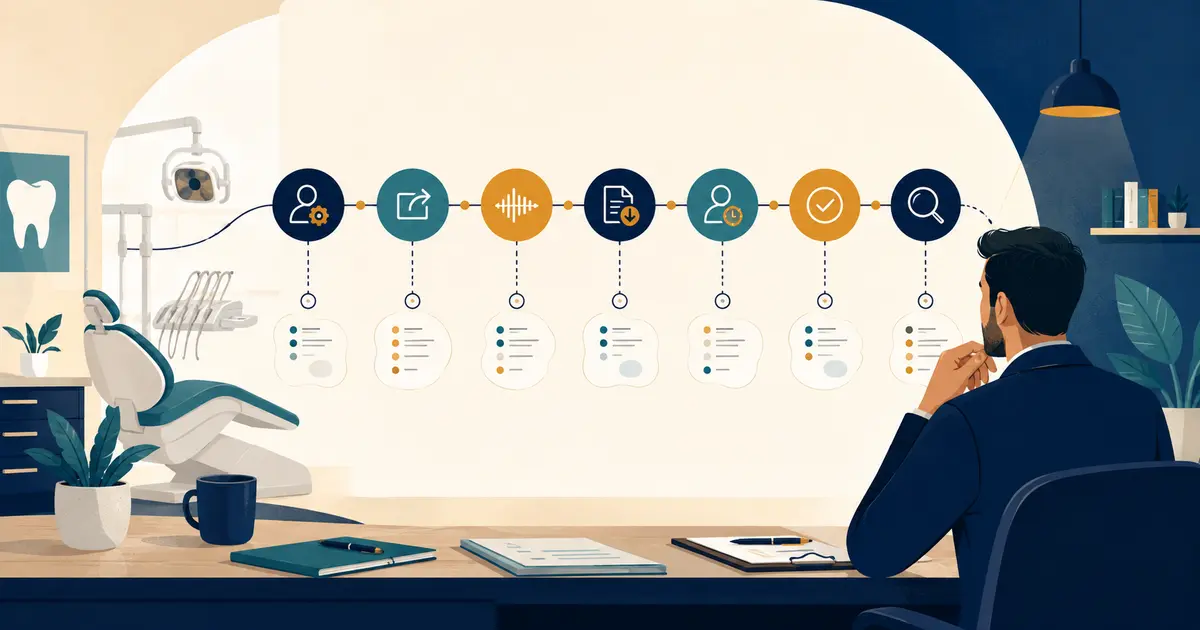
A 30-day dental front desk training plan
The pace should change with role scope and prior experience. Do not use the calendar as automatic permission for unsupervised work.
Before day one
- prepare the workstation and approved access;
- confirm the trainer and backup trainer;
- create a schedule for observation and practice;
- assemble current policies, scripts, directories, and escalation contacts;
- select fictional training records and test scenarios;
- remove obsolete documents from the training folder.
Days 1–3: orientation and safe basics
Teach the office layout, team roles, communication standards, privacy expectations, emergency procedures, and how to obtain help. Demonstrate the phone and scheduling systems with fictional information. Let the new employee practice the opening greeting, hold permission, transfer explanation, callback read-back, and message closure.
Do not begin with every exception. First establish a safe default: listen, verify, document neutrally, avoid promises outside the role, and route to the correct owner.
Days 4–7: supervised core work
Introduce common call types, appointment requests, confirmations, cancellations, records requests, billing questions, and routine messages. Pair each lesson with a scenario. A new-patient phone call checklist can provide a consistent sequence without forcing staff to sound scripted.
The trainer should listen to or observe work with appropriate notice and according to office policy. Correct one or two priorities at a time. A long list of minor comments makes it difficult for a trainee to identify the behavior that matters most.
Week 2: complete workflows
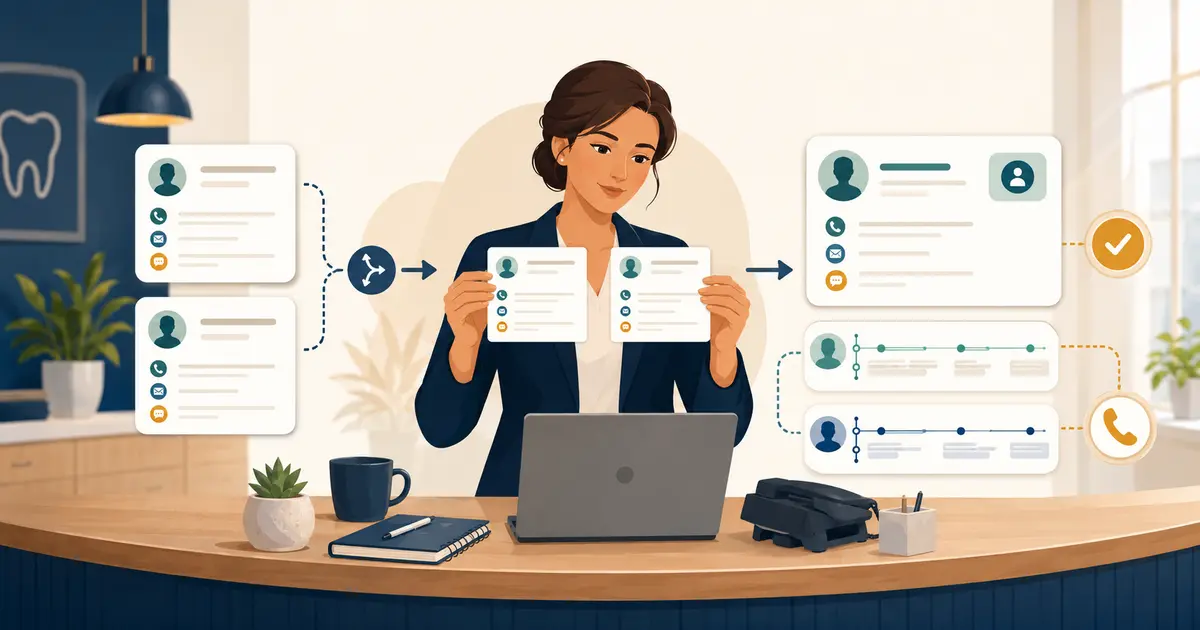
Move from isolated skills to end-to-end work:
- receive a request;
- verify the correct information;
- select the approved destination;
- document only what the next person needs;
- state the next step to the patient;
- assign or place the task;
- confirm the handoff;
- close or escalate the item.
Use a consistent dental call notes template so coaching can focus on accuracy, neutrality, and actionability rather than personal writing style.
Weeks 3–4: exceptions and independence
Add scheduling conflicts, upset callers, shared phone numbers, representative calls, language or accessibility needs, failed transfers, late callbacks, duplicate requests, downtime, and competing priorities. The trainee should demonstrate when to pause and ask for help.
At the end of the month, sign off by task, not by job title. A person may be ready for routine scheduling but still need supervision for records, billing, or privacy-sensitive requests.
Use realistic call practice
Build a small scenario library with fictional names and facts. Each scenario should include the caller's goal, relevant office condition, expected staff actions, prohibited shortcuts, and a clear finish.
Scenario 1: new patient asking for an appointment
Caller: “I chipped a tooth yesterday and want the first appointment you have.”
Good performance includes:
- a calm greeting and attentive listening;
- use of the practice's approved intake and scheduling rules;
- no diagnosis or unsupported promise;
- accurate contact details and next-step explanation;
- appropriate routing when the request falls outside front desk authority.
Scenario 2: billing question
Caller: “Why did I receive this balance? My insurance should have paid.”
The trainee should verify according to policy, capture the exact question, avoid interpreting coverage beyond available information, and route the request to the correct billing owner with a response expectation.
Scenario 3: request involving another person
Caller: “I am calling for my adult daughter. Tell me what treatment she needs.”
The trainee should follow the practice's identity and representative procedures, disclose nothing merely because the caller knows personal facts, and seek qualified help when authority is unclear. The patient identity verification protocol provides a useful companion lesson.
Scenario 4: upset caller after a missed callback
The trainee should acknowledge the experience without inventing an explanation, confirm the current request, identify the owner, provide an honest next step, and escalate according to policy.
A simple call coaching rubric
Score each area as “ready,” “needs coaching,” or “not yet demonstrated.”
| Area | Ready means |
|---|---|
| Opening | Identifies the practice clearly and speaks at a usable pace |
| Listening | Lets the caller explain the request and checks understanding |
| Verification | Confirms only the information required for the task |
| Accuracy | Uses current office facts and does not guess |
| Boundaries | Avoids clinical, financial, legal, or scheduling promises outside the role |
| Documentation | Creates a concise, neutral, actionable note |
| Ownership | Assigns the request to a named person or approved queue |
| Patient expectation | Explains what happens next without false certainty |
| Closure | Confirms contact details and ends courteously |
Use the rubric for coaching, not public ranking. Review examples with context, because the fastest call is not necessarily the best call.
Keep the manual current
Assign an owner to each major section. Review affected pages when providers, hours, services, software, phone routes, forms, policies, or team responsibilities change. Mark the effective date and archive obsolete versions so staff do not follow competing instructions.
Ask trainees which instructions were hard to find. Search failures are valuable evidence: if a staff member cannot locate the after-hours route during practice, the manual is not ready for a real disruption.
Avoid storing passwords, security answers, patient examples, or personal employee information in the manual. Use approved access tools and clearly fictional training data. HHS explains that covered entities should limit access to protected health information according to workforce roles and the minimum necessary standard.
Dental front desk manual starter outline
Copy this outline into the practice's documentation system:
- Welcome and role purpose
- Practice facts and team directory
- Daily opening and closing
- Patient communication standards
- Phone calls, messages, and callbacks
- Scheduling and appointment changes
- New-patient workflow
- Records, privacy, and identity verification
- Billing and insurance question routing
- Accessibility and language assistance
- Complaints and escalation
- Downtime and emergency procedures
- Systems and approved access
- Quality review and coaching
- Task sign-off records
The completed manual should make safe work easier, not merely prove that a document exists. Test it with a new employee or a team member covering an unfamiliar role. If they cannot identify the next action, owner, and stop point, revise the lesson.