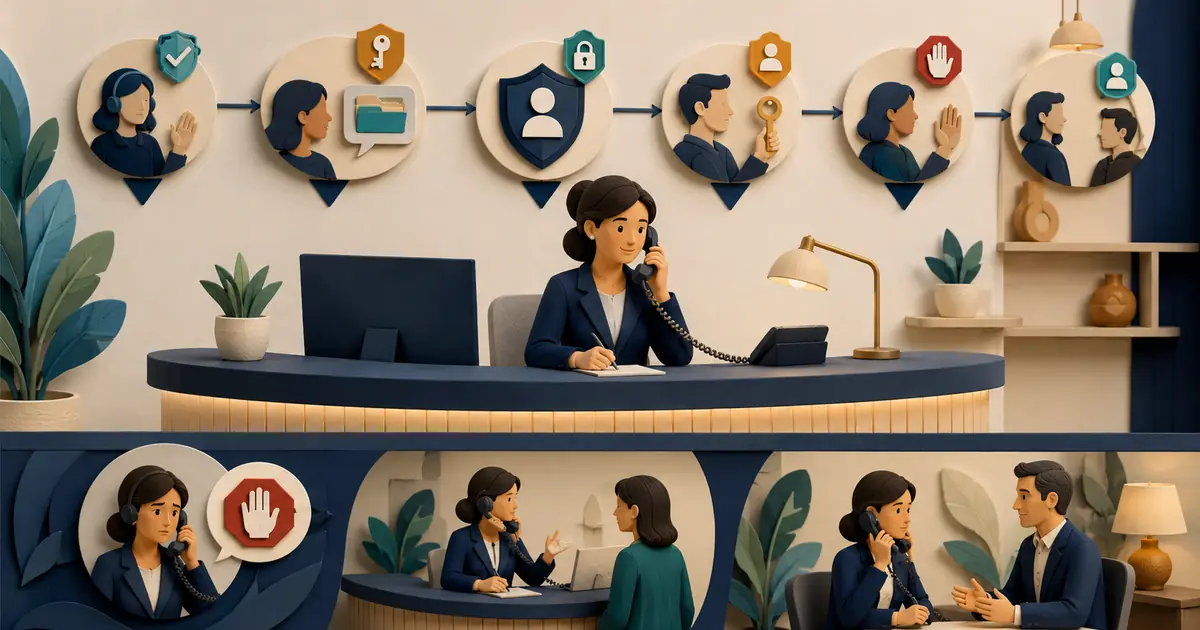
Dental patient identity verification by phone should match the risk of the request. Giving public office hours does not require the same process as disclosing sensitive information, changing account access, or acting on a representative's instructions.
HIPAA does not require one universal electronic verification method. HHS explains that covered entities should implement reasonable policies and procedures appropriate to the situation. The practice should design and approve its protocol with qualified privacy and legal guidance.
Classify the request before verifying
Use a simple request ladder:
| Level | Examples | Staff response |
|---|---|---|
| Public | Hours, address, general services | Provide approved public information |
| Routine administrative | Record a callback request or update non-sensitive contact workflow | Use office-approved basic verification and minimum information |
| Sensitive disclosure or account action | Discuss protected information, release records, change access or communication instructions | Apply stronger approved verification and authority checks |
| Clinical or high-risk exception | Symptoms, urgent concern, unusual representative, failed verification | Stop administrative processing and escalate under office protocol |
Do not collect more identifiers than the policy requires. Verification questions themselves can expose information if spoken where others can hear.
Use neutral script language
“Before I continue, I need to follow our office verification process for this type of request.”
Ask the approved factors without revealing the expected answer. Avoid questions such as, “Is your address still 123 Main Street?” when the caller has not supplied it.
If verification succeeds:
“Thank you. I can continue with the administrative portion of your request. I may need to involve an authorized team member for anything outside my role.”
If it fails:
“I’m not able to complete verification through this call. I won’t disclose or change that information. I can explain the approved next step or ask an authorized team member to review the request.”
The callback-number script can confirm contact details, but a phone number alone is not universal identity proof. The phone and voicemail privacy guide can inform message limits.
Verify representative authority separately
A caller may correctly identify the patient and still lack authority to receive information or direct an action. Follow the practice's process for parents, guardians, personal representatives, family members, caregivers, interpreters, and others.
HHS notes that HIPAA does not require proof of identity in every family or friend call; providers may use professional judgment and reasonable verification depending on the circumstances. That guidance does not authorize broad disclosure or replace rules for personal representatives and state law.
Record the claimed relationship, authority evidence or office basis, permitted scope, expiration or restriction where applicable, and reviewing employee. When uncertain, disclose nothing sensitive and escalate.
Keep knowledge-based questions limited
Avoid using information that is public, easily guessed, or visible on caller ID as the only factor for a sensitive request. Do not ask staff to improvise “security questions.” Use the office-approved method and appropriate systems.
Watch for social-engineering pressure: urgency, repeated failed answers, requests to change contact information before verification, or insistence that a familiar caller ID proves identity. Follow the phone-scam prevention playbook for independent verification and escalation.
Document the decision without storing answers unnecessarily
Record request class, method or policy step used, result, authority decision, action taken, escalation, and responsible employee. Do not copy secret answers, authentication codes, or excessive identifiers into a general note.
Use unique staff accounts and reviewable history. Limit access to the people who need it for their roles. Apply the practice's retention and incident procedures.
Train failure and accessibility scenarios
Practice with synthetic cases:
- patient forgets one approved factor;
- spouse requests information without clear authority;
- caller wants contact details changed first;
- relay-service caller uses an interpreter or communications assistant;
- caller becomes upset after a safe stop;
- staff member recognizes the voice but the request is sensitive.
Score consistent classification, approved verification, minimum disclosure, authority review, respectful explanation, and owned escalation. Recognition and confidence are not substitutes for the protocol.
Missed Calls Dental boundary
Missed Calls Dental can capture approved administrative requests and hand them to the practice. It does not provide universal identity proof, determine legal representative authority, diagnose, verify benefits, or independently book, change, or cancel appointments. Staff own sensitive disclosure and next actions. SMS is separate and readiness-gated.
Marcus Lee is an editorial pen name. This article was reviewed for accuracy and alignment with Missed Calls Dental product information.