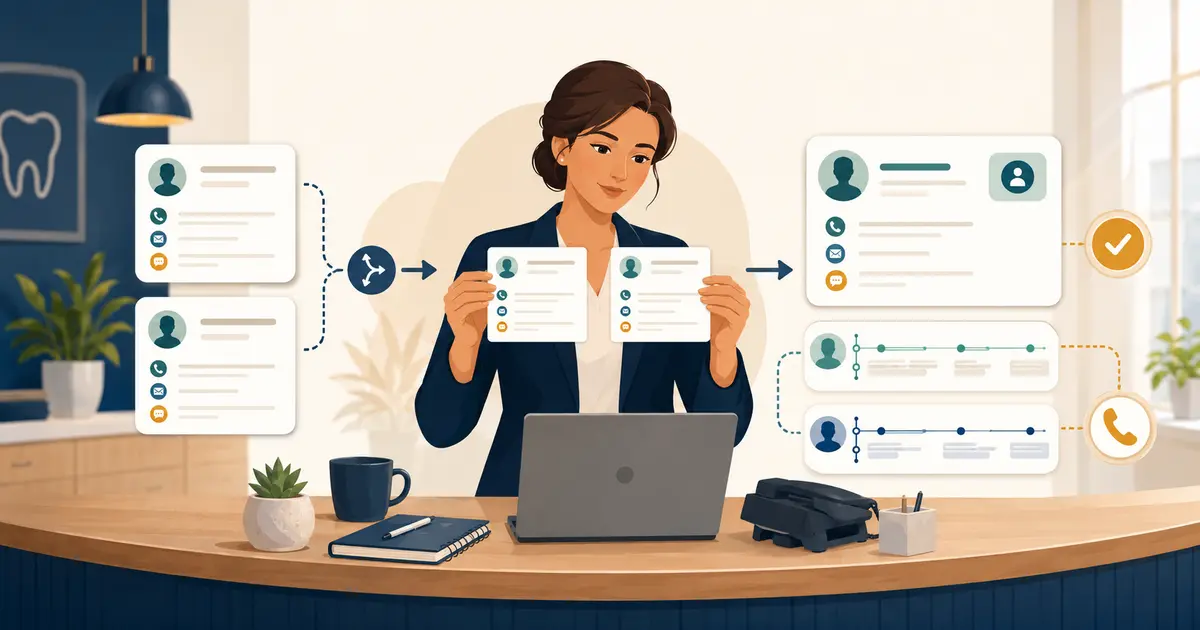
Strong dental office manager interview questions test whether a candidate can turn goals into daily execution. The manager should be able to clarify ownership, coach staff, protect the schedule, monitor finances, resolve patient-service problems, manage vendors, interpret metrics, and escalate clinical or legal decisions instead of acting beyond the role.
Ask every finalist the same core questions and score specific, job-related evidence.
Define the manager role before interviewing
The ADA describes dental office managers as overseeing daily operations that may include scheduling, staffing, patient accounts, finances, marketing, communications, compliance coordination, training, and patient relations. No candidate can succeed if the owner has not decided which of those responsibilities actually belong to the role.
Write a role charter with five sections:
- Outcomes: What should improve or remain reliable?
- Responsibilities: Which recurring work does the manager own?
- Decision rights: What may the manager approve without the owner?
- Boundaries: Which clinical, financial, legal, privacy, or ownership decisions require escalation?
- Measures: What evidence will show progress after 30, 60, and 90 days?
Then build an interview scorecard.
| Competency | Weight | Evidence sought |
|---|---|---|
| Operational leadership | 20% | Converts problems into owned workflows |
| Team coaching | 15% | Sets expectations and follows up fairly |
| Schedule and patient access | 15% | Balances capacity, service, and constraints |
| Financial management | 15% | Understands controls, reconciliation, and exceptions |
| Communication and conflict | 15% | Handles difficult conversations clearly |
| Data and problem solving | 10% | Defines metrics and investigates causes |
| Compliance judgment | 10% | Recognizes boundaries and engages qualified owners |
Dental office manager interview questions
Leadership and operating systems
- Tell me about an office process that repeatedly failed. How did you diagnose and change it?
Look for observation, cause analysis, staff input, a controlled change, and measurable follow-up—not only a new rule.
- How do you keep unfinished work visible across shifts?
Strong answers include named owners, due times, statuses, aging review, and closure evidence.
- What should happen in a daily dental office huddle?
Listen for a short review of staffing, schedule risks, patient needs, system exceptions, and open work. The huddle should assign action, not become a long meeting.
- Describe a decision you delegated successfully. What limits and review did you put around it?
Good managers delegate authority with boundaries rather than distributing tasks while keeping every decision.
- What would you review during your first two weeks in this practice?
Strong candidates begin by learning the owner’s goals, team roles, schedule, patient journey, queues, finances, systems, policies, and current metrics before promising wholesale changes.
Scheduling and patient access
- A provider’s schedule has recurring gaps. How would you investigate them?
Look for lead time, cancellation reasons, appointment types, reminder paths, template rules, waitlist quality, patient demand, and provider constraints.
- How would you respond if the team keeps running late?
Strong answers separate appointment-length assumptions, clinical variation, room turnover, late arrivals, staffing, handoffs, and overbooking.
- What is the difference between filling a schedule and managing capacity?
A capable manager considers clinical resources, provider time, patient access, appointment suitability, and workload—not only the number of filled spaces.
- Tell me about a time you changed a cancellation or no-show workflow. What result did you track?
Look for patient-friendly communication, consistent definitions, and an outcome such as completed confirmations or recovered eligible hours rather than raw call volume.
Patient communication and service recovery
- A patient says three employees gave three different answers. What do you do today, and what do you change afterward?
Strong answers resolve the immediate request, identify the approved source, correct contradictory guidance, coach the team, and update the process.
- Describe the most difficult patient complaint you managed.
Ask what the candidate heard, documented, decided, escalated, communicated, and learned. Watch for blame, unsupported refunds, clinical judgments, or disclosure of unnecessary details.
- How would you coach a receptionist who is warm with patients but leaves incomplete notes?
Good answers define the required note, demonstrate it, observe practice, give specific feedback, and review improvement.
- What should happen when a call transfer fails?
Expect caller recovery, an owned callback, technical evidence, controlled testing, and closure. The dental call transfer best practices provide a realistic post-hire standard.
Financial and revenue-cycle management
- Which financial reports would you review, and what decisions would they support?
Look for production, adjustments, collections, deposits, accounts receivable, claims, refunds, and exceptions—with awareness that accounting definitions and timing matter.
- A deposit does not match the payment report. Walk me through your response.
Strong answers preserve records, reconcile by payment method and batch, identify timing or posting differences, limit adjustments, escalate suspected loss or fraud, and document correction.
- Collections fell this month. What would you check before concluding that staff performance declined?
Look for production timing, workdays, payer mix, claim delays, posting, refunds, adjustments, system changes, and aged work.
- How do you prevent one employee from controlling an entire payment process?
Good answers mention role separation where practical, approval limits, daily reconciliation, access controls, exception review, and owner visibility.
Metrics and problem solving
- What dental office KPIs would you start with here?
The candidate should ask about business goals before selecting measures. Strong answers define formulas and avoid universal benchmarks without context. Use the existing dental call analytics dashboard guide to evaluate depth.
- Tell me about a dashboard number you discovered was wrong or misleading.
Look for source reconciliation, definition review, transparent correction, and restraint about decisions based on incomplete data.
- How do you know whether a new process is helping?
Expect a baseline, one intended outcome, guardrails, a test period, frontline feedback, and a decision to keep, adjust, or reverse the change.
Team leadership and accountability
- Describe a performance conversation that improved an employee’s work.
Strong answers cite a clear expectation, observed evidence, employee perspective, coaching, follow-up, and a fair outcome.
- How do you handle conflict between a clinical team member and front desk employee?
Look for private fact-finding, shared patient/workflow objective, role boundaries, agreed next behavior, and follow-up.
- What would you do if the owner repeatedly bypassed an office policy?
A mature answer raises the operational effect respectfully, seeks a decision, updates the policy if the owner changes it lawfully, and avoids asking staff to follow contradictory rules.
- How do you decide whether a mistake is a training problem, a process problem, or a performance problem?
Strong candidates check expectations, resources, access, workload, prior training, workflow design, and repeated individual behavior.
- How would you build a 90-day development plan for the front desk team?
Look for observed needs, role-based skills, safe practice, coaching, measurable competencies, and follow-up through a dental receptionist phone training plan.
Compliance and judgment
- An employee reports a privacy or safety concern involving a supervisor. What do you do?
The candidate should protect the report from retaliation, use an alternate escalation route, preserve facts, and involve the designated qualified owner.
- A vendor asks for temporary administrator access to troubleshoot a problem. What controls would you expect?
Look for authorization, minimum access, named account, time limit, logging, supervision, removal, and contract/privacy review.
- Where should an office manager refuse to make the decision alone?
Strong answers include diagnosis and treatment, disputed legal authority, significant privacy incidents, employment-law exceptions, contract interpretation, owner-level financial decisions, and matters outside training.
Use two manager-level practical exercises
Exercise 1: Monday morning operations board
Give the candidate this fictional situation:
- one receptionist called off;
- the hygiene schedule has a two-hour opening tomorrow;
- three new-patient calls from the weekend are unassigned;
- yesterday’s card deposit is different from the payment report;
- the phone vendor closed a transfer ticket without a successful retest;
- an employee asks a clinical question outside the manager’s role.
Ask for the first 30 minutes, first day, and first week plan. Score:
- safety and patient access priorities;
- ownership and due times;
- use of backup coverage;
- financial control;
- qualified escalation;
- communication with staff and patients;
- prevention after immediate recovery.
Exercise 2: KPI investigation
Provide a small fictional table showing fewer answered calls, more callbacks, stable total call volume, and a recent lunch schedule change. Ask what the candidate can conclude.
The best answer is not “staff need to answer more calls.” It is a list of questions: Are definitions stable? Which intervals changed? Did routing change? Was coverage reduced? Are callbacks completed? Did caller behavior or spam filtering change?
Red flags in manager interviews
- Claims to have no weaknesses or never make mistakes.
- Treats staff turnover as proof that “people do not want to work.”
- Uses pressure or public criticism as the main accountability method.
- Promises a specific revenue increase before reviewing the practice.
- Cannot explain the source or definition of a favorite benchmark.
- Describes sharing logins or bypassing controls to work faster.
- Makes clinical or legal decisions outside the role.
- Focuses on activity counts without patient, financial, or team outcomes.
- Blames the prior team without describing the system it worked within.
Keep questions job-related. EEOC guidance recommends avoiding inquiries about protected personal characteristics and restricts disability-related questions before a conditional offer. Have qualified HR or employment counsel review the hiring process.
Make the final decision from evidence
Require interviewers to score independently before discussing candidates. Compare:
- examples from prior work;
- practical exercise performance;
- references and lawful verification;
- alignment with the written role charter;
- risks the owner can realistically coach;
- the candidate’s questions about the practice.
The best candidate is not necessarily the person with the longest list of dental software. Hire the manager who can understand the system, make work visible, coach people fairly, use data carefully, and know when a decision belongs to someone else.