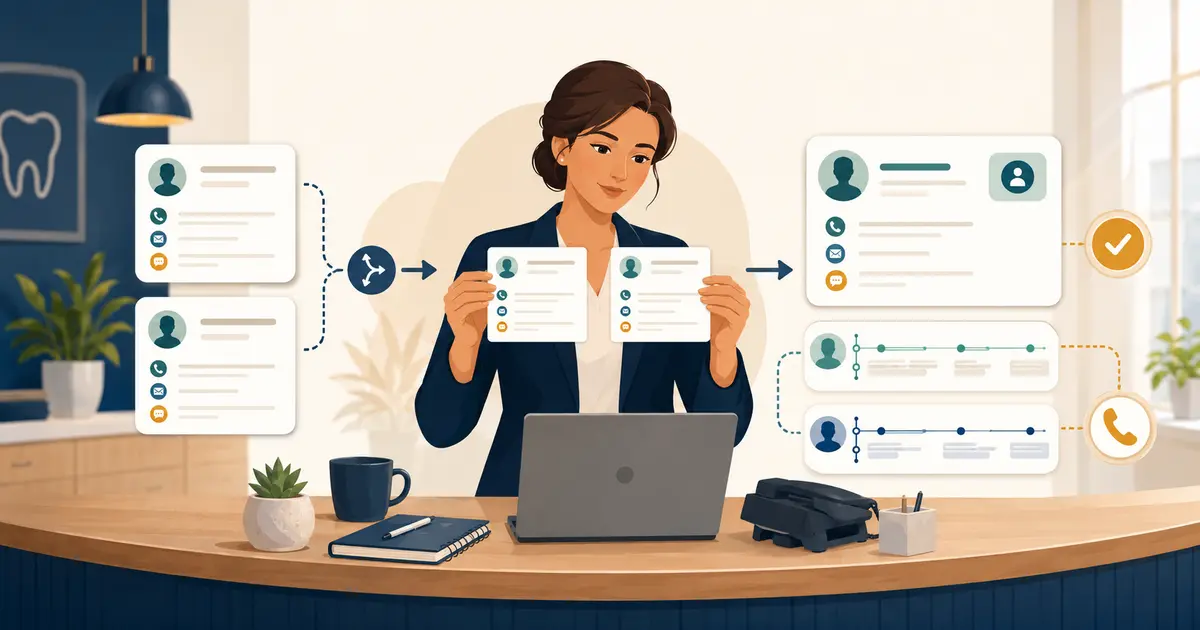
The best dental receptionist interview questions reveal how a candidate communicates, prioritizes, documents, protects privacy, learns systems, and recovers when a call or handoff goes wrong. Ask every finalist the same core questions, score answers against job-related criteria, and include a short practical exercise using fictional information.
Avoid hiring on friendliness alone. A strong front desk employee must be warm and precise while several people, phones, messages, and deadlines compete for attention.
Start with a dental receptionist scorecard
Define the role before the interview. Select six to eight competencies that reflect the actual job and assign the same rating scale to each candidate.
| Competency | What good performance looks like |
|---|---|
| Patient communication | Clear, calm, respectful language without overpromising |
| Call ownership | Captures the request, next step, owner, and due time |
| Prioritization | Separates urgent escalation from routine administrative work |
| Accuracy | Confirms names, numbers, dates, and instructions |
| Privacy judgment | Shares only what the role and situation permit |
| Systems learning | Can learn structured workflows and use reference material |
| Team handoffs | Gives useful context and confirms receipt |
| Service recovery | Acknowledges problems and moves toward a practical next step |
Use a four-point scale:
- Weak: no example, unsafe assumptions, or unclear ownership;
- Developing: reasonable intent but incomplete method;
- Strong: specific, role-appropriate example with a clear result;
- Exceptional: strong answer plus thoughtful prevention or follow-up.
Write evidence, not impressions. “Candidate described reading back the callback number and assigning a due time” is more useful than “seems organized.”
25 dental receptionist interview questions
Communication and patient service
- Tell me about a time you helped a frustrated caller feel heard without promising something you could not deliver.
Strong answers acknowledge the concern, clarify the request, explain the next available step, and avoid arguing.
- How would you explain that an appointment request has been received but is not yet confirmed?
Listen for precise language that distinguishes a request from a booked appointment.
- Describe how you would answer a price question when the final amount depends on an exam, treatment plan, or insurance information.
Look for helpful boundaries, approved estimates, and a clear next step—not dismissal or a guarantee.
- What would you say if a caller asks a clinical question you are not qualified to answer?
A strong candidate captures the concern accurately and follows the office’s clinical escalation process.
- Give an example of changing your communication style for someone who had difficulty hearing, understanding, or using the usual channel.
Look for patience, respect, and willingness to use approved accommodations.
Phones and front desk workflow
- You are checking in a patient, two phone lines are ringing, and a coworker asks for help. What do you do first?
There is no universal sequence. The answer should identify immediate safety or urgency, acknowledge people, use available coverage, and create owned follow-up.
- Walk me through a safe warm transfer. What do you do if no one answers?
Look for permission, brief context, confirmed connection, and caller recovery if the transfer fails.
- How do you make sure a voicemail or missed call does not disappear during a busy day?
Strong answers use an approved queue, named owner, due time, and documented outcome.
- Tell me about a time a phone, scheduling, or office system failed while customers were waiting.
Look for calm containment, an approved fallback, communication, and escalation rather than random configuration changes.
- What information belongs in a useful call note? What information does not?
Listen for concise facts, the caller’s request, action taken, owner, and next step—without unnecessary sensitive detail or personal opinion.
Use the dental front desk workflow to tailor these questions to the practice’s actual handoffs.
Prioritization and judgment
- Describe a situation in which two tasks were both important and due at the same time. How did you decide?
Strong answers identify impact, deadline, available backup, and communication with affected people.
- A caller uses the word “emergency.” What should a receptionist do next?
The candidate should follow the practice’s approved clinical escalation rules, not diagnose or independently decide treatment.
- When should a front desk employee stop and ask a manager for help?
Look for boundaries involving clinical judgment, privacy, authority, money, threats, exceptions, and unclear policy.
- How would you handle two records that appear to describe the same caller request?
A careful answer compares facts and unfinished work before linking or escalating; it does not delete one record immediately.
- Tell me about a mistake you caught before it affected a customer or patient. What helped you notice it?
Look for a repeatable check, not a claim of never making mistakes.
Accuracy, privacy, and documentation
- How do you confirm a name, callback number, date, or email address accurately?
Strong candidates describe reading back, spelling, checking context, and correcting the record visibly.
- A spouse calls for information about a patient. What would you do?
The answer should rely on the practice’s verification, permission, and personal-representative policy rather than relationship alone.
- Tell me about a job where you handled confidential information. What habits protected it?
Listen for concrete practices: screen positioning, secure communication, clean workspace, access controls, and careful conversations.
- What would you do if a coworker asked to use your login because their account was not working?
The right direction is to refuse credential sharing and use the approved access or support process.
- How do you document a difficult conversation without adding blame or opinion?
Look for neutral wording, observable facts, direct quotes only when needed, actions, ownership, and next steps.
Learning, teamwork, and reliability
- How do you learn a new phone or practice-management system?
Strong answers combine guided training, reference material, safe practice, questions, and feedback.
- Tell me about feedback that changed how you worked.
Look for ownership, a specific adjustment, and evidence that the change lasted.
- What does a good shift handoff include?
Expect open work, priority, owner, due time, attempts already made, and the next action—not a long narrative.
- Describe a process you improved without ignoring your manager or creating confusion for coworkers.
Strong candidates observe a problem, propose a controlled change, test it, and communicate the final process.
- What would success in your first 30 days at a dental front desk look like?
Good answers focus on learning the office’s standards, completing core tasks accurately, asking appropriate questions, and building reliable habits.
Add two practical interview exercises
Questions reveal how candidates describe themselves. Work samples show how they approach the job.
Exercise 1: The three-minute call note
Read this fictional scenario:
Jordan Lee calls at 10:12 a.m. and says a previously discussed appointment time may no longer work. Jordan asks for a return call after 2:00 p.m. at 312-555-0148. No change has been confirmed.
Ask the candidate to write the note. A strong response might be:
10:12 a.m. — Jordan Lee requested a callback after 2:00 p.m. regarding a possible appointment-time change. Callback: 312-555-0148, read back and confirmed. No schedule change confirmed. Assigned to scheduling queue; due today.
Score accuracy, neutrality, request status, callback confirmation, ownership, and absence of invented details. The dental call notes template can become the post-hire standard.
Exercise 2: The interrupted front desk
Give the candidate five cards:
- a patient is waiting to check in;
- a caller is on hold;
- a message mentions a potentially urgent concern;
- a payment batch is due later today;
- a coworker asks where to find a form.
Ask the candidate to think aloud while ordering the next actions. Do not score one “perfect” order. Score whether the candidate recognizes clinical escalation, communicates delays, assigns ownership, and avoids abandoning lower-priority work.
Questions employers should avoid
Keep questions job-related and consistent. The EEOC advises employers to avoid questions about protected personal characteristics and notes that disability-related questions and medical examinations are generally restricted before a conditional offer.
Do not ask about:
- age, race, religion, national origin, sex, pregnancy, or family plans;
- marital status, children, childcare arrangements, or a spouse’s work;
- disability, medications, medical history, or prior workers’ compensation claims;
- citizenship when the lawful question is whether the candidate is authorized to work in the United States;
- other protected information under federal, state, or local law.
Ask all candidates the same practical availability question instead: “This role is scheduled Monday through Thursday from 7:30 a.m. to 5:00 p.m. Can you reliably work that schedule?” Have employment counsel or a qualified HR professional review the complete hiring process.
Use a final interview score sheet
| Area | Weight | Candidate evidence | Score 1–4 |
|---|---|---|---|
| Patient communication | 20% | ||
| Prioritization | 15% | ||
| Accuracy and documentation | 20% | ||
| Privacy and judgment | 15% | ||
| Phone workflow | 15% | ||
| Learning and teamwork | 15% |
Set weights before interviews begin. Require interviewers to write evidence independently before discussing candidates. After hiring, connect the same competencies to a structured dental receptionist phone training plan and probationary review. The interview should predict the work the employee will actually perform—not reward the person who interviews most confidently.