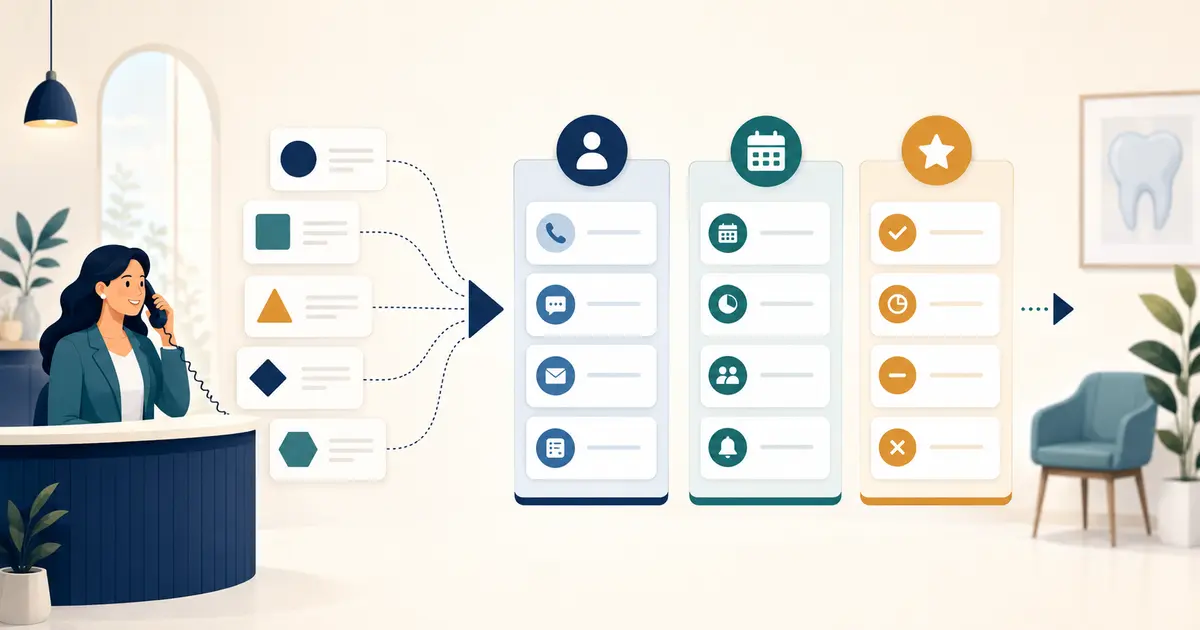
A dental call answer rate is the number of eligible answered calls divided by eligible offered calls. The hard part is not the division. It is defining “eligible,” “answered,” and “offered” consistently across phone routes and reporting periods.
Front desk teams should keep the raw counts beside every rate. Do not use an unsupported average call volume or missed-call benchmark as a substitute for practice data.
Define offered calls
An offered call is a call event the phone system presented to the practice's routing logic. Decide how to handle calls blocked by the carrier, rejected before the queue, disconnected immediately, routed directly to a known extension, or forwarded from another number.
Document the source system and event states. If one platform counts internal transfers as new calls and another does not, their totals are not comparable without normalization.
The dental call tracking metrics guide provides a broader metric dictionary.
Define eligibility
Create inclusion and exclusion rules. A common operational view may include patient and prospective-patient calls while separating known spam, vendors, wrong numbers, test calls, and internal calls. The practice should decide whether referral offices and pharmacies belong in the same or a separate service measure.
Do not exclude difficult calls after seeing the result. Apply the rule consistently. Keep excluded counts visible so leaders can review data quality.
Unknown caller type remains unknown. Do not classify every unanswered number as a prospective patient.
Define answered states
Separate:
- answered live by location staff;
- answered live by central staff;
- answered by a remote human service;
- answered by AI backup;
- reached voicemail and left a message;
- reached voicemail and disconnected;
- abandoned in queue;
- transfer answered or failed.
These states support different questions. A caller reaching AI backup may count as answered coverage but not as front-desk live answer. A completed voicemail is captured, not live answered.
Missed Calls Dental may answer eligible forwarded missed calls and capture requests for staff follow-up. Report that state separately so teams can see both coverage and the callback work created.
Choose the formulas
Examples:
- live staff answer rate = eligible calls answered by staff / eligible offered calls;
- total answered coverage rate = eligible calls answered by staff or approved backup / eligible offered calls;
- missed-call rate = eligible unanswered calls / eligible offered calls;
- capture-after-miss rate = complete captured requests / eligible missed calls;
- callback connection rate = unique callers connected / eligible reviewed requests.
Display numerator, denominator, time period, routing conditions, and source. Do not call one formula “the” answer rate without the definition.
Handle repeats and duplicates
One person may call several times. Call-level reporting should retain each event because it affects workload. Caller-level reporting may group events under a documented privacy-reviewed rule.
Do not merge family members solely because they share a phone number. Do not drop repeats merely to improve the rate. Show call events and unique caller groups separately.
The unanswered-call recovery plan helps managers connect repeats to workflow ownership.
Account for routing and transfers
Preserve original number, queue, location, answer destination, transfer attempts, final destination, and result. A call answered centrally and then dropped on transfer should not look identical to a call resolved by the location.
Test whether the phone system creates multiple legs for one caller interaction. Normalize reports so a transfer leg does not inflate offered-call totals.
Phone-provider behavior is provider-specific. Use actual documentation and test calls.
Mark outage and configuration periods
Flag carrier, internet, power, vendor, forwarding, and device failures. A period with no recorded calls may mean low volume or missing data.
Do not report missing events as zero. Show source coverage and excluded outage time. Reconcile carrier records, local logs, answering records, and callback reports after recovery.
The dental phone outage plan provides continuity and reconciliation steps.
Segment the rate for action
Review by time of day, day of week, location, queue, ring group, open or closed state, simultaneous-call condition, and staffing pattern. Protect privacy and avoid tiny groups.
The purpose is to find constraints. A low rate at lunch may need assigned coverage. A low rate during brief peaks may need queue or overflow changes. A rate change after configuration work may indicate a routing defect.
Do not use the metric alone to judge an employee. Pair it with staffing, call mix, holds, transfers, documentation, and case review.
Connect answer to outcome
Answering is an early stage. Track complete request capture, ownership, callback, caller connection, appointment request, confirmed appointment, and final outcome separately.
A high answer rate with inaccurate information or no owner is not success. A lower staff answer rate with dependable backup and callback may still support callers well, but it creates workload that managers must see.
The call abandonment and hold-time scorecard adds queue measures.
Build a weekly report
Show:
| Measure | Count | Denominator | Rate | Data-quality note |
|---|---|---|---|---|
| Eligible offered calls | — | — | Definition version | |
| Staff live answers | Eligible offered | Locations included | ||
| Backup answers | Eligible offered | Human or AI split | ||
| Eligible misses | Eligible offered | Voicemail treatment | ||
| Complete captures | Eligible misses | Required fields | ||
| Callback connections | Reviewed requests | Attempt window |
Include exclusions, outage periods, and source coverage. Use a stable period long enough to include normal variation.
Audit the numbers
Sample calls from each state and compare the report with phone events, voicemail or backup record, queue item, and outcome. Look for internal legs counted as new calls, abandoned calls marked answered, spam left eligible, and missing outage periods.
Google Ads call reporting illustrates another important principle: call platforms may expose specific fields and use forwarding numbers for measurement. Do not combine advertising call definitions with the office phone denominator without documenting the overlap.
Improve one constraint at a time
After finding the largest verified gap, choose one change: ring ownership, lunch coverage, queue threshold, overflow, callback block, training, or routing repair. Record the effective date and compare the next cohort with the same definition.
The useful answer to “how many calls do dental offices miss?” is not a generic average. It is a reproducible count from the practice's own eligible calls, paired with the reasons and follow-up outcomes that managers can change.
Maintain a denominator audit
Select sample days and rebuild the eligible offered-call count from raw events. Reconcile carrier totals, phone-system legs, queues, transfers, voicemail, backup answers, and known exclusions. Record unmatched events and the rule used to resolve them.
Repeat the audit after routing, carrier, queue, or reporting changes. If the denominator changes because the system now records transfers differently, label the break in the trend. Do not rewrite prior rates without documenting the restatement.
Give staff a way to flag obvious errors such as a test call counted as a patient call or a completed transfer counted twice. Preserve corrections and use them to improve the event dictionary. A dependable answer rate is a maintained measurement process, not a permanent property of the phone report. Publish the denominator definition beside every chart so managers can understand changes without searching for a separate technical document or assuming that every inbound event was eligible. Version every definition.