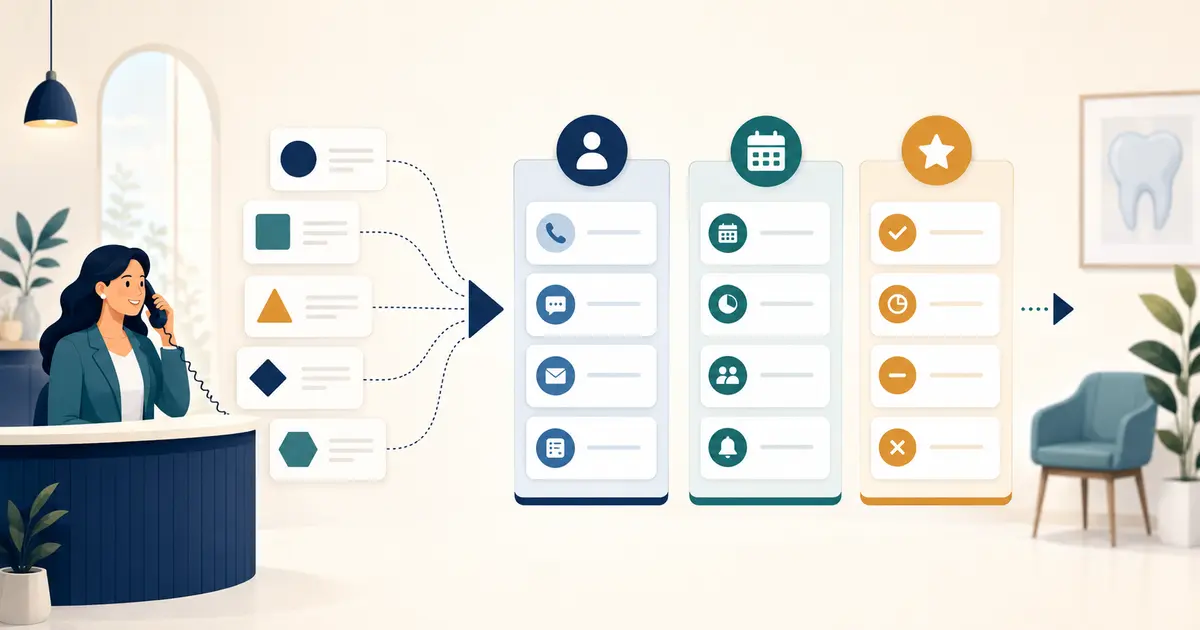
Dental call abandonment rate measures the share of eligible inbound calls that end before the practice or designated service completes the intended answer path. Dental phone hold time measures how long callers spend in an actual hold state. Both metrics can reveal access problems, but only when the denominator, call states, exclusions, and time window are defined.
There is no responsible universal benchmark for every dental office. Practice size, hours, phone menus, carrier behavior, call mix, staffing, and measurement systems differ. Build an internal baseline first.
Define abandonment precisely
A basic formula is:
abandoned eligible calls ÷ total eligible inbound calls × 100
The hard work is defining “eligible” and “abandoned.” Decide how the report treats:
- spam and blocked calls;
- wrong numbers;
- caller disconnects in the first few seconds;
- calls abandoned in an auto attendant;
- calls abandoned while ringing;
- calls abandoned on hold;
- calls disconnected during transfer;
- duplicate attempts from the same caller;
- calls routed to voicemail;
- calls answered by an overflow or after-hours service;
- technical failures;
- callbacks that later recover the request.
Keep raw states even if leadership also wants a simple headline number. Combining every failure into one percentage hides where the process broke.
The call tracking metrics guide covers a broader owner dashboard. This scorecard goes deeper on response and waiting states.
Define hold time separately
Hold time should begin when the caller is placed in the system's hold state and end when an employee resumes, transfer completes, the caller disconnects, or the system ends the hold. Do not confuse hold time with:
- ringing before answer;
- time in an auto-attendant menu;
- queue wait before an employee answers;
- silence during a conversation;
- transfer ringing;
- time waiting for a callback.
Report median and distribution when the system supports them. An average can hide a small number of very long holds. Also track calls abandoned during hold and holds without a return update.
Map the call states
Use a state model such as:
- offered;
- answered;
- queued;
- placed on hold;
- resumed;
- transferred;
- request captured;
- caller disconnected;
- callback due;
- recovered;
- completed;
- unresolved exception.
Ask the phone vendor exactly which events it records. If a report labels a call “answered” when an auto attendant picked up, it may not mean a person or AI completed the caller's request.
Segment before acting
Break the data down by:
- day and half-hour;
- open, lunch, after-hours, weekend, and holiday periods;
- location and published number;
- new versus existing caller when known and appropriate;
- marketing number versus main number;
- call route or menu choice;
- employee or queue;
- transfer destination;
- call outcome;
- outage or staffing event.
Look for repeatable patterns. A lunch-hour spike suggests a different solution than one failed extension or a holiday schedule error.
The busy-line coverage plan can help translate concurrent-call patterns into routing and ownership rules.
Pair speed with quality
Faster answering is not automatically better. Review whether calls produce:
- accurate contact information;
- clear request states;
- complete handoffs;
- correct owner;
- appropriate privacy safeguards;
- accessible communication;
- no clinical, benefit, price, or booking overstatement;
- successful follow-up;
- minimal duplication.
A rushed call can create more downstream work than a careful one. Use a balanced scorecard rather than ranking employees by speed alone.
Build an internal baseline
Choose a normal period that includes complete operating days and excludes a known outage only if the exclusion is documented. Record:
- total eligible inbound calls;
- abandoned calls by state;
- answer and queue times;
- hold events and duration distribution;
- transfers and failures;
- voicemail outcomes;
- overflow or AI outcomes;
- callbacks created and recovered;
- unresolved requests at closing.
Keep the definitions with the baseline. If the phone system changes, start a bridge period because event labels may not be comparable.
Investigate causes with call samples
Metrics show where to look, not why the caller left. Use authorized, privacy-conscious review methods to sample:
- very short calls;
- longest waits;
- repeated callers;
- failed transfers;
- abandoned holds;
- unanswered calls during staffed periods;
- routes with unusual spikes;
- calls that created complaints or incomplete requests.
Do not assume every short call reflects impatience. It may be spam, a wrong number, a routing error, or a technical disconnect.
The American Dental Association recommends a consistent greeting, limited interruptions, and careful use of holds during prospective-patient calls. Use that guidance as an operational prompt, not a universal numeric target.
Choose interventions by cause
Possible responses include:
- correct schedules and forwarding rules;
- simplify a phone menu;
- remove dead extensions;
- change lunch coverage;
- establish a hold-return interval;
- use a callback option with a real owner;
- add overflow for defined conditions;
- train warm-transfer recovery;
- update staffing by observed call windows;
- filter obvious spam without blocking legitimate callers;
- improve outage fallback;
- create a missed-call review queue.
Change one major variable at a time when possible. Record the effective date so the before-and-after comparison is meaningful.
Recover abandoned calls
Define which abandoned calls create a recovery task. A safe workflow includes:
- validated caller number when available;
- duplicate check;
- owner and response standard;
- approved callback or text language;
- identity verification before disclosure;
- opt-out and channel preference;
- documentation of outcome;
- escalation for invalid or repeated failures.
Do not label a call recovered merely because a message was sent. Recovery should reflect the practice's defined outcome, such as a two-way response or completed staff review.
The unanswered-call recovery plan provides a manager workflow for these tasks.
Use a monthly scorecard
| Measure | Definition | Current | Prior | Owner action |
|---|---|---|---|---|
| Eligible inbound calls | Defined included calls | Validate volume | ||
| Abandoned while ringing | Caller ended before owned answer | Review staffing/routing | ||
| Abandoned on hold | Caller ended during hold | Review hold practice | ||
| Failed transfers | Destination did not accept | Fix route/fallback | ||
| Median hold time | Middle completed hold | Watch distribution | ||
| Longest decile | Slowest ten percent of holds | Review outliers | ||
| Recovery tasks created | Calls meeting recovery rule | Confirm ownership | ||
| Recovery tasks completed | Defined completion evidence | Audit outcomes | ||
| Unresolved at closing | Open without accepted owner | Escalate daily |
Add a short narrative explaining material changes. Numbers without operational context invite the wrong response.
Avoid invented benchmarks
Search results and vendor reports often present a “good” response time or abandonment rate without showing population, period, call definition, or measurement method. Do not copy those numbers into a performance policy.
If an external comparison is used, require the source, sample, industry, date, definitions, exclusions, and distribution. Even then, the practice's patient access obligations and improvement capacity matter more than ranking against an unknown group.
Publish the internal definition beside every dashboard. When a carrier, phone system, routing rule, or reporting window changes, mark the date and avoid treating the new series as directly comparable until the team validates it.
Keep raw counts beside percentages. A sharp rate change during a low-volume hour may represent only a few calls, while a modest change during a peak period may affect many more callers and recovery tasks.
Dental call abandonment and hold time become useful when they connect to caller states, quality, and ownership. Measure consistently, segment causes, recover lost requests, and use the findings to improve the system—not to reward employees for ending calls faster.