Dental call reason codes should answer one question: Why did the person call? They should not describe whether staff answered, whether the request was resolved, or whether an appointment was later confirmed. Keeping intent separate from outcome makes reporting easier to interpret and less likely to reward the wrong behavior.
Separate the three layers
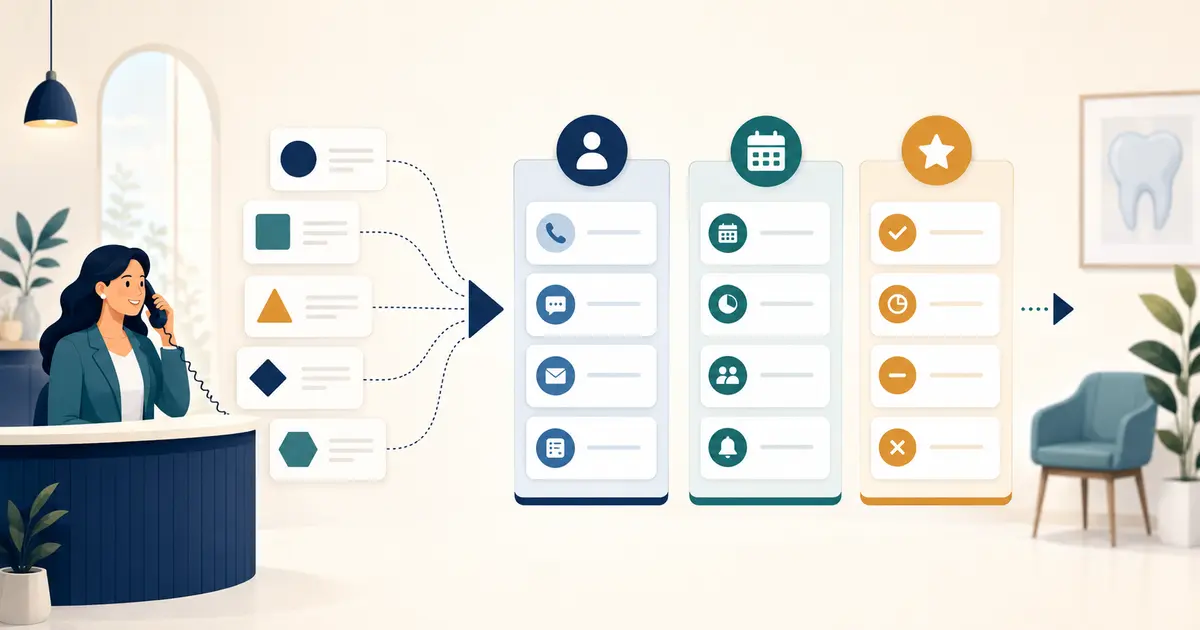
Use three independent fields when possible:
| Field | Question | Example |
|---|---|---|
| Reason | Why did the caller contact the office? | New-patient request |
| Handling state | What happened during the contact? | Transferred to scheduling |
| Disposition | What was the final known outcome? | Appointment confirmed by staff |
The existing dental call disposition code guide covers the third layer. Combining all three into one menu creates ambiguous codes such as “new patient booked,” which cannot represent a new-patient request that is pending, declined, duplicated, or unresolved.
Start with a small reason taxonomy
A practical first version might include:
- new-patient request;
- existing-patient appointment request;
- cancellation or change request;
- general office information;
- billing or payment question;
- insurance question;
- records or referral request;
- complaint or service recovery;
- vendor, laboratory, or professional call;
- clinical or urgent-language escalation;
- wrong number, spam, or non-patient call;
- other or unknown.
These are examples, not a universal list. Build the final taxonomy from a permitted sample of your own calls, the work your office actually performs, and qualified compliance guidance. A reason code records the caller's words at an administrative level; it is not a diagnosis or clinical classification.
Write a definition for every code
For each reason, document four items:
- a plain-language definition;
- two or three included examples;
- common exclusions and the correct alternative;
- the role allowed to change the code.
For example, “insurance question” may include a caller asking whether the office accepts inquiries about a plan. It should not mean that benefits were verified. “Clinical or urgent-language escalation” records that the approved escalation path was used; it does not state what condition the caller has or determine priority medically.
The front-desk ownership workflow can define who accepts each category after it is recorded.
Preserve unknowns instead of forcing certainty
Make “other” and “unknown” available, but review them. “Other” means the reason is understood but not represented. “Unknown” means the office could not determine the reason from the available evidence. Silence, a dropped call, or a vague voicemail should not be guessed into the largest category.
Review a small sample of unknown and other records monthly. Add a new code only when the pattern is recurring, operationally useful, and distinct. Retire or merge categories that employees cannot apply consistently.
Test reliability before using the data
Give several employees the same fictional call summaries and compare their choices. Investigate disagreement rather than averaging it away. Typical problems include overlapping definitions, category names that imply an outcome, and an “urgent” label that asks non-clinical staff to make a clinical judgment.
Track correction rate, unknown share, disagreement examples, and definitions changed. Then connect the stable reason field to the dental call analytics dashboard without using the taxonomy as a performance quota. An increase in complaint calls may reflect better coding, not worse service; a decrease in insurance calls may reflect routing or data loss.
Missed Calls Dental boundary
Missed Calls Dental can capture a caller's stated request and provide a summary for office follow-up. It does not diagnose, assign clinical urgency, verify insurance, or independently book, change, or cancel appointments. The practice owns reason-code definitions, review, staff action, and final outcomes. SMS is separate and readiness-gated.
Rachel Morgan is an editorial pen name. This article was reviewed for accuracy and alignment with Missed Calls Dental product information.