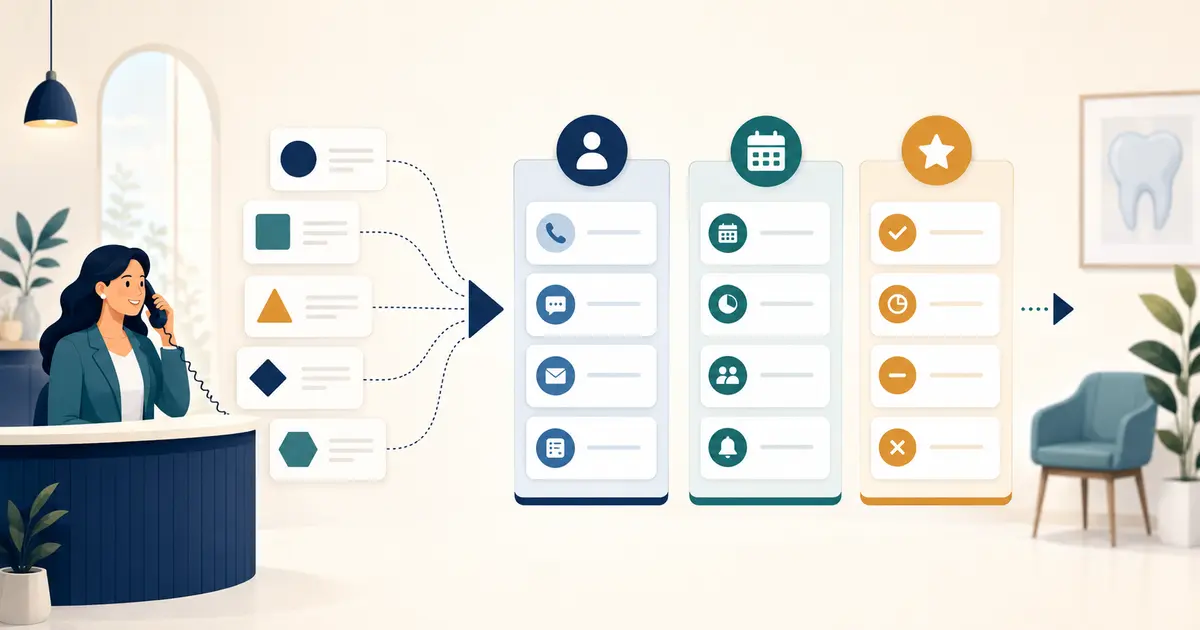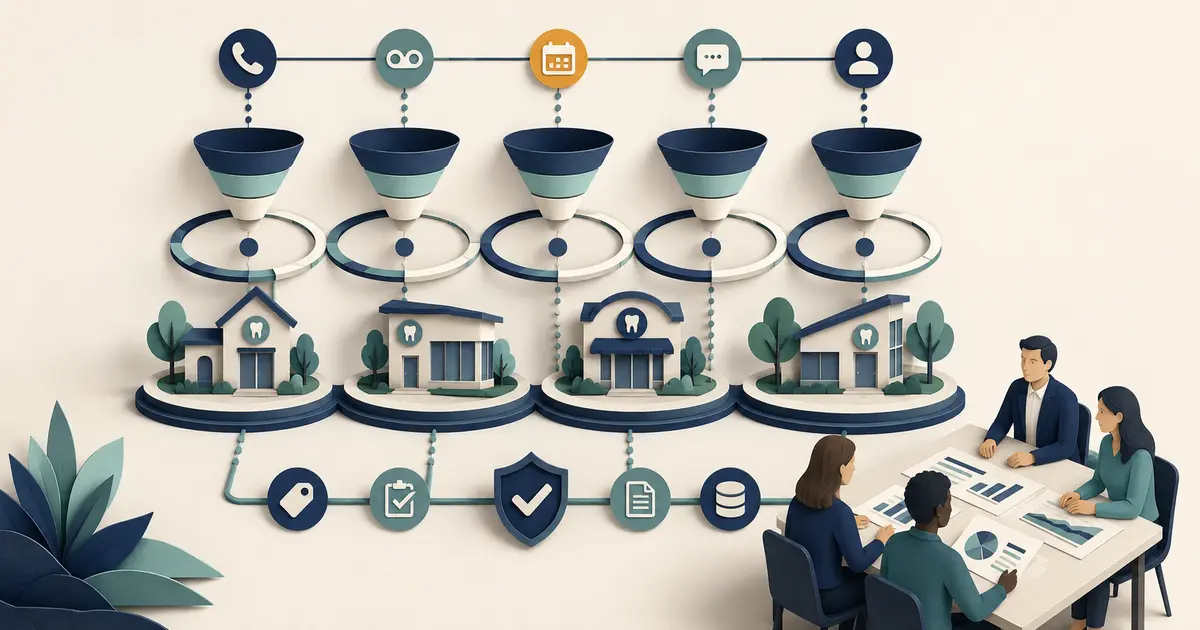
DSO call analytics should make locations comparable without erasing the conditions that make them different. A call answer rate from one phone platform may not mean the same thing as a rate from another. A “conversion” may be a request at one office and a completed visit at another.
Future group owners should build a metric dictionary and data-quality process before using call reports for performance decisions.
Create the event dictionary
Define raw events first:
- call offered;
- answered by location staff;
- answered by central staff;
- answered by backup service;
- abandoned before answer;
- routed to voicemail;
- captured after miss;
- transfer attempted and completed;
- callback attempted;
- caller connected;
- request captured;
- appointment confirmed;
- visit completed;
- duplicate, spam, vendor, wrong number, or test.
For each, record the source system, timestamp, location key, required fields, exclusions, and known limitations. Do not infer an event that the source cannot observe.
The dental call tracking metrics guide provides practice-level definitions that can become the group baseline.
Define metrics as full formulas
Publish numerator, denominator, cohort, time zone, window, and exclusions. For example:
| Metric | Numerator | Denominator | Important context |
|---|---|---|---|
| Answer rate | Eligible answered calls | Eligible offered calls | Includes or excludes backup? |
| Missed-call capture rate | Complete captured requests | Eligible missed calls | Capture channels included |
| Callback connection rate | Unique callers connected | Eligible reviewed requests | Attempt window |
| Appointment conversion | Confirmed appointments | Eligible inquiries or connected callers | State definition |
| Visit completion | Completed visits | Confirmed appointments | Cohort follow-up window |
Never display a percentage without its counts. Blank data is unknown, not zero.
Keep one cohort through the funnel
Group calls by a defined event date, such as eligible inquiry date, and follow that cohort into later requests, appointments, and visits. This prevents a late-month call from being compared with only immediate outcomes.
Choose a follow-up window and disclose it. Preserve late outcomes separately rather than silently rewriting closed reports.
The dental call conversion rate guide explains why requests, confirmations, and visits need separate stages.
Normalize location identity and time
Use stable location IDs rather than names that may change. Store timestamps in a consistent underlying standard and report local operating context correctly. Document daylight-saving behavior.
Map shared phone numbers, overflow lines, central teams, and calls transferred between locations. Preserve original route, answering location, responsible location, and final outcome location when they differ.
Do not assign a call to a location merely from the caller's area code.
Expose local context
Compare locations with hours, call volume, new-versus-existing mix, specialty, number of lines, staffing model, central coverage, marketing mix, outage periods, and schedule availability visible.
This context does not excuse an unresolved workflow. It prevents leaders from concluding that a rate difference is caused by staff performance when routing or denominator definitions differ.
Use peer groups only when their definitions and operations are sufficiently similar.
Control duplicates and cross-channel outcomes
A caller may call twice, receive a text, submit a form, and schedule at another location. Define a privacy-reviewed matching rule and duplicate window. Preserve raw events and the rule version.
When identity is uncertain, do not force a match. Shared family phone numbers can represent different people. Cross-location patient matching requires appropriate access and verification.
The DSO missed-call management guide describes the operational queue behind the data.
Separate attribution from causation
Record source number, campaign data, referral source, and later outcomes where available. Define an attribution rule. Do not claim that the call, text, or ad caused treatment revenue merely because events can be linked.
For DSO new-patient call conversion, report stage movement and uncertainty. A call may influence an appointment alongside brand, referral, insurance, location, and availability.
The dental call attribution guide provides a first-party model.
Build data-quality checks
Run automatic or scheduled tests:
- stage counts do not exceed eligible prior stages without an explained rule;
- timestamps are ordered plausibly;
- every outcome maps to a valid location and cohort;
- duplicate rules are reproducible;
- unknown and blank remain distinct from zero;
- closed locations do not appear open without explanation;
- failed integrations and outages are flagged;
- metric definitions match the dictionary version.
Reconcile a sample back to phone events, request records, authoritative schedules, and visit outcomes.
Protect privacy and access
Analytics needs less detail than operations in many cases. Use aggregated or limited fields when possible. Restrict record-level access by role and location. Suppress small groups where reporting could expose individuals.
HHS's minimum-necessary guidance supports limiting protected information and access to the defined purpose. Map analytics, phone, messaging, PMS, warehouse, support, and subcontractor relationships.
Log exports, restrict downloads, define retention, and test user removal. A central dashboard should not become an unrestricted patient search tool.
Report uncertainty and exclusions
Label incomplete source periods, carrier outages, integration failures, unverified outcomes, and policy changes. Show coverage percentages so leaders know how much of the workflow the report can observe.
Avoid filling missing data with averages. Do not publish an “average dental office call volume” as if it applies to every location. The useful comparison is the group's own consistent measure over comparable periods.
Use analytics for improvement
Review funnel constraints by location. One office may need routing correction, another callback ownership, another schedule availability, and another better outcome documentation.
Choose a test, owner, start date, expected process change, and evaluation cohort. Avoid changing several rules simultaneously when the goal is learning.
Do not use a single rate as a disciplinary score. Pair data with case review and operational context.
Govern the metric layer
Assign owners for source systems, dictionary, transforms, dashboard, access, quality checks, and business interpretation. Version every formula and document the effective date.
Test the dashboard after phone-system, scheduling, messaging, or location changes. Preserve a rollback and a way to recreate prior reports.
NIST's Cybersecurity Framework supports governance, identification, protection, detection, response, and recovery thinking for systems and data. Apply that discipline to call analytics.
Comparable DSO call analytics are built, not discovered. Shared definitions, visible denominators, local context, and traceable outcomes give leaders a reliable basis for action.
Publish a metric change log
Every dashboard release should state which definitions, sources, mappings, exclusions, cohort windows, duplicate rules, and access controls changed. Include the effective date, affected locations, reason, owner, validation, and whether historical results were restated.
When possible, run old and new logic in parallel for a short validation period. Explain the bridge between results. Do not present a definition-driven jump as operational improvement.
Give location leaders a way to challenge a record and preserve the correction trail. A disputed classification may reveal a source defect, mapping problem, or unclear dictionary rule. Resolve it centrally and communicate the impact to all locations using the metric.
Retain prior metric versions and representative test cases. If a dashboard cannot recreate an earlier reported number, leadership cannot evaluate trends or decisions reliably. Version discipline turns call analytics into an auditable management system instead of a sequence of screenshots. Schedule recurring reviews with both central analysts and location managers so operational context can correct definitions without weakening comparability or hiding exceptions. Record decisions and owners.