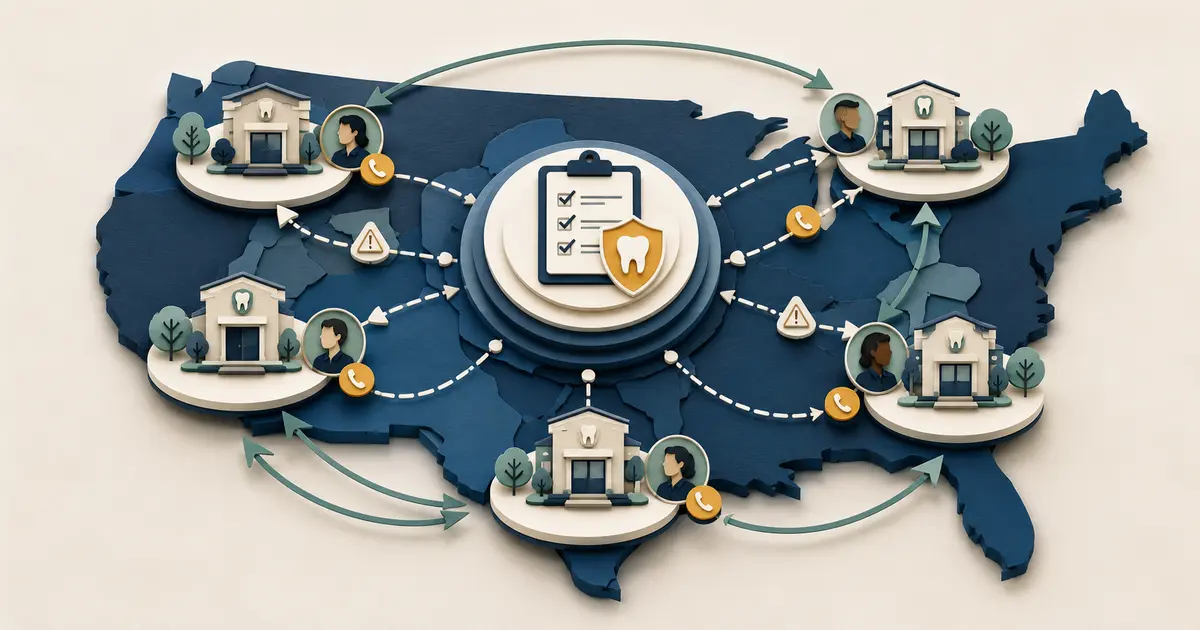
DSO missed-call management should create one standard for visibility without pretending every location operates the same way. The central team can define call events, request states, security controls, and reporting, while local practices retain current hours, provider rules, schedules, emergency paths, and patient follow-up ownership.
The goal is a shared operating system for missed calls, not a central inbox with unclear responsibility.
Define “missed” once
Decide which events count across the group: ring-no-answer, busy, queue abandonment, transfer failure, voicemail, carrier rejection, forwarding failure, or another state. Keep raw phone events available and document exclusions.
Distinguish:
- offered call;
- answered by location staff;
- answered by central staff;
- answered by backup service;
- abandoned before answer;
- captured after miss;
- duplicate or repeat attempt;
- spam, vendor, or wrong number.
The multi-practice call coverage guide provides the broader governance framework.
Keep a location authority record
For each location, maintain verified name, address, phone, hours, time zone, holiday exceptions, providers, general services, accessibility and language paths, emergency direction, referral channels, and escalation contacts.
Assign local owners and central change controls. A central service should not answer from a stale national profile when a location is closed, a provider is absent, or a route changed.
Version the record and test effective dates. Avoid allowing local updates that bypass review or central changes that erase a necessary exception.
Route by purpose and location
Use explicit rules for incoming number, caller selection, location context, hours, queue state, and backup. Test wrong-location calls, shared marketing numbers, patients moving between locations, and calls intended for a provider who works at multiple sites.
Do not infer location solely from area code. Ask a neutral clarifying question when the route is uncertain.
Phone-provider behavior is provider-specific. Test busy, ring-no-answer, simultaneous calls, transfers, voicemail order, and outage recovery at every location pattern.
The multi-location answering service guide explains location-aware handoffs.
Standardize request states
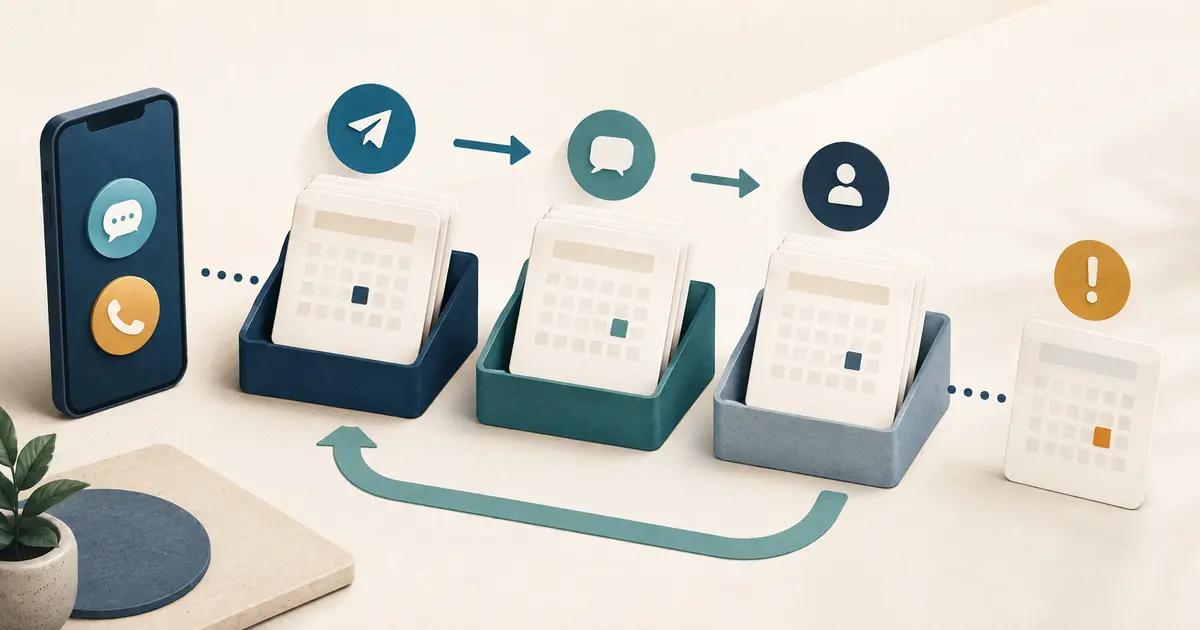
Use common definitions for captured, review required, callback assigned, contact attempted, connected, appointment request reviewed, confirmed, escalated, resolved, and closed with reason.
Allow location-specific queues and due rules within those definitions. A central team may normalize data, but the local office must know who owns the patient relationship and schedule decision.
Missed Calls Dental can capture requests from eligible forwarded missed calls for front-desk follow-up. It does not book appointments, so the central workflow should record a request state until authorized location staff confirm.
Define central and local roles
Create a responsibility matrix:
| Activity | Central owner | Location owner |
|---|---|---|
| Event and metric definitions | Approve standard | Apply and report exceptions |
| Phone routing pattern | Set supported architecture | Verify local carrier behavior |
| Office facts schema | Govern fields and approvals | Maintain current values |
| Request capture | Provide platform and rules | Review patient-specific context |
| Scheduling and clinical decisions | Define boundaries | Perform authorized decision |
| Access and security | Set baseline controls | Approve local users and remove access |
| Quality review | Compare locations fairly | Correct local workflow |
Avoid dual ownership. One person or role should be accountable for each open request.
Protect privacy across locations
Do not give every user access to every location by default. Apply least privilege based on role, location, and task. Test cross-location searching, shared patients, float staff, central support, exports, and user termination.
HHS's minimum-necessary guidance supports limiting protected information and access to the defined purpose. Map phone, answering, messaging, analytics, support, and integration vendors and determine business associate roles from the actual relationships.
Use individual accounts, strong authentication, logs, retention, incident response, and a clear way to investigate a wrong-location disclosure.
Build exception categories
Shared categories might include wrong location, no location selected, stale office fact, no callback number, duplicate, failed route, urgent escalation, language or accessibility need, after-hours ownership, staff absence, privacy concern, and unresolved scheduling request.
Allow a local note, but keep categories stable for comparison. Avoid a free-text-only system that prevents the central team from seeing patterns.
Every exception needs state, owner, due rule, and resolution. Central visibility does not replace local action.
Design overnight and weekend ownership
Document which team monitors captured requests by time zone and day. Set a handoff from central or backup coverage to each opening location. Define how urgent escalations follow the dentist-approved local process.
Reconcile requests at opening, midday, and closing. A record should not be lost because it arrived after the location's last queue review or during a time-zone boundary.
The weekend and holiday answering guide provides a detailed cadence.
Test multi-location failures
Run fictional or approved scenarios for the wrong called number, shared marketing line, caller changing location, provider at two locations, one office closed, one carrier unavailable, duplicate request in two locations, central platform outage, and local staff unable to access the queue.
Test emergency escalation, identity match across locations, and a call transferred to an unavailable office. Preserve the original route and final owner.
Report comparable metrics
Track offered calls, eligible missed calls, captured requests, complete records, callback attempts, connections, verified outcomes, failed routes, duplicates, wrong locations, and unresolved aging.
Use the same definitions and reporting windows. Show location hours, call mix, and routing differences so leaders do not rank offices unfairly. Avoid converting every call into a lead or assigning revenue without defensible attribution.
The dental call attribution guide can help connect marketing source to later outcomes without causal overstatement.
Review standards and local exceptions
Hold a central review for definitions, security, vendors, and systemic defects. Hold local reviews for queue ownership, stale facts, staffing, and specific exceptions. Assign changes with owners and retest.
Document how to disable a route, export pending work, operate manually, restore service, and reconcile after recovery. Keep local contact lists available outside the failed platform.
Good DSO patient communication combines one language for states and metrics with clear local authority. That balance makes missed calls visible without making the central team responsible for decisions only the practice can make.
Establish an inter-location handoff agreement
Document when one location or central team may accept work for another, what information it may view, which script it uses, how the receiving location acknowledges ownership, and what happens when acknowledgement fails. Include time zones, weekends, holidays, and local emergency paths.
Use a handoff identifier that follows the request across routes. Preserve original called number, intended location, answering location, responsible location, contact attempts, corrections, and final outcome. This prevents a central answer from erasing local accountability.
Audit wrong-location and shared-patient cases. Confirm that users did not access more information than necessary and that the caller received the correct practice identity. Correct directory, routing, permission, and knowledge problems at their source.
Set a dispute rule for requests that two locations believe the other owns. One central escalation role should assign temporary responsibility so the caller does not wait while the organization debates ownership. Record the final assignment and update the rule when the pattern repeats.
Review the agreement after acquisitions, closures, number changes, provider moves, and vendor changes. The routing map and access model should change together; otherwise, calls may reach staff who can answer but cannot safely act.