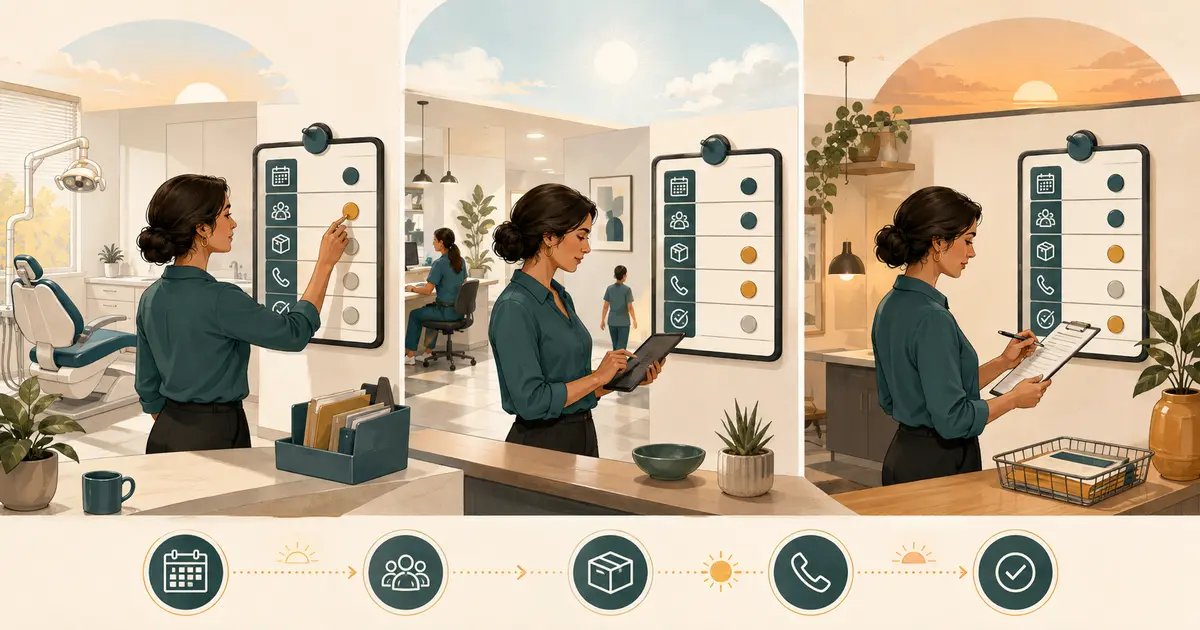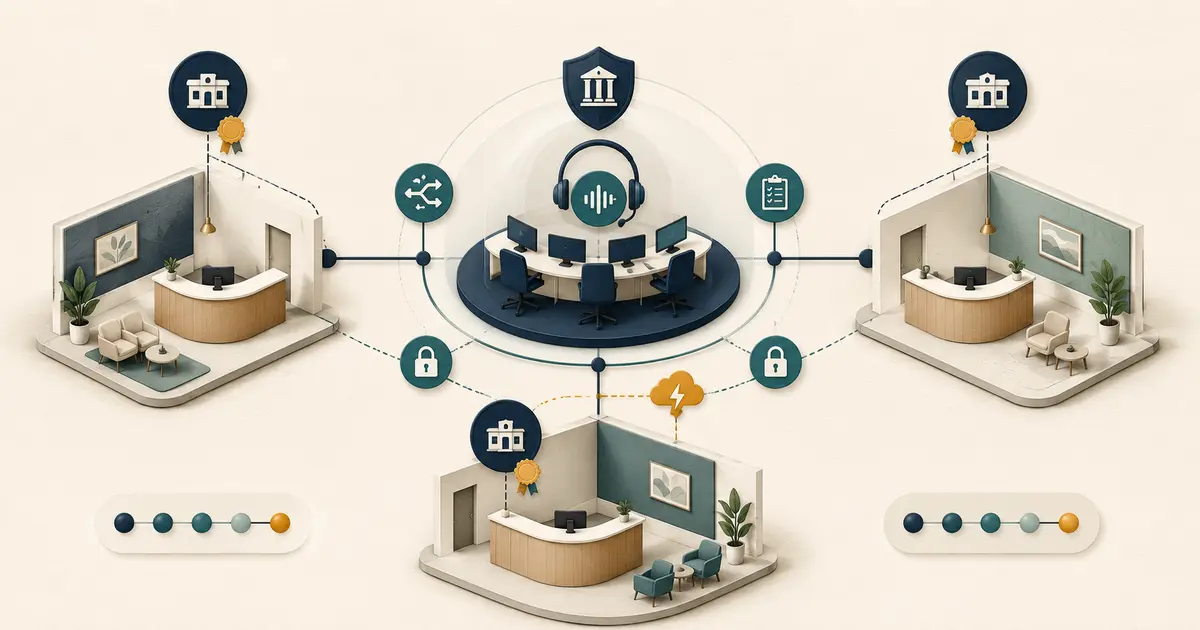
Multi-practice dental call coverage works when the organization standardizes states and controls while preserving location-specific facts, schedule authority, clinician escalation, and ownership. Centralization should make responsibility clearer, not create a large anonymous queue.
Choose the operating model
Common models include:
- each practice answers its own calls;
- shared overflow among practices;
- regional or centralized receptionist team;
- external answering service;
- AI support for a narrow call type;
- hybrid coverage by time and location.
Document which calls enter each model, during which hours, and who owns the handoff. Do not describe a hybrid process as a single centralized system if staff still maintain separate queues.
The multi-location answering-service guide compares routing and ownership at the location level.
Standardize states before scripts
Use shared definitions for new, assigned, waiting, attempted, reached, escalated, confirmed, failed, and closed. Then let scripts reflect local facts.
Without shared states, one practice may call a message “complete” when it was sent to voicemail while another requires successful contact. Reports become incomparable.
Maintain a location registry
For every practice, govern:
- official name and public number;
- address and time zone;
- posted hours and closures;
- services approved for public description;
- providers and general referral process;
- languages and accessibility options;
- payment and benefit wording;
- schedule authority;
- urgent-call instructions;
- primary and backup owners;
- effective date and approver.
Do not let a central agent guess which policy applies. Show uncertainty and route to an owner.
Define routing evidence
Caller ID, dialed number, campaign number, menu choice, patient statement, and record lookup may point to different locations. Establish a priority and uncertainty rule.
Test:
- caller dials one practice but names another;
- shared family uses multiple locations;
- provider works across sites;
- after-hours rules differ;
- one location is closed temporarily;
- call transfers between regions;
- destination does not answer;
- centralized platform is unavailable.
The record should show how the final route was chosen.
Preserve local clinical and schedule authority
Central staff may capture an appointment or clinical request, but the local practice or authorized centralized team must complete the actual action under a documented model.
Do not let a shared call center promise an appointment, benefit, treatment, or urgent response across locations without verified authority. Clinical decisions remain with qualified clinicians.
The standardized front desk calls guide explains how shared scripts can retain local exceptions.
Govern access and vendors
Use role-based access by region, location, function, and sensitivity. Review whether centralized employees can see only the records they need. Apply individual accounts, multifactor authentication, logs, periodic reviews, and prompt removal.
Map telephony, PMS environments, messaging, answering vendors, AI, analytics, recordings, support, and subcontractors. Determine HIPAA roles and contracts with qualified advisers.
NIST Cybersecurity Framework 2.0 emphasizes governance and supply-chain risk alongside protection, detection, response, and recovery.
Plan outages and failover
Identify single points of failure: central number, internet connection, carrier, identity provider, VPN, shared queue, integration, and notification service.
For each, define detection, alternate route, local fallback, public wording, manual queue, recovery owner, and reconciliation. Test failover without using broad uncontrolled call forwarding.
The phone outage plan provides a drill for individual practices that can be extended across the group.
Measure consistently
Use common definitions for offered, answered, missed, captured, assigned, overdue, reached, escalated, and closed. Report raw counts and rates by location. Note different hours, campaign mix, closures, and service scope.
Do not rank practices from data with different definitions or incomplete integrations. Review call samples and workflow outcomes before making staffing conclusions.
Establish governance meetings
A monthly call-coverage review should include:
- location owners;
- central operations;
- privacy and security;
- IT or telephony;
- clinical leadership for escalation rules;
- vendor management;
- training owner.
Review incidents, failed handoffs, outdated facts, access changes, configuration releases, complaints, unresolved queues, and planned tests. Assign decisions and due dates.
Keep Missed Calls Dental accurate
Missed Calls Dental can support eligible forwarded missed calls and capture caller requests for staff follow-up. It does not provide a centralized PMS, book across locations, verify benefits, diagnose, or triage. Each practice or group must configure forwarding, maintain approved facts, receive requests, and complete follow-up.
Good governance creates a common language for calls while keeping the right decisions close to the practice and clinician who own them.
Create a responsibility matrix
List major call types down the rows and central team, local front desk, manager, clinician, IT, privacy, and vendor across the columns. Mark who receives, acts, approves, supports, and audits each type. Include failures such as wrong-location routing, unavailable schedule, protected disclosure concern, and failed clinician acknowledgment.
The matrix should show one final accountable owner for every state. Several teams may contribute, but “shared” cannot be the answer to who closes the request. Review the matrix when a practice joins, leaves, changes hours, or changes systems.
Maintain configuration evidence by location. Store current ring groups, forwarding destinations, voicemail routes, notification channels, and rollback instructions. A central administrator should not push a group-wide change without a representative pilot and location sign-off.
Use a location-readiness gate before moving calls to central coverage: facts approved, staff roles active, schedule authority defined, clinician contacts tested, privacy access reviewed, outage path working, and reconciliation owner trained. A newly acquired or franchised office may use different terminology and policies; map them before standardizing.
Quarterly, run a cross-location failure drill. Disable a destination in a controlled test, confirm failover, verify that the central queue identifies the affected practice, and reconcile the resulting fictional requests. Inspect whether local staff receive enough context to act.
Report governance health alongside call metrics: outdated facts, overdue access reviews, failed tests, unresolved configuration exceptions, and locations without backups. These measures reveal whether the network can sustain coverage before caller outcomes deteriorate.
Centralization is useful when it reduces ambiguity. If local employees maintain separate shadow instructions because the shared system cannot represent an exception, fix the registry and authority model rather than forcing the office to hide the difference.
Approve a change-release process
Classify changes as local, regional, or group-wide. Every request should name the affected locations, systems, call types, owner, approver, effective time, test plan, communication plan, and rollback. Group-wide routing should begin with a representative pilot rather than an immediate universal push.
Require each location to confirm its facts and receiving owner before release. After the change, use external fictional calls to test the intended branches, including busy, no answer, closed hours, transfer failure, and outage fallback. Preserve the call and notification evidence.
Monitor the first day for wrong-location routes, missing permissions, unowned requests, and unexpected effects on local voicemail or caller ID. Pause or roll back when the receiving teams cannot reconcile the work.
At the governance meeting, close the release only after local owners confirm the final state. Retire superseded diagrams and instructions across central and local repositories. Controlled release keeps standardization from becoming a single large failure domain.
Pair each release with a named rollback owner. If a route or script fails, the group should know which prior version to restore and how every affected location will be notified.