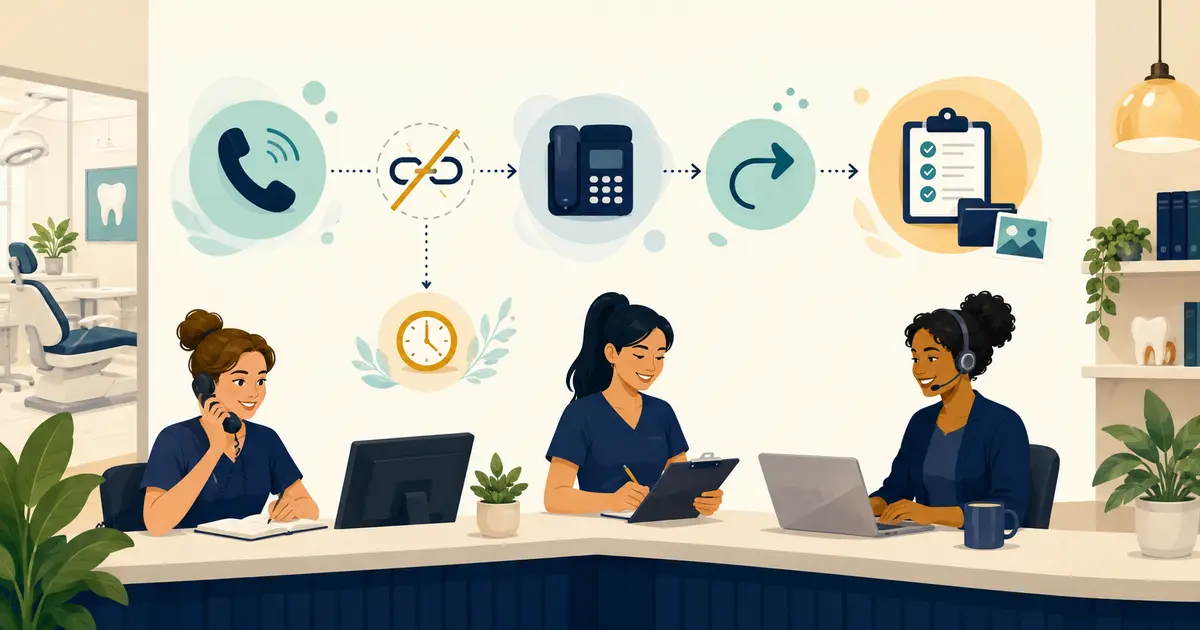
To standardize dental front desk calls across locations, use one shared conversation framework, one controlled script library, and one quality-review method. Keep local hours, addresses, schedule authority, insurance language, transfer paths, and escalation owners in separate location profiles rather than forcing every office to use identical answers.
The goal is consistent expectations, not identical personalities. A patient should hear the same level of clarity and care at every location while still receiving accurate information for the office they intend to contact.
Standardize the stages of the call
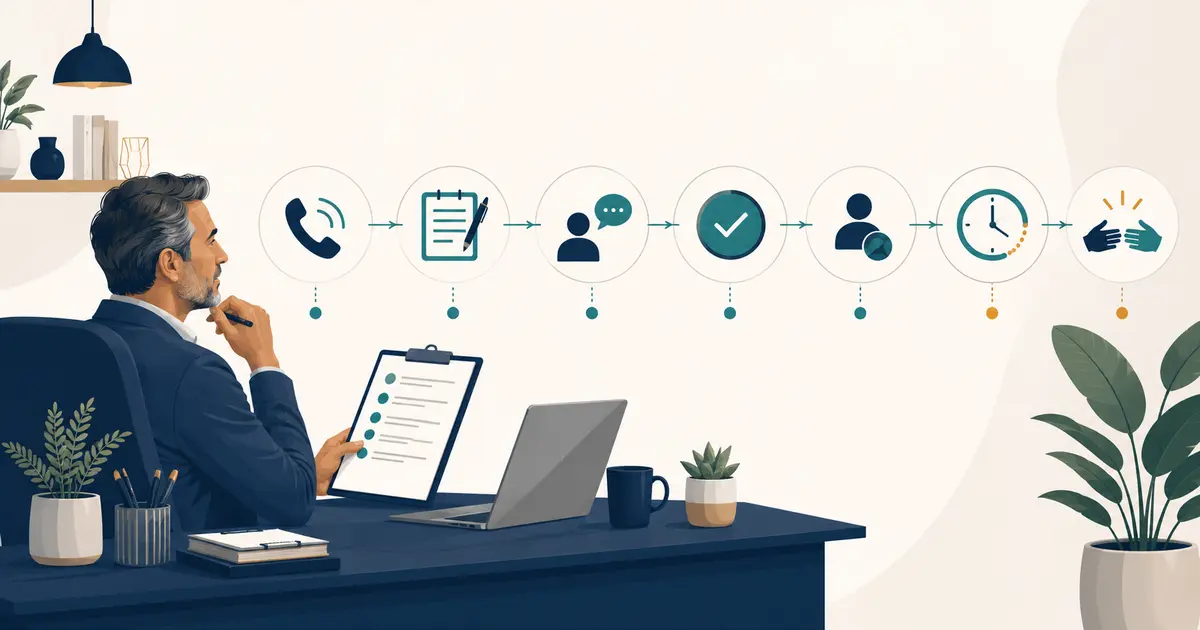
Start with a short framework that applies to most front-desk conversations:
- Identify: name the practice, location, and employee.
- Clarify: ask what the caller wants help with.
- Verify: confirm the patient, callback number, intended location, and relevant appointment details under office policy.
- Respond or route: provide approved information or move the request to the authorized role.
- Confirm: repeat what is complete and what remains pending.
- Close: state one next step, owner, and realistic response window.
- Document: record the outcome in the correct location's work process.
The American Dental Association recommends a standard greeting, scripts for frequent phone topics, and role-playing common scenarios. Its guidance also emphasizes inviting callers to share why they called. Review the ADA guidance on prospective-patient phone calls as a baseline, then adapt it to the practice's real locations and authority rules.
A shared framework makes coaching easier. Managers can review whether the employee clarified the request and closed with a next step without grading a natural conversation against a word-for-word performance.
Separate the shared standard from local facts
Use two layers.
Layer 1: organization-wide call standard
This should define:
- greeting structure;
- tone and plain-language rules;
- identity-verification process by request type;
- minimum request fields;
- appointment-language boundaries;
- insurance and price boundaries;
- clinical-question handoff;
- complaint handling;
- hold and transfer etiquette;
- pending versus completed wording;
- voicemail and callback standards;
- documentation and ownership fields;
- quality-review method.
Layer 2: location profile
Each office should maintain current:
- location name and address;
- main and callback numbers;
- office and holiday hours;
- services actually offered there;
- dentist and clinical coverage information approved for callers;
- new-patient status and approved wording;
- scheduling authority and local schedule access;
- benefit-plan and financial contact roles;
- language support;
- transfer destinations;
- clinical and manager escalation owners;
- outage and after-hours fallback;
- effective date and profile owner.
Do not paste local facts into five separate script documents. Keep the shared conversation language central and attach the correct location profile. When hours change, the manager should update one owned fact rather than search every script for an old closing time.
Use a location-aware greeting
A caller should know which office answered, especially when numbers route to a shared team.
For a direct location line:
“Green Valley Dental, North Office—Jordan speaking. What can our team help you with?”
For a centralized team that receives several location numbers:
“Thank you for calling Green Valley Dental. This is Jordan. Are you calling about our North, Downtown, or West office?”
If the phone system already identifies the intended location reliably, do not make the caller repeat it without reason. Confirm it naturally before providing local information or changing an appointment.
Avoid a generic “Dental office, please hold” opening. It hides the location, gives no employee identity, and starts the relationship with an unexplained delay.
Build an authority matrix by request type
Standardization fails when an employee at one office can complete a task that another office must route, but both use the same confirmation language.
Create a matrix:
| Request | Shared wording | Local authority to define | Required handoff when not authorized |
|---|---|---|---|
| New-patient inquiry | Clarify visit request and intended location | Who can view openings and confirm appointments | Scheduling owner for that location |
| Cancel or reschedule | Confirm current appointment and desired change | Who can edit each schedule | Pending request with owner and response window |
| Insurance question | Explain only approved general information | Who verifies and discusses individual benefits | Benefits role for the correct office |
| Price question | Use current approved fee language | Who may provide estimates or discuss balances | Financial coordinator or manager |
| Clinical question | Do not diagnose or provide non-authorized triage | Which clinical role receives the message | Location-specific clinical path |
| Complaint | Listen and document facts | Who investigates and responds | Office manager or designated owner |
| Records request | Explain the approved request process | Who verifies, processes, and releases records | Records owner under office policy |
| Wrong location | Confirm the intended office | Who may transfer or reassign the request | Named receiving role and acknowledgment |
Use “Your request is pending” whenever the employee cannot complete the task. Do not let centralized staff say an appointment changed, a benefit is confirmed, a refund is approved, or a clinical decision was made when only a message was sent.
The multi-location answering-service guide covers number mapping, call routing, request ownership, and fallback. Keep this article's focus on what staff say and how the organization maintains consistent conversation quality after the call reaches a person or service.
Standardize high-risk phrases
Most of a call can remain natural. Require exact or tightly controlled language only where inconsistency creates a meaningful risk.
Appointment request not yet confirmed
“I have recorded your request for [location and timing]. The appointment is not scheduled or changed yet. [Role] will review the actual schedule and contact you at [confirmed number] by [approved window].”
Individual insurance question
“I can share the North office's approved plan information. Your specific coverage and estimated responsibility still need the office's verification process, so I will route that request to [authorized role].”
Clinical question
“That concern needs the clinical team's judgment. I will pass your message to the right person at [location]; first, what number should they use to reach you?”
Information is unknown
“I want to give you accurate information for the [location] office. I do not have an approved answer to that question, so I will ask [role] to review it.”
Complaint
“I understand you want the office to review what happened. I will document the facts you share and send them to [manager role]. I cannot decide the outcome on this call.”
Exact phrases should protect a boundary, not make the whole conversation sound mechanical.
Define the minimum information for every handoff
Every location should create the same usable request structure:
- caller or patient name when available;
- confirmed callback number;
- intended location;
- new or existing patient status when relevant;
- general reason for contact in the caller's words;
- appointment date and time when the request concerns an existing appointment;
- timing preference;
- information already provided;
- expectation given to the caller;
- assigned owner;
- next action and due point.
Do not use an open text box as the entire standard. It produces “please call patient” at one office and an unnecessary clinical narrative at another.
HHS explains that the HIPAA minimum-necessary framework generally calls for reasonable efforts to limit uses, disclosures, and requests for protected information to the purpose at hand, with important exceptions such as treatment disclosures. It also emphasizes policies based on workforce roles. Review the HHS minimum-necessary guidance with qualified advisors when defining access and message content.
Control script versions
One shared standard requires one source of truth.
For every script or call rule, record:
- title and request type;
- approved wording;
- location exceptions;
- owner;
- approved date;
- effective date;
- last review date;
- replacement version;
- linked policy or fact source.
Remove outdated printed copies. Do not let one manager update a shared script in email while another trains from a document saved six months earlier.
Use a change process:
- Identify the reason for the change.
- Confirm whether it is organization-wide or local.
- Obtain the required clinical, legal, financial, or owner review.
- Update the controlled source.
- State the effective date.
- Train affected roles.
- Test the change with scenarios.
- Retire the old version.
A temporary holiday route or dentist absence should have an automatic end date or an assigned restoration owner.
Train with scenarios, not a reading assignment
Use the same role-play set at every location, then add local exceptions.
Core scenarios should include:
- new patient asking for a specific appointment;
- existing patient requesting a cancellation or reschedule;
- caller asking what insurance will pay;
- caller asking for a final price;
- patient with a clinical question;
- complaint about an earlier visit;
- records request;
- caller reaches the wrong location;
- requested employee is unavailable;
- schedule or phone system is down;
- two calls arrive close together;
- after-hours request appears at opening.
For each scenario, score:
- Was the correct location established?
- Did the employee clarify the request?
- Was identity verification appropriate to the request?
- Did the employee stay within authority?
- Were local facts accurate?
- Was the pending or completed status clear?
- Did the handoff contain the minimum useful information?
- Was an owner assigned?
Coach one behavior at a time. “Be friendlier” is vague. “State the location before asking the caller to hold” is teachable and testable.
Use a small quality-review rubric
Do not measure call quality only by duration or answer count. A short call can create an inaccurate promise, and a long call can still end without an owner.
A practical rubric can score five areas:
| Area | Passing behavior |
|---|---|
| Opening | Practice, location, and employee are clear |
| Accuracy | Approved current facts are used; unknowns are not guessed |
| Authority | No unauthorized scheduling, insurance, financial, or clinical decision |
| Handoff | Request includes location, callback number, reason, owner, and next step |
| Closing | Caller understands what is complete, pending, and expected next |
Review a small, consistent sample across locations. Use live observation, role-play, request records, and caller feedback according to the practice's policy and applicable law. Do not secretly expand recording or monitoring merely to make QA easier.
Compare locations by failure type, not as a public ranking of employees. Look for stale facts, missing access, unclear ownership, inadequate training, or a script that does not fit the workflow.
Keep access aligned with role and location
Shared coverage does not require every employee to see every record.
Define:
- which locations each role supports;
- which information that role needs;
- read versus update permissions;
- who can change schedules;
- who can view financial information;
- who can access clinical messages;
- who can export data;
- who administers users;
- how access changes when responsibilities change;
- how access ends when employment or a vendor relationship ends.
The HHS audit protocol includes review of whether workforce access matches job functions and whether access to electronic protected information is terminated when employment or another workforce arrangement ends. See the HHS HIPAA audit protocol as a compliance reference, then apply the practice's approved access policy.
Use named accounts rather than shared passwords. Centralized managers need visibility into work status, not unrestricted access by default.
Handle cross-location transfers as owned work
When a caller reaches the wrong office, do not send them into another blind transfer.
Use a warm-transfer sequence when practical:
“You reached our North office, and your request belongs with Downtown. I can try to connect you. If the team is unavailable, may I confirm your callback number so I can send an owned request instead of asking you to start over?”
If the transfer fails:
“The Downtown team did not answer. I have sent your request to [role] with your confirmed number. Your appointment or account has not been changed. They will contact you by [approved window].”
The sending location keeps temporary ownership until the receiving role acknowledges the request. Otherwise “transferred to Downtown” may mean no one received it.
Review consistency after changes
Re-run the shared scenarios when the practice changes:
- office hours;
- services by location;
- provider schedules;
- benefit-plan participation language;
- fees or financial policies;
- phone routing;
- scheduling authority;
- request software;
- a manager or clinical escalation owner;
- a location opening, closure, or merger.
Track a short set of operational signals:
- wrong-location requests;
- transfers that fail;
- requests missing an owner;
- inaccurate appointment expectations;
- stale office facts used;
- duplicate requests;
- unassigned queue age;
- repeat caller contacts caused by unclear follow-up;
- coaching themes by scenario.
Use those failures to improve the standard. Do not add more script text when the real problem is missing system access or no assigned owner.
Multi-location call-standard checklist
Before rollout, confirm:
- [ ] one shared call framework is approved;
- [ ] every location has a current owned fact profile;
- [ ] greetings identify the correct office;
- [ ] authority is defined by request type and location;
- [ ] exact wording is limited to important boundaries;
- [ ] every handoff uses the same minimum useful fields;
- [ ] scripts have owners, dates, and version control;
- [ ] outdated copies are retired;
- [ ] all locations complete the same core role-play scenarios;
- [ ] quality review scores clarity, accuracy, authority, handoff, and closing;
- [ ] access matches role and location;
- [ ] wrong-location transfers retain ownership until acknowledgment;
- [ ] temporary exceptions have an end date or restoration owner;
- [ ] operational failures lead to specific workflow changes.
Effective DSO call management does not require every employee to say the same sentence. It requires every location to identify itself, use the same decision boundaries, rely on current local facts, produce the same usable handoff, and give the caller one accurate next step.