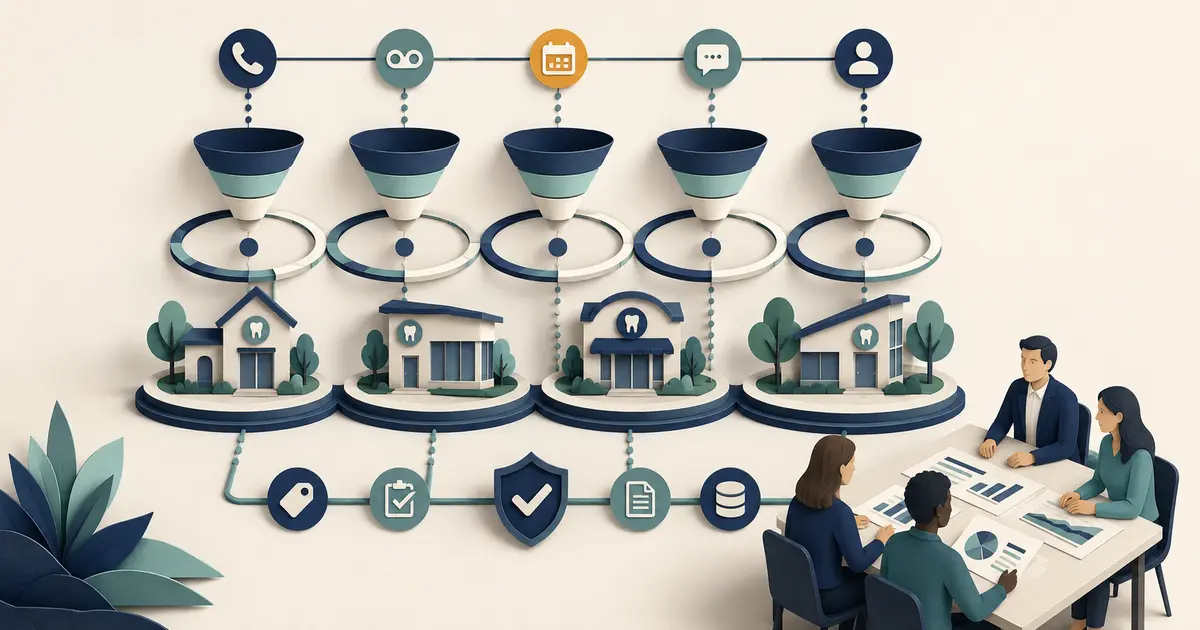
Dental call disposition codes should tell the practice what happened next, not what an employee hoped would happen. A code such as “good lead” mixes opinion, eligibility, and outcome. A useful taxonomy is small, mutually exclusive at each stage, and correctable when later evidence arrives.
Start with the operating decisions the practice needs to make. Then design codes that support those decisions.
Separate four different questions
One field cannot reliably describe the entire call. Keep these dimensions separate:
- Connection: Was there a conversation, voicemail, abandonment, or technical failure?
- Request type: New-patient inquiry, existing-patient administration, billing, records, vendor, or other.
- Handoff state: Resolved on call, assigned for follow-up, transferred, or awaiting authorized review.
- Final outcome: Completed administrative request, declined, unreachable after policy, duplicate, wrong number, or unknown.
This structure prevents “answered” from being mistaken for “resolved.” The call analytics dashboard guide can display the dimensions without collapsing them into one success rate.
Build a concise final-outcome list
Use labels that two trained reviewers would apply the same way.
| Code | Use when | Do not use when |
|---|---|---|
| Completed | The office-confirmed administrative next step is done | A message was merely sent |
| Follow-up open | A named owner and due time exist | No one owns the request |
| Caller declined | The caller explicitly chose not to proceed | Staff did not reach the caller |
| Unreachable | The approved attempt policy ended without contact | Another attempt remains due |
| Duplicate | The same request already has an authoritative record | Two different callers share a number |
| Wrong or non-patient call | The call is unrelated to patient service | The request type is simply unknown |
| Technical failure | The call path prevented a usable interaction | Staff forgot to complete the record |
| Unknown | Evidence is insufficient | A more flattering code is preferred |
Unknown is a valid quality signal. Hiding it distributes bad assumptions into every later metric.
Define correction and closure rules
Store the original event, current disposition, person making the change, timestamp, and reason. A later office outcome may replace “follow-up open,” but it should not erase the fact that the call initially required follow-up.
Choose who can close each outcome. For example, a call handler can mark a wrong number, but an office-owned system or authorized employee may be required to confirm completion. Never let a vendor's “message delivered” event stand in for an office result.
The phone-lead follow-up guide provides aging and ownership rules. Use the call-tracking metrics guide to define denominators before reporting rates.
Test reviewer agreement
Give two reviewers the same 20 synthetic or appropriately de-identified scenarios. Have them code each independently. Compare disagreements, revise definitions, and test again.
Pay special attention to:
- transfers that ring but are not answered;
- voicemail followed by a later callback;
- duplicate records from one caller;
- calls that contain several request types;
- abandoned calls without a usable number;
- inquiries that cannot be resolved because the office lacks capacity.
If reviewers need a paragraph of judgment for every record, the code set is not operational yet.
Report a funnel without inventing conversion
Show counts at each stage: eligible calls, connected conversations, qualified administrative requests, assigned follow-ups, and office-confirmed outcomes. State exclusions and keep unknowns visible.
Google Ads call reporting can provide call details for supported configurations, but the practice still needs its own outcome definition. Compare campaign and non-campaign calls only when their eligibility rules match.
Review the taxonomy quarterly and after a workflow or vendor change. Add a code only when it supports a recurring decision and cannot be represented by an existing dimension.
Missed Calls Dental boundary
Missed Calls Dental can support approved request capture and handoff records. The practice owns eligibility, final dispositions, system-of-record outcomes, appointment decisions, and performance claims. SMS is separate and readiness-gated.
Maya Patel is an editorial pen name. This article was reviewed for accuracy and alignment with Missed Calls Dental product information.