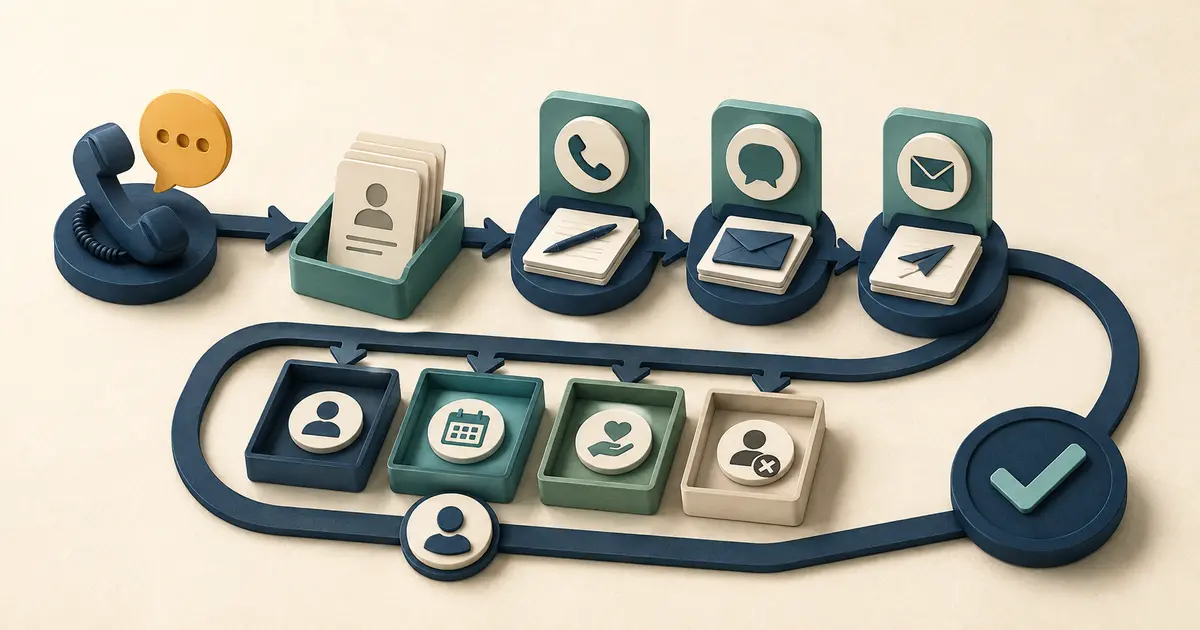
Dental phone lead follow-up should turn an eligible caller request into an owned, respectful sequence with a visible outcome. Define who enters the queue, what staff may say, which channel is approved, how attempts are recorded, and what closes the item.
Do not use “lead” to erase the fact that the caller may already be a patient or may be sharing sensitive information.
Define the eligible queue
Write inclusion and exclusion rules. A queue might include prospective callers who asked about becoming a patient and provided a callback number. It might exclude vendors, wrong numbers, spam, existing patients, recruiting calls, and people who declined contact.
Preserve uncertain records for review. Do not guess that every missed number is a new patient.
The new-versus-existing patient communication guide helps front desk teams separate the paths.
Capture the original request
Store:
- received time and source;
- caller name as provided;
- validated callback number;
- general request in the caller's words;
- preferred contact method;
- location or timing preference when useful;
- language or accessibility request;
- consent or communication preference as applicable;
- current state;
- owner and due rule.
Keep the original wording separate from any summary. Do not add a diagnosis, treatment recommendation, or assumed reason for not scheduling.
Use clear states
Recommended states include:
- new;
- assigned;
- first attempt;
- additional approved attempt;
- reached;
- information provided;
- appointment request captured;
- appointment confirmed by authorized staff;
- waiting on caller;
- not eligible under defined rule;
- declined;
- wrong number;
- opted out;
- closed;
- unresolved.
An attempt is not a conversation, and a conversation is not a booked appointment.
Set a response standard from capacity
There is no universal response-time benchmark for every dental practice. Define a standard the team can monitor across open, lunch, closed, weekend, and holiday periods. Name the clock start, monitored hours, owner, backup, and escalation.
If the queue repeatedly exceeds capacity, adjust staffing, routing, campaign volume, or the promise. Do not publish “instant response” when the operating model cannot support it.
The dental office callback time guide shows how to set and measure a local standard.
Use approved contact attempts
A callback can say:
“Hello, this is Alex from Harbor Dental returning your call. Is now a good time to talk?”
If voicemail is permitted:
“This is Harbor Dental returning your call. Please call us at 555-0100 during our posted hours.”
Limit details. HHS advises reasonable safeguards and limited disclosure in patient messages.
For text, use the practice's approved consent and opt-out process. A missed call should not become permission for unrelated promotional outreach.
Answer without overpromising
Staff can provide verified office information and explain the actual request process. They should not:
- promise availability before checking;
- guarantee benefits or final cost;
- diagnose or recommend treatment;
- pressure the caller;
- claim a limited offer that is not real;
- disparage another practice;
- mark a request confirmed before the schedule is updated.
The new-patient phone call checklist provides a practical conversation flow.
Coordinate across channels
One caller may phone, text, submit a form, and leave voicemail. Use a shared identifier and merge events under approved identity rules. Preserve the source history and do not send competing messages from multiple employees.
At shift change, review new items, open conversations, promises, pending schedule reviews, failed contacts, and replies without owners.
Close the loop
Define what closes each outcome. Examples:
- appointment confirmed in the authoritative schedule;
- caller declined and no further contact is authorized;
- wrong number suppressed;
- request transferred and accepted by the correct team;
- attempts completed under policy;
- caller asked to stop;
- unresolved item escalated to a manager.
Do not delete unresolved records to improve the report.
Measure the funnel honestly
Track eligible callers, assigned requests, attempts, reached callers, appointment requests, confirmed appointments, wrong numbers, opt-outs, unresolved items, and staff corrections. Show raw counts with rates.
The dental call conversion rate guide explains cohort and denominator choices. Avoid calling every confirmed appointment incremental revenue.
Keep Missed Calls Dental accurate
Missed Calls Dental can answer eligible forwarded missed calls and capture requests for front desk follow-up. It does not decide whether a caller is a lead, contact patients outbound, book appointments, verify benefits, or provide clinical guidance. The front desk owns follow-up and the final outcome.
A reliable follow-up process is helpful rather than aggressive. It respects the caller's channel and choices, communicates accurate states, and makes unfinished work visible to the team.
Create a follow-up playbook by outcome
For each outcome, define the next action and stop condition. A reached caller who asks for scheduling goes to the schedule-request workflow. A benefit question goes to the approved benefits owner. A clinical message goes to clinician-approved escalation. A wrong number is suppressed and reviewed. A caller who declines or asks to stop exits according to policy.
Avoid a fixed sequence that ignores the last interaction. If the caller said they will contact the practice later, repeated automated attempts may be inappropriate. If staff promised a callback after checking information, the item needs an internal owner rather than another generic outreach message.
Review channel coordination. Phone, text, email, forms, and voicemail should write to a shared state or reconcile at defined intervals. Staff should see the most recent contact before acting. Use one timeline so a patient does not receive a “we missed you” text after completing a phone conversation.
Set quality checks for the first attempt, final attempt, and every escalated item. Confirm identity handling, limited voicemail detail, accurate office facts, request state, no unsupported promises, and a recorded outcome. Sample unresolved records as carefully as successful ones.
Use the queue to improve upstream processes. Repeated missing callback numbers suggest an intake problem. Many wrong-location requests may reveal confusing listings. A large after-hours backlog may require routing or staffing changes. Do not respond only by increasing the number of attempts.
At the monthly review, retire stale scripts, verify owners and backups, test opt-out and wrong-number handling, and close aged items under an approved rule. Publish the queue definition and measurement card so future employees know exactly what is being counted.
Set a campaign-capacity gate
Before increasing ads or outreach, compare the expected new call volume with open-hours and after-hours follow-up capacity. Name the employees who own the resulting queue and the point at which marketing pauses or coverage expands.
Review the oldest open items daily during a campaign. If staff cannot meet the published response rule, change the promise and volume before adding automation. More captured requests do not help when they wait without an owner.
Create a weekly source review with marketing and front desk leads. Marketing explains campaign changes; front desk explains request quality, caller questions, wrong-location traffic, and capacity. Use the shared evidence to improve targeting and the call path without turning staff into salespeople.
Keep the contact sequence respectful and purpose-specific. A person who called about care should not be enrolled automatically in unrelated promotions. Preserve channel preferences, stop requests, and the final operational outcome.
Audit those stop conditions with fictional records before every campaign begins.