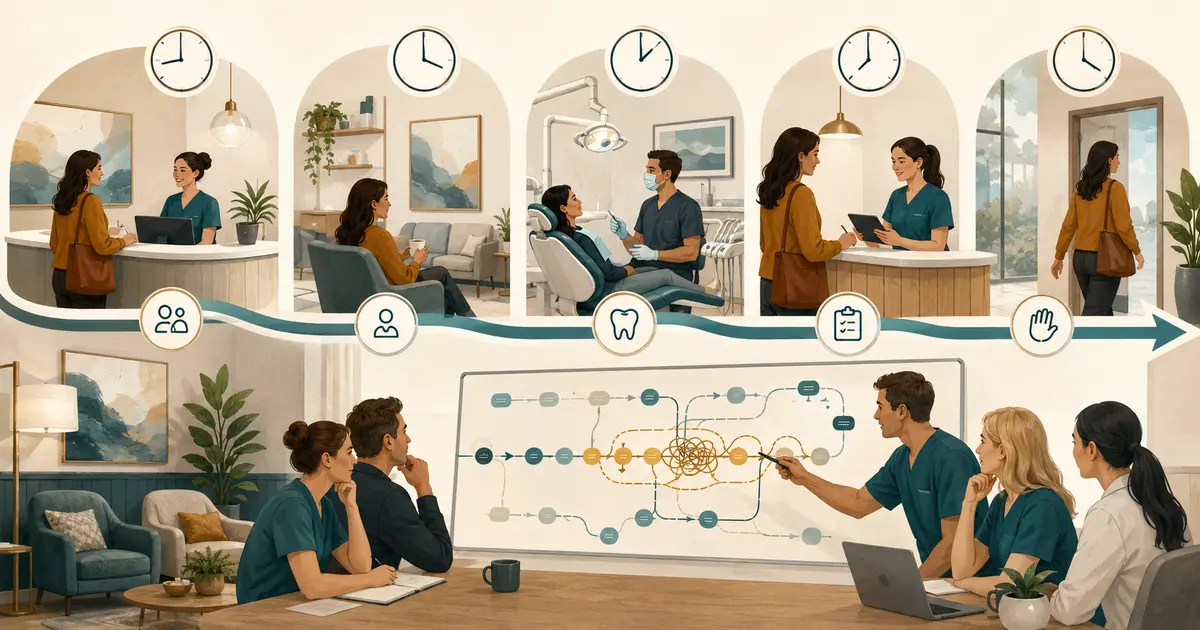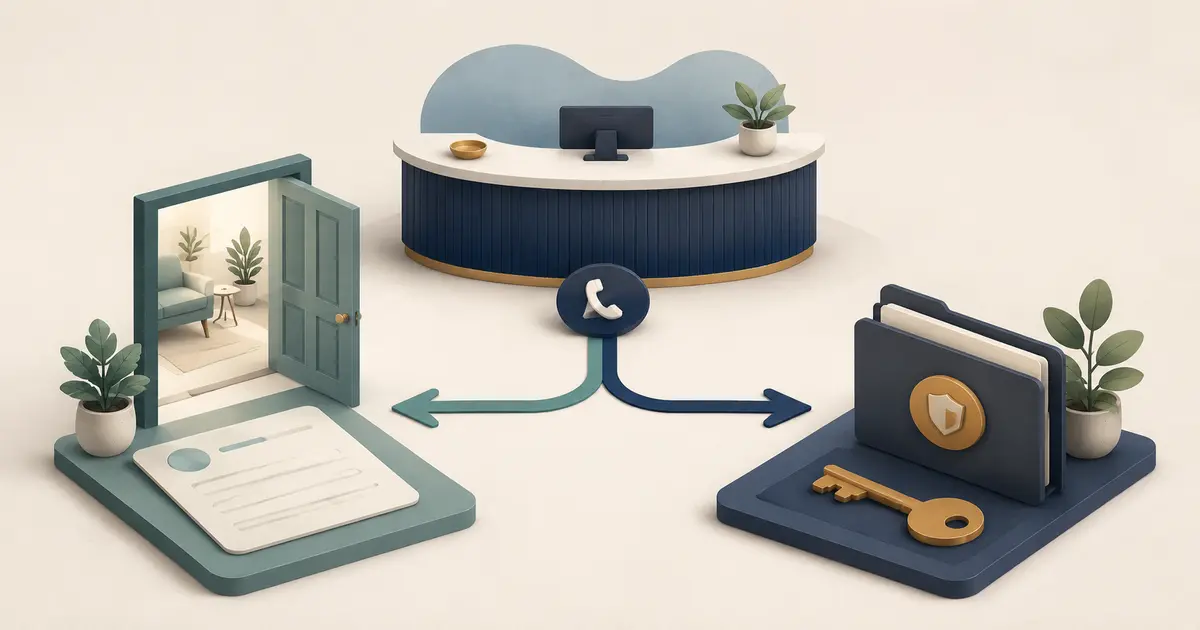
New patient communication at a dental practice starts without a verified office record, while an existing-patient call may involve protected information, a known care relationship, or an open task. The front desk should use separate workflows rather than asking both callers the same questions.
The distinction is operational, not a reason to provide different courtesy or access.
Start with a neutral greeting
Use the practice name, the employee's first name if approved, and an open question:
“Thank you for calling Harbor Dental. This is Alex. How may I help you today?”
Do not ask a caller to announce a diagnosis, procedure, balance, or insurance detail before you know why the information is needed and who can hear the call.
The live-call greeting examples provide alternatives for different office conditions.
Route a new-patient call
A new caller usually needs orientation and a request path. Capture only what the approved workflow needs:
- name as provided;
- reliable callback number;
- preferred contact method;
- general reason for calling in the caller's words;
- preferred location when applicable;
- broad timing preference when authorized;
- source of the inquiry if the practice tracks it;
- accommodation or language request;
- next-step owner.
Explain what happens next. If staff must review availability, say the request is pending. Do not call it booked or confirmed.
Use the new-patient call checklist for a fuller intake sequence.
Route an existing-patient call
An existing caller may be asking about a known appointment, a record, billing, benefits, a prior message, or care instructions. Verify identity using the practice's approved process before discussing protected details. Do not use a single weak data point merely because the name appears on caller ID.
Locate the relevant record or queue and determine its current state. Avoid creating a second request when an open item already exists. Add the caller's new information with a timestamp, source, and owner.
If the caller asks a clinical question, capture the message and follow the clinician-approved escalation path. Front desk employees and general automation should not diagnose or triage.
Use a shared state vocabulary
Both paths become clearer when the team uses the same terms:
| State | Meaning |
|---|---|
| New | Received but not reviewed |
| Assigned | An owner accepted the next step |
| Waiting on practice | Staff action is pending |
| Waiting on caller | A specific response is needed |
| Offered | An option was communicated but not accepted |
| Confirmed | The authoritative system and authorized staff completed the action |
| Escalated | An approved higher-authority path owns it |
| Closed | The final outcome and reason are recorded |
Never use “confirmed” as a synonym for “message received.”
Adjust the questions, not the respect
New callers may need the office's location, hours, accepted inquiry process, and next steps. Existing patients may need identity verification and continuity with an open record. Both need plain language, realistic expectations, and a chance to request accessible communication.
Avoid labels such as “just a lead” or “already our patient” in shared notes. Record the operational status without reducing the person to a sales category.
Handle insurance and price questions carefully
For either caller, distinguish general practice information from patient-specific benefit determinations. Staff can follow approved scripts, collect necessary plan information through the approved secure process, and explain who will verify what.
Do not say a service is covered or state a final patient amount without authoritative, current information and the practice's approved workflow. The insurance question phone script keeps that boundary explicit.
Protect privacy in callbacks and messages
HHS permits providers to communicate with patients and leave messages, while advising reasonable safeguards and limited disclosure. Follow documented patient preferences where available. With a new caller, do not assume that a shared number or voicemail is private.
A neutral callback message can say:
“This is Harbor Dental returning your call. Please call us at 555-0100 during our posted hours.”
Use fictional details in training. Never place actual patient information in a sample script or QA note.
Define the handoff record
Every request should show:
- caller type as known, not guessed;
- identity-verification state;
- request in the caller's own words;
- information already provided;
- promises avoided;
- owner and backup;
- due rule;
- next approved channel;
- final outcome.
For a new caller, the record may later be linked to a created patient record under staff controls. For an existing caller, changes should attach to the correct record without overwriting the original history.
Test edge cases
Practice these scenarios:
- a parent calling for a minor;
- an adult family member calling for another adult;
- a caller whose number matches more than one record;
- a former patient returning after several years;
- a referral with incomplete information;
- a caller requesting an interpreter or relay service;
- an urgent-sounding request requiring approved escalation;
- a caller who will not provide optional information;
- a duplicate request from text and phone;
- a request received after hours.
Employees should know when to stop, document, and transfer authority.
Keep AI and answering support within bounds
Missed Calls Dental can answer eligible forwarded missed calls and capture caller requests for front desk follow-up. It does not determine whether a caller is a patient, access the practice management system, book appointments, verify benefits, or make clinical decisions. Staff must resolve identity, record linkage, scheduling, and clinical escalation.
Good communication makes the next state obvious. The caller should know what the practice received, what remains unconfirmed, who acts next, and how to follow up if the expected response does not occur.
Build a side-by-side training card
Create one page that contrasts the two paths without turning either into a rigid interrogation. For a new caller, show the minimum intake, public information, request status, and staff handoff. For an existing caller, show identity verification, record lookup, open-task check, disclosure limit, and correct owner. Include a third “status unknown” path that captures a callback request without guessing.
Train employees to explain why a question is needed. “May I confirm the best callback number?” is clearer than collecting several identifiers without context. If a caller declines optional information, staff should know whether the request can proceed, needs another channel, or must be reviewed.
Quality review should sample both paths. Check whether employees ask new callers for excessive clinical or insurance detail, whether existing callers receive information before identity is verified, and whether appointment requests are mislabeled as confirmed. Review duplicate records created when the same person called and texted.
Update the card after changes to forms, phone systems, locations, record-matching rules, language services, or scheduling authority. Retire old copies in desks and shared drives. During role-play, include a polite caller, an impatient caller, and an uncertain caller; a workflow that works only when the conversation follows the script is not ready.
The practical outcome is consistency without sameness. Both groups receive respectful service, while the practice asks only the questions and applies only the controls that fit the caller's actual relationship and request.
Assign one manager to own the card, its revisions, and staff questions so contradictory local versions do not return.