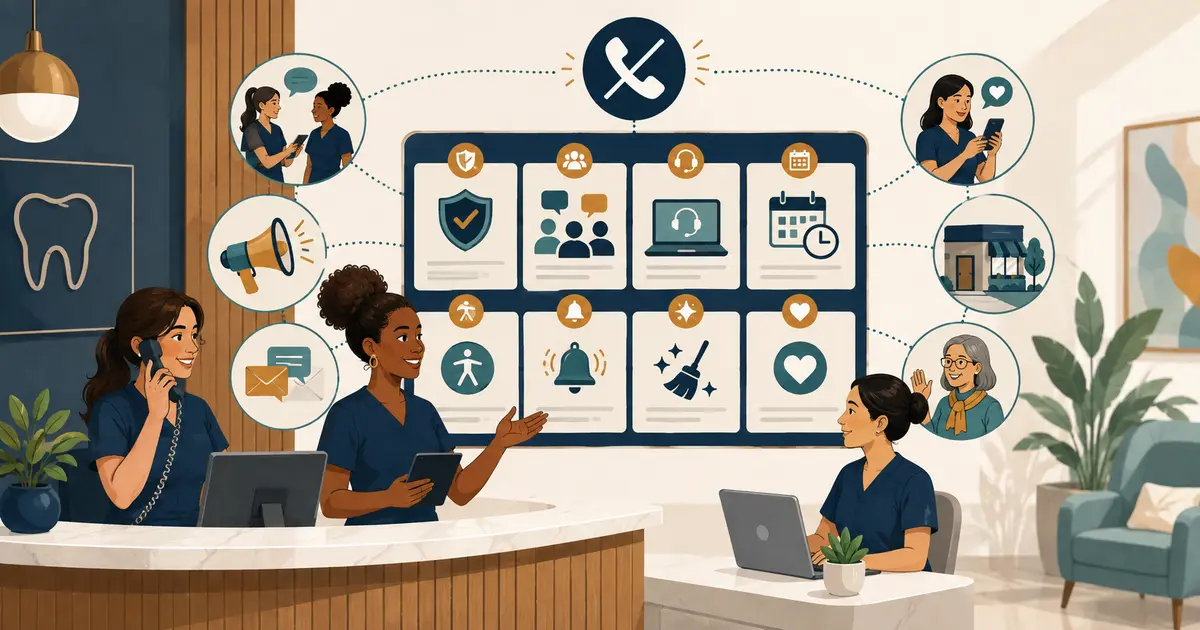
The dental new patient experience begins before anyone enters the office. A prospective patient's first search, phone call, form, reminder, parking decision, greeting, handoff, and follow-up all shape whether the practice feels organized and trustworthy. The goal is not theatrical hospitality. It is to reduce uncertainty while respecting privacy, access needs, time, and patient autonomy.
Use this checklist to design the operational journey. Clinical examination, radiographs, diagnosis, treatment recommendations, consent, and emergency advice belong to qualified clinicians and applicable professional guidance.
Copy the new patient experience checklist
First contact
- [ ] Use a consistent greeting and identify the practice and staff member.
- [ ] Ask what prompted the contact and whether an urgent concern needs clinical routing.
- [ ] Explain available appointment options without diagnosing or promising treatment.
- [ ] Capture only necessary intake information through approved channels.
- [ ] Confirm preferred and permitted contact method.
- [ ] State what will happen next and by when.
Before the visit
- [ ] Send the correct address, parking or transit information, accessibility details, and arrival instructions.
- [ ] Explain which forms or records are requested and provide a non-digital alternative.
- [ ] Distinguish requested arrival time from appointment time.
- [ ] Identify incomplete items before the day when practical.
- [ ] Route accommodation, language, anxiety, medication, or medical questions to authorized owners.
- [ ] Avoid sensitive details in unsecured reminders.
Arrival and check-in
- [ ] Greet the patient by the preferred name when identity is appropriately confirmed.
- [ ] Protect conversations from being overheard.
- [ ] Explain remaining forms and approximate next step.
- [ ] Give honest updates when the schedule is delayed.
- [ ] Offer accessible help without making assumptions.
Clinical handoff
- [ ] Tell the patient who will meet them and what the next stage generally involves.
- [ ] Transfer the patient's stated reason for the visit accurately.
- [ ] Avoid repeating sensitive information in public areas.
- [ ] Confirm that clinical questions reached a clinician.
Checkout and follow-up
- [ ] Summarize the administrative next step in plain language.
- [ ] Clearly label benefit and cost information as an estimate where applicable.
- [ ] Confirm appointments, referrals, forms, or follow-up owners.
- [ ] Give an approved channel for questions and urgent needs.
- [ ] Record promised callbacks with owner and due time.
- [ ] Send the same neutral feedback invitation to every eligible patient under the practice's rule.
Map the journey before writing scripts
Walk through the process as a patient. Create a table with five columns:
| Stage | Patient question | Practice owner | Evidence of completion | Failure path |
|---|---|---|---|---|
| First contact | “Can you help with my need?” | |||
| Scheduling | “When and where do I go?” | |||
| Preparation | “What do I need to do?” | |||
| Arrival | “Am I in the right place?” | |||
| Visit handoff | “What happens now?” | |||
| Checkout | “What is the next step?” | |||
| Follow-up | “Who owns what was promised?” |
The “failure path” matters. If a form is incomplete, who helps? If records do not arrive, who decides whether the visit changes? If the patient uses a wheelchair or needs language assistance, where is the request routed? If the office runs late, who gives an update?
The ADA says the first visit sets the tone for the relationship and recommends a warm welcome. Translate that principle into repeatable handoffs instead of relying on one naturally outgoing employee.
Improve each patient transition
Make the first phone call useful
Use a conversation guide, not a rigid sales script:
- Welcome and identify the practice and yourself.
- Ask the reason for the call in the patient's own words.
- Screen for an urgent need using the practice's approved routing questions.
- Explain appointment options and boundaries.
- Collect necessary registration and contact preferences.
- Confirm what the patient should expect next.
- Invite questions and recap the appointment.
The ADA's patient-intake guidance recommends standard greetings, consistent scripts for common scenarios, and collecting basic information such as the reason for the call, availability, contact preference, medical issues, and dental-benefit coverage. Front-desk staff should collect and route this information without interpreting symptoms or guaranteeing coverage.
Example:
“Thank you for calling [practice]. This is [name]. How can I help today?”
After listening:
“I can help with the next administrative step. I’ll ask a few questions from our intake process, then explain the appointment options available. A dentist will make clinical decisions after the appropriate evaluation.”
Reduce previsit uncertainty
Send a concise welcome message with:
- date, time, and requested arrival time;
- address and suite;
- parking, transit, and building-entry details;
- accessibility contact;
- forms and secure submission method;
- records or identification requested;
- cancellation and late-arrival policy;
- approved phone number or portal for questions;
- instructions for urgent dental needs.
Do not bury the instructions in marketing copy. Test every link on a phone. Offer a way to complete forms at the office and enough time for patients who need it. Avoid shaming someone for incomplete digital paperwork.
Review your website through the same lens. The ADA recommends clear practice information, team bios, services, financing information, and a map, along with readable, high-quality content. Keep information current and avoid promises the practice cannot consistently support.
Design a private, respectful arrival
Train staff to greet patients without loudly stating a treatment reason or insurance issue. Ask before using a nickname. Explain what needs to be completed and what the patient can expect next.
If the schedule is delayed, acknowledge it. Use dental office KPIs to measure flow and an approved update such as:
“I’m sorry for the delay. Our current estimate is [verified range]. I will update you again by [time]. If that timing no longer works, I can review the scheduling options available to me.”
Do not promise that a patient will be “seen immediately” because they are new, arrived early, or complained. Follow clinical priority and scheduling authority.
Make every handoff audible and complete
A patient should not need to retell the same story at every transition. Use a privacy-safe handoff that names the next person and restates the patient's stated goal without adding interpretation.
“Alex, this is Jordan, who will help with the next part of your visit. I’ve let Jordan know that your main question is [patient's words/general description]. Jordan will explain what happens next.”
The ADA recommends escorting the patient to the operatory and explaining generally what will happen during the appointment and why. Clinical personnel should handle medical history, screenings, radiograph decisions, examination, and treatment discussions under applicable standards.
Build clear status signals in the practice system so “ready,” “waiting,” “needs clinician,” and “checkout” mean the same thing to everyone. Use the dental office SOP template to standardize the transition.
Keep financial communication clear and bounded
New patients often want to know what insurance will pay or what treatment will cost. Front-desk staff can explain the practice's process and available information, but should not present an estimate as a guarantee.
Use language such as:
“This is an estimate based on the information currently available. The dental plan makes its own benefit determination. We can explain the practice's payment options and whom to contact with questions.”
Do not bundle a complex treatment decision into a rushed checkout. Clinical recommendations and informed consent require an appropriate conversation with the dentist. Give the patient space to ask questions and a clear contact for later follow-up.
End with a written next-step recap
Before the patient leaves, confirm:
- next scheduled appointment, if any;
- who owns a referral, record, lab, or benefits follow-up;
- what the patient is expected to do;
- how and when the practice will respond;
- whom to contact with clinical or administrative questions;
- urgent-care instructions approved by the practice.
Put promises into the work queue. “We will call” needs a named owner and due time. If the patient asks to correct demographic or record information, use how to correct dental records rather than leaving the request in a checkout note.
Measure the experience without review gating
Use dental patient retention strategies to design a short survey under a consistent eligibility rule. Ask about access, clarity, respect, waiting, and next steps. Invite feedback regardless of the staff's impression of the visit. Keep private improvement feedback separate from public-review requests.
Review patterns monthly:
- incomplete previsit requirements;
- calls transferred more than once;
- arrival-to-rooming time;
- patients not told about delays;
- unresolved checkout promises;
- repeated questions showing unclear instructions;
- accessibility or communication barriers;
- survey themes.
Choose one improvement, assign an owner, test it, and check whether the patient journey becomes clearer. A memorable first visit is built less by gifts than by reliable transitions and respect for the patient's time and decisions.