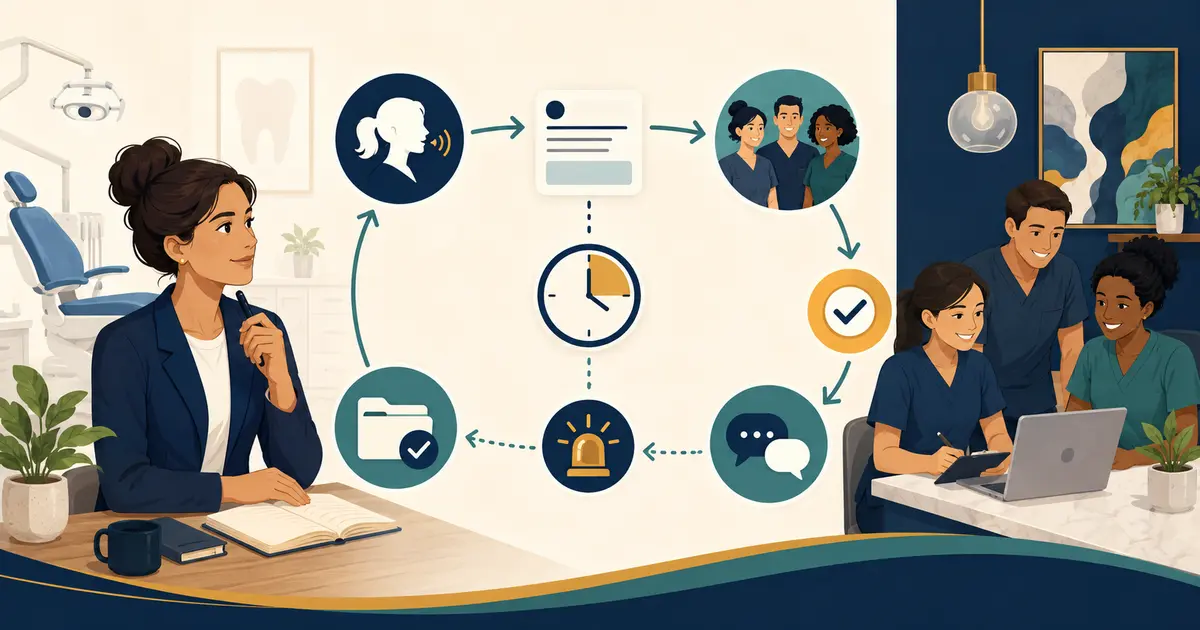
A professional dental answering service should give callers accurate practice information, collect a useful request, and deliver it to the right employee without exceeding the authority your office has approved. For a new practice, choose the service only after defining the call scope, coverage windows, urgent-call process, privacy requirements, staff handoff, routing, fallback, and complete cost.
“Professional” and “best” are not service types. Turn those words into observable requirements.
Define what the service must accomplish
Start with one clear outcome:
“When our staff cannot answer, callers hear an accurate practice greeting, can leave a general request and callback information, and receive an honest expectation for office follow-up.”
Then list the call conditions you plan to cover:
- no-answer overflow during open hours;
- busy lines or simultaneous calls;
- lunch;
- evenings;
- overnight;
- weekends and holidays;
- temporary staffing gaps;
- phone outages or office closures;
- direct campaign or new-patient calls.
Do not buy 24-hour coverage if you need only a narrow evening window. Do not evaluate a message-taking service as if it were appointment scheduling or clinical triage.
The private-practice answering guide can help you estimate coverage needs before opening.
Compare service models on the same scope
Live answering service
Human agents answer within their training and approved scripts. Review staffing, consistency, wait time, escalation, quality review, language coverage, and operator access to caller information.
AI answering
An AI system may provide consistent request capture and approved office facts. Review disclosure, interruption handling, accuracy, exceptions, data flow, monitoring, and failure behavior. It must not pretend to be human.
Hybrid coverage
A hybrid model might keep staff first, use AI or an outside service for overflow, and route defined exceptions to a human or on-call path. It can fit a complex practice, but it adds routes and ownership boundaries to test.
Compare the same calls, hours, authority, and handoff outcome across candidates. Otherwise, the feature lists will not describe the same job.
The AI versus traditional answering-service comparison provides a neutral framework.
Write the approved call scope
The service may be allowed to:
- identify the practice and location;
- share approved hours, address, and general service information;
- collect caller name and callback details;
- record whether the caller is new or existing when useful;
- capture a general reason for contact;
- record preferred callback timing;
- create an appointment request;
- follow the office's approved after-hours instruction;
- transfer calls under defined conditions.
Write the prohibited list beside it:
- no diagnosis or treatment advice;
- no clinical triage unless a qualified, contracted clinical service truly provides it;
- no promise of appointment availability;
- no claim that an appointment is booked, canceled, or changed without verified completion;
- no individual insurance-benefit confirmation;
- no unverified final fee quote;
- no payment collection without a separately approved process;
- no invented office facts or policies;
- no promise of an exact callback time the practice has not accepted.
Ask the vendor to demonstrate how an agent handles a question outside the approved scope. The correct result is a clear limitation and office handoff.
Evaluate the caller experience
Test with fictional callers and score:
- time to answer;
- accurate practice identification;
- disclosure of an outside or AI service when applicable;
- clear speech, pace, interruptions, and hold behavior;
- correct capture and confirmation of names and numbers;
- response to corrections and ambiguous statements;
- accurate office facts;
- realistic follow-up expectation;
- professional closing;
- handling of disconnections and repeat callers.
Do not choose solely because one voice sounds polished. Compare whether the resulting request is complete and usable.
The ADA recommends consistent greetings, prepared scripts, and careful intake for prospective-patient calls. Review the ADA patient-intake guidance when defining the experience your new practice wants.
Build the staff handoff
Decide where every request will appear and who owns it.
A useful handoff may include:
- call date, time, and source;
- location;
- caller name and confirmed callback number;
- new or existing patient status when relevant;
- general reason for contact;
- preferred callback window;
- approved information already shared;
- transfer or escalation result;
- current status and assigned employee.
Ask:
- Does the service create one queue or several notifications?
- Can staff tell which requests are new, acknowledged, handled, or blocked?
- Are duplicate calls linked?
- Can a manager reassign work?
- What happens when the primary employee is absent?
- Can the practice export records in a usable format?
- How are corrections made?
The handoff should reduce ambiguity, not force the front desk to listen to every call again.
Verify the urgent-call boundary
An answering service can follow an approved instruction, record a statement, and notify an on-call person. That is not automatically clinical triage.
Ask:
- Who decides whether a call is urgent?
- What training or credentials does that person have?
- Which script applies to patients of record and other callers?
- What happens when the on-call person does not answer?
- Which life-threatening-emergency wording is approved?
- What does the caller hear about response time?
- How is the event documented?
The ADA recommends that closed-office messages direct callers with life-threatening emergencies to 911 or the nearest emergency department and provide the approved dental-emergency path. Review the ADA emergency-treatment guidance while counsel and practice leadership set the final policy.
Review privacy, contracts, and access
Map all organizations that handle caller information, including telecom, answering, AI, hosting, notification, analytics, and support providers.
HHS explains that a service that creates, receives, maintains, or transmits protected health information on behalf of a covered entity may be a business associate and that a written agreement must address permitted use and safeguards. Review the HHS business-associate guidance with qualified advisors.
Verify:
- contracting entity and subcontractors;
- required agreements;
- recordings, transcripts, summaries, and metadata created;
- individual accounts, roles, and offboarding;
- operator and support access;
- notification content;
- retention, export, deletion, backup, and termination;
- incident reporting and contact path;
- whether customer data is used for another purpose.
Use fictional information during demos and trials.
Test phone routing and fallback
If the practice will keep its main number, ask the actual phone provider about:
- no-answer, busy, unavailable, and scheduled forwarding;
- original caller-ID preservation;
- ring timing and voicemail order;
- holiday schedules;
- transfer behavior;
- forwarding charges;
- destination failure;
- owner-controlled rollback.
Run test calls during every intended coverage window. Confirm what the caller hears when the service is unavailable and how staff recover requests after an outage.
The phone-outage planning guide provides a broader continuity checklist.
Compare complete pricing and terms
Request an itemized quote that covers:
- base subscription;
- included calls, minutes, or messages;
- overage units and rounding;
- evenings, weekends, holidays, transfers, and on-call fees;
- setup, custom scripts, and future changes;
- phone numbers and telecom fees;
- users and locations;
- contract length, renewal, cancellation, and data access;
- staff time for review and re-entry.
Calculate a normal month, busy month, and routing-error month. The answering-service cost guide shows how to compare pricing models without using unsupported averages.
Use weighted criteria without hiding critical failures
| Area | Suggested evidence |
|---|---|
| Caller experience | Recorded fictional calls and scored scripts |
| Scope and authority | Written allowed/prohibited task list |
| Request quality | Call-to-handoff comparison |
| Staff ownership | Front-desk processing test |
| Urgent-call process | Approved scripts and fallback tree |
| Privacy and security | Data map, agreements, access and deletion tests |
| Routing and continuity | Open, closed, holiday, and failure calls |
| Cost and terms | Itemized quote and three usage scenarios |
A high total score should not erase a critical failure. Unsupported clinical advice, false appointment confirmation, lost requests, or an unresolved privacy requirement should remain a stop condition.
Professional answering-service checklist
- [ ] Coverage conditions and desired outcome are written.
- [ ] Candidates are compared on the same call scope.
- [ ] Allowed and prohibited tasks are explicit.
- [ ] Fictional calls test normal and edge cases.
- [ ] The office receives accurate, owned requests.
- [ ] Appointment, fee, benefit, payment, and clinical boundaries pass.
- [ ] Urgent-call and on-call procedures are approved.
- [ ] Privacy, contracts, access, retention, and incidents are reviewed.
- [ ] Actual forwarding, fallback, and rollback work.
- [ ] Normal, busy, and failure-month costs are understood.
- [ ] Staff can operate the workflow without ongoing sales support.
The best dental answering service for a new practice is not the one with the longest feature list. It is the service that performs a clearly defined job, produces a dependable handoff, stays within approved authority, and keeps working when ordinary office conditions are less than perfect.