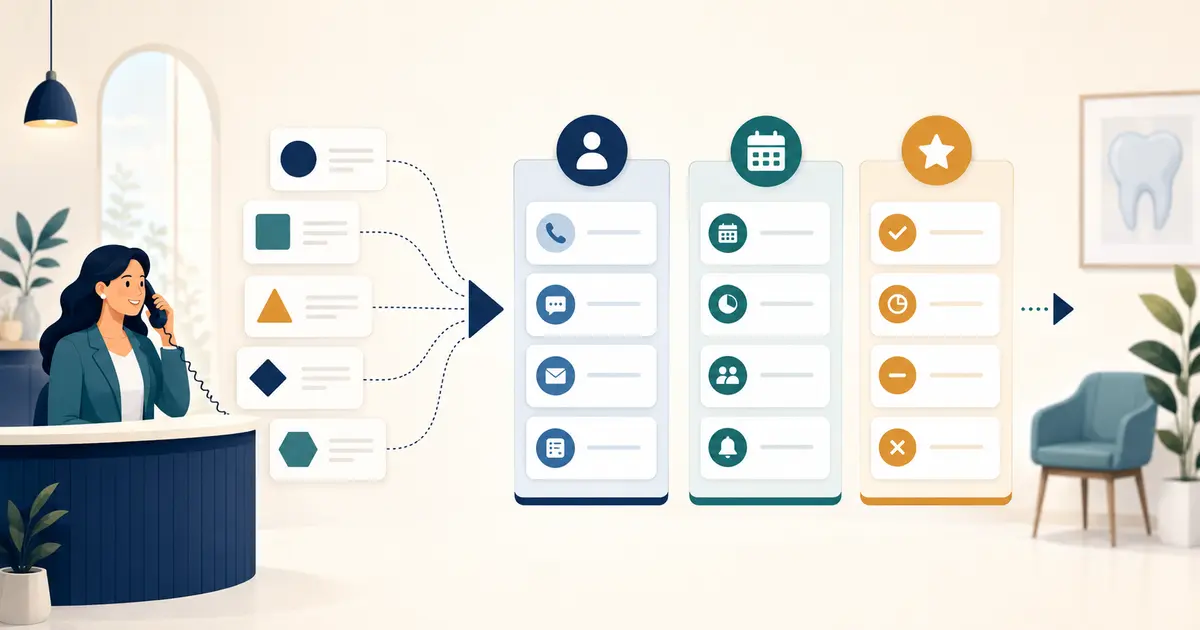
A missed-call text-back conversion rate for a dental office is not one universal number. It may describe replies divided by messages, confirmed appointments divided by eligible missed calls, or completed visits divided by connected callers. Each calculation answers a different question.
Managers should define the funnel before evaluating performance. Do not use an unsupported industry benchmark or present a request as booked revenue.
Define the eligible missed-call cohort
Start with calls the office intended to answer but did not. Document whether eligibility includes ring-no-answer, busy, simultaneous calls, lunch, open hours, closed hours, transfers, or specific caller types.
Exclude or classify known spam, wrong numbers, vendors, test calls, duplicates, blocked numbers, and calls without a usable messaging destination. Keep exclusions visible instead of quietly shrinking the denominator.
Use the call event date to create a cohort. Follow that same group through later stages so an appointment confirmed next month is still attributed consistently.
The dental call conversion rate guide explains the broader measurement discipline.
Map the text-back funnel
Use distinct events:
- eligible missed call;
- text eligible under the approved policy;
- message attempted;
- message delivered;
- human reply received;
- actionable request identified;
- front desk review completed;
- caller connected;
- appointment request made;
- appointment confirmed by authorized staff;
- visit completed;
- closed with another outcome.
A delivery receipt is not a reply. A reply is not necessarily an appointment request. A request is not a confirmed appointment.
Missed Calls Dental may provide SMS follow-up only after the required approval in the configured workflow. It does not automatically text every missed caller or book appointments.
Write formulas with named denominators
Examples:
- delivery rate = delivered messages / attempted messages;
- reply rate = unique human replies / delivered messages;
- actionable-request rate = actionable requests / unique human replies;
- booking rate from eligible missed calls = confirmed appointments / eligible missed calls;
- booking rate from connected callers = confirmed appointments / connected callers;
- completed-visit rate = completed visits / confirmed appointments.
Display numerator, denominator, rate, cohort dates, and follow-up window together. A rate without those labels is easy to misread.
Control duplicates and identity
One caller may call twice, receive one message, reply from another number, and later schedule through the website. Define a person or conversation key using only approved data and privacy controls. When identity is uncertain, preserve separate records and mark them for review rather than forcing a match.
Choose a duplicate window and rule. Keep raw events so analysts can reproduce the grouping. Do not merge family members merely because they share a phone number.
The missed-call text-back workflow describes the operational states behind the measurement.
Define the attribution window
Choose how long after the missed call a reply, booking, or visit can be associated with the cohort. Use a window that fits the practice's workflow and report it explicitly.
Distinguish direct operational linkage from causal credit. If a caller receives a text, later returns through a web form, and schedules, the practice may link the records under its rule. That does not prove the text alone caused the appointment.
For marketing analysis, preserve referral source and campaign data separately. The dental call attribution guide provides a first-party outcome model.
Review consent and message policy
Define the purpose, legal basis, consent or permission record where required, opt-out handling, quiet hours, sender identity, content limits, frequency, and alternate channel with qualified advisers.
The ADA advises practices to record preferred communication methods for reminders and notes that phone and text outreach may implicate the Telephone Consumer Protection Act. HHS guidance supports limiting protected information to what the purpose reasonably requires.
Messages should identify the practice and provide a clear next step without exposing sensitive detail. Suppress future sends promptly after an applicable opt-out.
The SMS consent and opt-out checklist addresses the operational record.
Capture delivery and reply states accurately
Separate queued, sent to provider, delivered, failed, undeliverable, blocked, and unknown. A provider acceptance response may not prove delivery to the person.
For replies, distinguish human reply, automatic carrier response, opt-out, wrong number, unrelated message, and actionable request. Preserve the original text under the approved retention and access policy.
Do not let a failed message disappear from the denominator. It may reveal stale phone data or a configuration problem.
Connect the metric to staff ownership
An automated text can generate work outside normal hours. Define who reviews replies, how urgent or sensitive content is escalated, how duplicates are linked, and what happens near closing.
Use a queue with current state, owner, due rule, attempts, and outcome. Measure reply-to-review time and unresolved aging, but avoid promising a universal response time the office cannot sustain.
Build a simple report
For each cohort, show:
| Measure | Count | Denominator | Rate | Notes |
|---|---|---|---|---|
| Eligible missed calls | — | — | Definition and exclusions | |
| Delivered messages | Attempted | Provider states included | ||
| Human replies | Delivered | Unique grouping rule | ||
| Actionable requests | Human replies | Approved request categories | ||
| Confirmed appointments | Eligible calls and connected callers | Staff-confirmed only | ||
| Completed visits | Confirmed appointments | Cohort follow-up window |
Use blanks for unavailable data, not zero. Add reconciliation checks so stages cannot exceed earlier eligible stages without an explained cross-channel rule.
Segment for operational learning
Compare open versus closed hours, day of week, routing condition, new versus existing caller when reliably known, location, message template, delivery state, and time to staff review. Protect privacy and avoid small groups that could expose individuals.
Do not optimize reply rate with vague or alarming copy. The message should remain accurate and useful.
Audit the full path
Sample records and compare phone event, outbound message, delivery status, reply, queue action, authoritative schedule, and completed-visit record. Look for duplicate credit, request counted as booking, stale number, opt-out failure, and an outcome assigned to the wrong cohort.
Record corrections and rerun reports. A trustworthy metric should be reproducible from source events and written rules.
Use the rate for decisions
The funnel can reveal whether the constraint is call eligibility, delivery, reply, staff review, connection, scheduling availability, or documentation. Improve the limiting stage rather than chasing the highest headline rate.
The useful number is not the most flattering missed-call text-back conversion rate. It is the one the manager can define, audit, and connect to a real patient communication workflow.
Add reconciliation checks
At the end of each reporting period, compare eligible call IDs, message IDs, delivery events, unique reply threads, queue records, authoritative appointments, and completed-visit records. Investigate any stage count that exceeds its eligible predecessor without an explained cross-channel rule.
List unmatched events: replies without a linked call, appointments without a reviewed request, duplicate messages, outcomes outside the window, and records suppressed after opt-out. Resolve data-quality issues before comparing templates or locations.
Preserve the calculation version and source coverage. If a provider outage or integration gap affected the period, label the report rather than backfilling assumptions. A manager should be able to recreate every count from the written rules and source identifiers. Keep exceptions visible when comparing one reporting period with another.