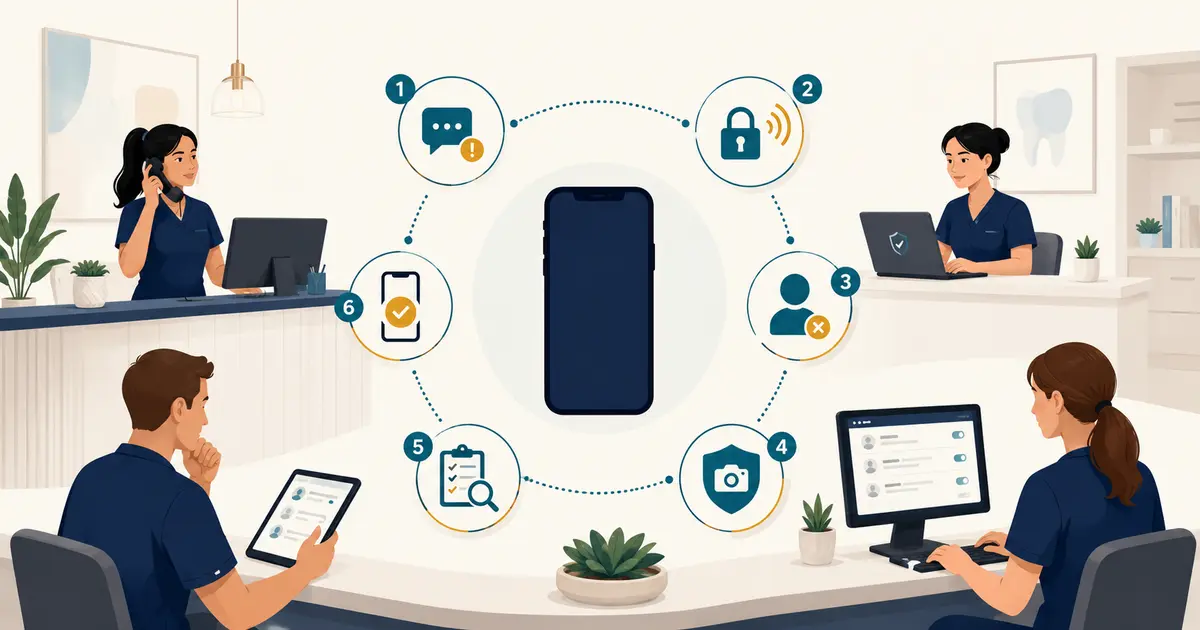
A lost or stolen dental work phone should trigger a practiced response immediately. The first report should start access control and evidence preservation—not a debate about blame or an automatic conclusion that a reportable breach occurred.
Report facts through a trusted path
The staff member should contact the designated manager or security contact using a known number or channel. Record the device, assigned user, approximate loss time and place, last known use, whether it was unlocked, and which work applications or accounts it could reach.
Do not send passwords, recovery codes, or patient details in the incident message. If personal devices are permitted, follow the dental front desk personal-device policy and its agreed separation and removal process.
Contain access safely
Using authorized administration tools, revoke application sessions, device registrations, email and phone-system access, and relevant tokens. Apply remote lock or wipe only under the approved device-management and evidence-preservation procedure. Notify the carrier when appropriate and protect number-porting and account-recovery paths.
Do not improvise by changing every shared password before identifying affected systems. Use the dental phone system access audit to confirm the device and user no longer retain access and to find recovery methods tied to the lost phone.
CISA advises organizations to protect data stored on devices and to take deliberate steps before reuse or disposal. NIST's BYOD guidance treats device security across the lifecycle, including incident and disposal considerations.
Preserve evidence and establish scope
Capture device-management status, encryption and screen-lock configuration, last check-in, applications installed, local storage behavior, notification previews, backups, recent access logs, and remote-action timestamps. Preserve the source and timezone for each item.
Determine what information was on the device or accessible through active sessions. Distinguish encrypted managed data, locally stored files, cached notifications, synced contacts, and data that remained only in protected applications. Avoid speculation; document known, unknown, and pending facts.
Assess notification obligations
Escalate promptly to the practice's privacy, security, legal, insurance, and other qualified advisers as applicable. HHS explains that covered entities and business associates must provide notifications after breaches of unsecured protected health information and provides specific timing and content requirements. Whether a particular lost device constitutes a breach requires a fact-specific assessment under applicable rules; loss alone should not be labeled automatically either way.
Record the assessment, decisions, responsible reviewer, dates, and required notifications. Follow the applicable federal and state requirements and contractual duties.
Restore without recreating the weakness
Provision the replacement from an approved baseline. Require updates, encryption, screen lock, multifactor authentication, limited notifications, managed applications, and tested remote-management controls. Do not restore unnecessary personal backups into a work profile.
After stability, run a dental phone incident postmortem to address delayed reporting, excessive local data, weak recovery methods, or incomplete inventory. Confirm that caller requests affected during the incident have owners and due times.
Missed Calls Dental boundary
Missed Calls Dental can revoke or support review of access to its own product according to supported processes and available evidence. It does not manage the practice's phone, carrier, email, device encryption, remote wipe, or breach determination. The practice owns incident command, scope assessment, qualified review, notification, recovery, and follow-up. SMS is separate and readiness-gated.
Marcus Lee is an editorial pen name. This article was reviewed for accuracy and alignment with Missed Calls Dental product information.