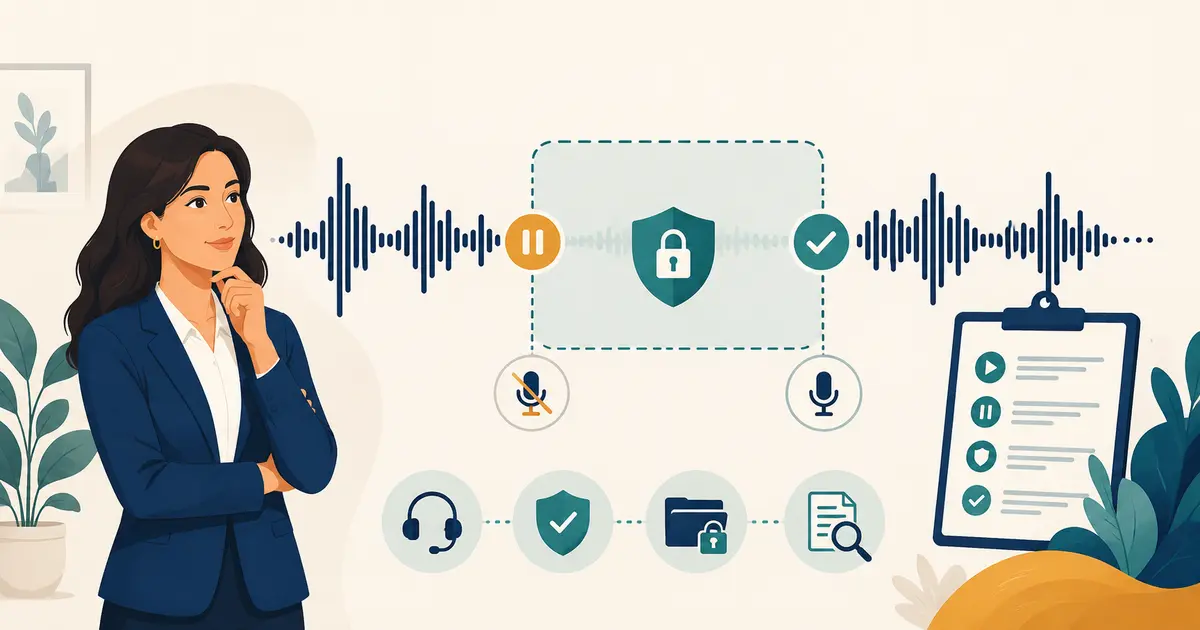
A dental call recording pause-and-resume checklist should govern the exact moment recording stops before sensitive data is spoken and the evidence that it resumed only when appropriate. A visible button is not a complete control: the practice must test behavior, train staff, and define what happens when the feature fails.
Confirm the legal and contractual design
Before recording calls, obtain qualified legal advice about consent and notice requirements in every applicable jurisdiction. Review the dental call recording consent guide and the practice's contracts, policies, and actual call routes.
If payment-card data may be spoken, involve the acquiring bank, payment provider, and qualified PCI professional. PCI Security Standards Council FAQ 1210 says sensitive authentication data must not be retained after authorization and explains that recording technology should prevent it from being recorded when the technology exists. The official FAQ—not an informal summary—should guide the review.
Define the pause trigger
List the information that requires the approved control and the script used before collection. Keep the list aligned with the practice's payment and privacy workflows. Do not ask staff to make ad hoc legal classifications during a busy call.
Assign authorized roles and decide whether the system pauses automatically, manually, or through a secure payment handoff. If the safer process is not to collect the information by voice, state that directly.
Test the full recording path
In a controlled fictional call, verify:
- the notice and consent workflow behaves as designed;
- the staff member can see the actual recording state;
- audio is absent for the entire protected interval;
- no transcript, summary, screen capture, metadata field, or downstream copy retains the suppressed content;
- recording resumes only after the sensitive exchange is complete; and
- playback, export, retention, and deletion controls honor the result.
Test transfers, conferences, holds, reconnects, mobile clients, and vendor integrations. A pause that affects one recording but not a transcription or analytics stream does not meet the intended design.
Define failure handling
If staff cannot confirm pause, they should stop collecting the sensitive data through that channel and use the approved alternate process. Document who receives the incident, how affected artifacts are isolated, and how the practice assesses legal, contractual, privacy, and security obligations.
Use the recording retention policy and recording compliance checklist to govern access and lifecycle. Do not treat deletion as a substitute for incident review.
Monitor and retest
Sample fictional or appropriately authorized test calls on a schedule and after any platform, integration, script, or route change. Review audit evidence for authorized access and failures without replaying real patient recordings unnecessarily. Apply minimum-necessary access to recordings and derived data.
This checklist is operational guidance, not legal advice or a PCI compliance determination. The practice should document its qualified review, accepted design, training date, test evidence, and next review date.
Missed Calls Dental boundary
Missed Calls Dental is not presented as a payment-card collection tool and does not determine recording law, consent, PCI DSS scope, or the practice's compliance. Product recording or derived-data behavior must be verified against the current supported configuration. The practice owns legal and PCI review, scripts, controls, access, retention, and incident handling. SMS is separate and readiness-gated.
Ethan Collins is an editorial pen name. This article was reviewed for accuracy and alignment with Missed Calls Dental product information.