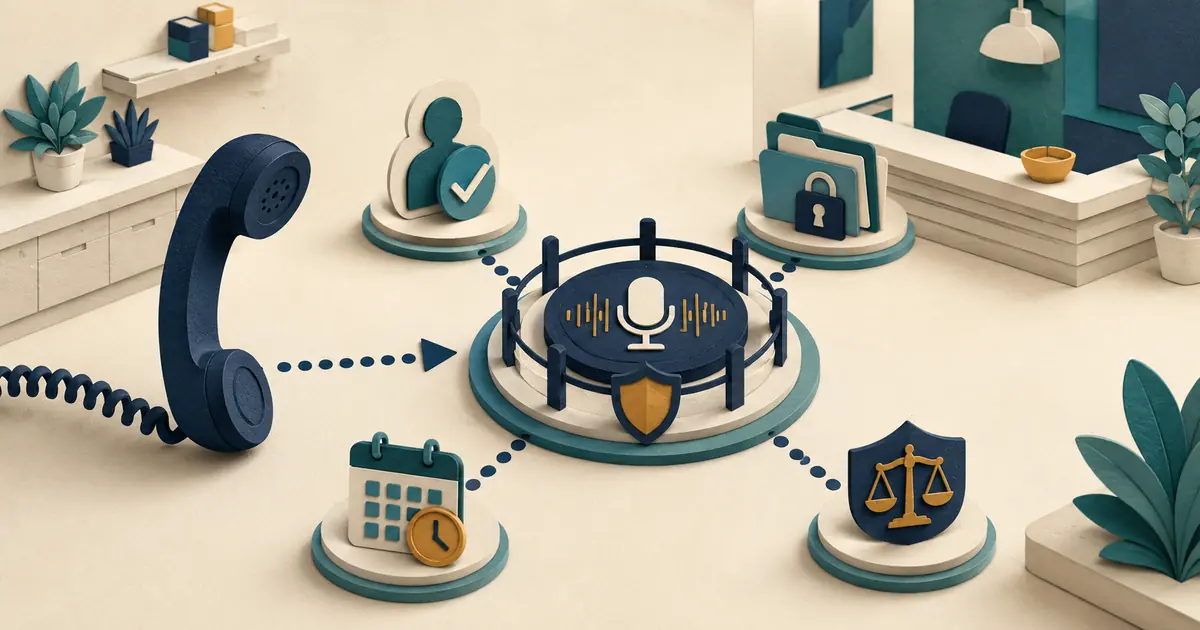
Patient consent for dental call recording cannot be reduced to one sentence copied from another business. Federal law, state law, the locations of the parties, the purpose of recording, and the practice's privacy obligations may all matter. A dental office should obtain qualified legal guidance and configure the phone workflow to match the approved policy.
This article is an operational checklist, not legal advice.
Confirm the legal analysis before enabling recording
The practice and counsel should document:
- which calls may be recorded;
- the business purpose;
- states or jurisdictions involved;
- whether one-party, all-party, or another consent rule applies;
- how caller location uncertainty is handled;
- whether employees require separate notice or consent;
- the exact disclosure and timing;
- what happens when a caller objects;
- whether recording is ever paused;
- retention, access, export, and deletion;
- vendor contract responsibilities.
Federal interception law includes exceptions and consent concepts, but state requirements can be more restrictive. Do not assume a federal baseline resolves every call.
See the broader call recording and transcription compliance questions for vendor and governance review.
Decide when the notice occurs
The approved notice should be delivered before the portion of the conversation the policy says requires notice or consent. Avoid burying it after the caller has already shared information.
Counsel may approve language such as:
“This call may be recorded for [approved purpose].”
That example is not a universal script. The office must use wording and an interaction appropriate to its jurisdictions and facts.
If affirmative agreement is required under the approved policy, define what qualifies. Silence, staying on the line, pressing a key, or saying “yes” may not be interchangeable.
Provide an objection path
Staff need a written response when a caller says no or asks to stop.
The policy should specify whether staff:
- stop or pause recording;
- move the conversation to an unrecorded line;
- offer another channel;
- end the recorded session and call back;
- route the caller to a designated employee;
- document the choice without copying sensitive details into an informal note.
Test the objection path. A notice without a functioning alternative may not produce the experience the policy promises.
Do not confuse recording with documentation
HHS states that HIPAA does not require covered entities to document every oral communication. A practice may still need documentation for other clinical, business, legal, or quality reasons, but recording every call is not automatically required.
Ask whether the purpose can be met with a concise staff note, request summary, or structured disposition instead of a full audio file.
The phone and voicemail privacy guide helps compare what information belongs in different channels.
Minimize what the recording contains
Even when recording is permitted, train staff not to solicit unnecessary information. Avoid collecting payment-card data, detailed clinical histories, or unrelated identifiers merely because the audio exists.
Create a pause or alternate process for information the recording policy excludes. Confirm that vendors, transfers, and conference calls respect the same rule.
Control access and retention
Document:
| Control | Decision |
|---|---|
| Access | Which roles may listen, export, or delete |
| Authentication | How each user is identified |
| Retention | How long audio, transcript, and metadata remain |
| Export | Who approves it and where it may be stored |
| Correction | How inaccurate transcripts or tags are handled |
| Incident response | Who investigates inappropriate access or disclosure |
| Termination | How vendor-held data is returned or deleted |
If the vendor is a business associate for the service provided, review the required agreement and safeguards. A vendor's marketing label is not a substitute for the practice's contract and configuration review.
The HIPAA and BAA checklist provides additional questions for service providers.
Train staff with scenarios
Use synthetic calls to test:
- caller accepts the approved recording process;
- caller objects immediately;
- caller asks to stop mid-call;
- a transfer moves to another employee or vendor;
- the caller's location is uncertain;
- payment or sensitive clinical information begins;
- the recording indicator or storage service fails;
- an authorized person requests access or deletion under the applicable process.
Staff should know when to stop and contact the privacy officer, manager, or counsel.
Audit the complete chain
Check the greeting, recording start time, consent or objection record, access list, retention behavior, export, deletion, and vendor logs. A configured announcement alone does not prove that objections, transfers, retention, and deletion work.
Missed Calls Dental boundary
Missed Calls Dental is not marketed as a call-recording product. Its AI Answering service may create a transcript and summary for eligible calls that reach the assigned AI assistant number. Practices must still evaluate applicable notice, consent, privacy, access, and retention requirements for their use and jurisdiction.
Marcus Lee is an editorial pen name. This article was reviewed for accuracy and alignment with Missed Calls Dental product information.