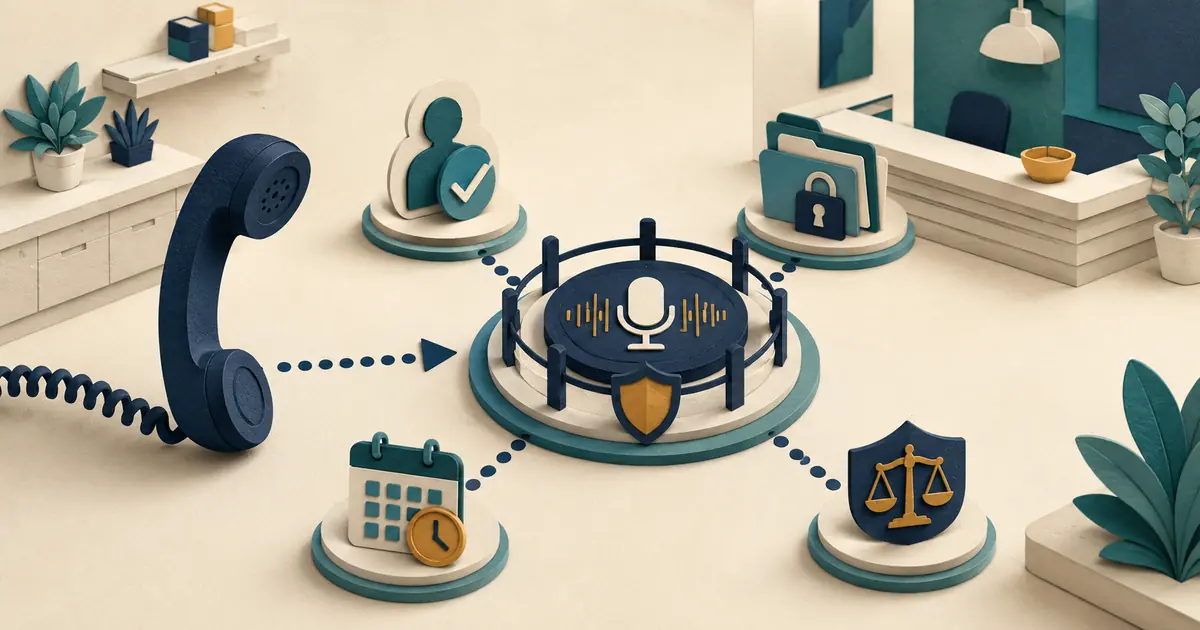
HIPAA-compliant texting for dental offices is not established by a vendor badge or encryption claim. The practice must review the purpose, protected information, participants, vendor relationships, safeguards, access, retention, patient requests, and incident process for the actual workflow.
This article is educational, not legal advice. HIPAA may be only one of several applicable federal and state requirements.
Define the texting purpose
List each use separately:
- appointment reminder;
- patient-initiated question;
- request acknowledgment;
- scheduling discussion;
- billing or benefit communication;
- clinical follow-up;
- record or image exchange;
- recall or marketing outreach;
- internal staff notification.
The necessary information, channel, consent, retention, and access can differ. Do not approve “texting” as one undifferentiated activity.
The SMS consent and opt-out checklist addresses permission and suppression controls outside this HIPAA-focused review.
Draw the data flow
Map:
practice system -> messaging vendor -> carrier or network -> patient device -> replies -> staff queue -> patient record
Add subcontractors, backups, analytics, support, exports, email alerts, mobile notifications, and integrations. Mark where protected health information is created, received, maintained, transmitted, cached, or displayed.
The data flow often reveals risks that the chat window hides.
Determine business associate roles
HHS defines a business associate based on the functions or services performed and the relationship to the covered entity. If a vendor creates, receives, maintains, or transmits protected health information on behalf of the practice, a business associate agreement may be required.
HHS sample BAA provisions address permitted uses, safeguards, incident reporting, subcontractors, access, amendments, accountings, return or destruction, and termination. Qualified counsel should tailor the contract to the actual service and state law.
A BAA does not configure the platform safely by itself.
Apply reasonable safeguards
HHS states that covered providers may communicate electronically with patients when they apply reasonable safeguards. The exact safeguards depend on the circumstances.
Operational controls may include:
- verifying the destination before sending;
- limiting message content;
- using neutral notification previews;
- moving detailed conversations to a secure portal;
- preventing protected content on shared lock screens;
- confirming patient communication preferences;
- training staff on wrong-recipient and urgent-message handling;
- monitoring failed deliveries and replies.
The secure messaging guide helps choose the stronger channel for sensitive content.
Control identity and access
Use individual accounts, role-based access, multifactor authentication where available, short session timeouts, device controls, audit logs, and prompt deactivation. Separate scheduling, billing, clinical, and administrative queues where appropriate.
Verify the patient under the practice's approved process before discussing protected details. A phone number may be shared, recycled, or wrong. Do not rely solely on caller ID or a display name.
CISA recommends MFA for business accounts, particularly privileged access and users who handle sensitive data.
Respect patient requests and channel limits
Record communication preferences, restrictions, confidential-communication requests, and opt-outs in the authoritative location. Explain the material risks of a requested channel using counsel-approved language when appropriate.
Do not promise that ordinary carrier SMS is a secure portal. Do not make access to care depend on optional promotional texting consent.
The appointment request text template demonstrates limited status wording without sensitive detail.
Set retention and record rules
Decide:
- which messages become part of the record;
- how they are associated with the correct patient;
- how original and corrected versions are preserved;
- retention by message type;
- treatment of attachments and media;
- export format;
- deletion and backup behavior;
- legal or investigation holds;
- patient access and amendment workflows where applicable.
“Stored forever” and “deleted after 30 days” both require a documented rationale and alignment with legal and operational duties.
Prepare for incidents
Create a response path for wrong recipients, compromised accounts, screenshots, lost devices, unauthorized exports, vendor breaches, failed deletion, missing logs, and protected information in a shared notification.
Employees should preserve evidence, contain access, and notify the approved privacy or security owner. They should not decide alone whether an event is a reportable breach.
NIST Cybersecurity Framework 2.0 can help organize governance, protection, detection, response, and recovery outcomes.
Test before approval
Use fictional records to test:
- enrollment and preference capture;
- correct and wrong numbers;
- shared family number;
- protected content blocked from a basic channel;
- staff role access;
- opt-out and alternate channel;
- delivery failure;
- urgent or clinical reply;
- audit log;
- export and correction;
- account removal;
- vendor outage and termination.
Record the configuration and retest after material changes.
Keep Missed Calls Dental accurate
Missed Calls Dental captures caller requests from eligible forwarded missed calls. It is not a practice's general texting platform, secure portal, or legal adviser. The practice owns its patient follow-up channels, privacy analysis, vendors, policies, and records.
A sound HIPAA texting decision is specific. It identifies which message is sent, by whom, through which systems, to which verified recipient, under which controls, for how long, and what happens when something fails.
Create an approved texting use-case register
List every approved use with its purpose, owner, patient group, data elements, channel, template, consent or preference basis, vendor, BAA status, retention rule, exception queue, and review date. Mark proposed uses separately from active ones. Staff should not expand a reminder platform into clinical or marketing messaging without review.
Attach a data-flow diagram and configuration evidence to each use. A vendor may offer encryption while a staff notification copies the message into ordinary email or a mobile preview. Review the full path rather than the central platform alone.
Set a launch gate: contract and adviser review complete, user roles configured, MFA enabled where supported, templates approved, identity process trained, opt-out working, wrong-recipient response documented, audit logs visible, retention tested, and rollback available. A missing gate should pause the use case.
Perform periodic access and content reviews. Sample messages under approved privacy controls, verify the recipient and purpose, check minimum necessary content, trace replies to owners, and inspect exports and support access. Include inactive accounts and former employees.
When a new use is proposed, ask whether the same result can be achieved with less information or a safer channel. A secure platform does not make every message necessary. Document why texting is appropriate for the task and how patients can use another method.
At vendor exit, export required records, preserve preferences, disable sending, revoke credentials, remove integrations, verify data return or destruction, and test the replacement workflow. Compliance must survive the contract change.
Require a documented risk acceptance
No platform eliminates risk. For each approved use, record the remaining limitations—such as carrier delivery, patient-controlled devices, shared numbers, notification previews, or an unavailable secure alternative—and the controls the practice chose. Name the person authorized to accept the residual risk and the date for review.
If a material risk cannot be reduced to the practice's approved level, choose a different channel or narrow the message. Do not hide the decision inside a vendor contract.
Train staff on the approved use and the reason for its limits. Employees are more likely to follow a channel boundary when they understand which disclosure, identity, or retention problem it prevents. Include a safe way to ask the privacy owner before sending.
Revisit the acceptance after incidents, complaints, vendor changes, new integrations, or changes in law and policy. Document the new evidence and decision rather than assuming the original approval remains current.