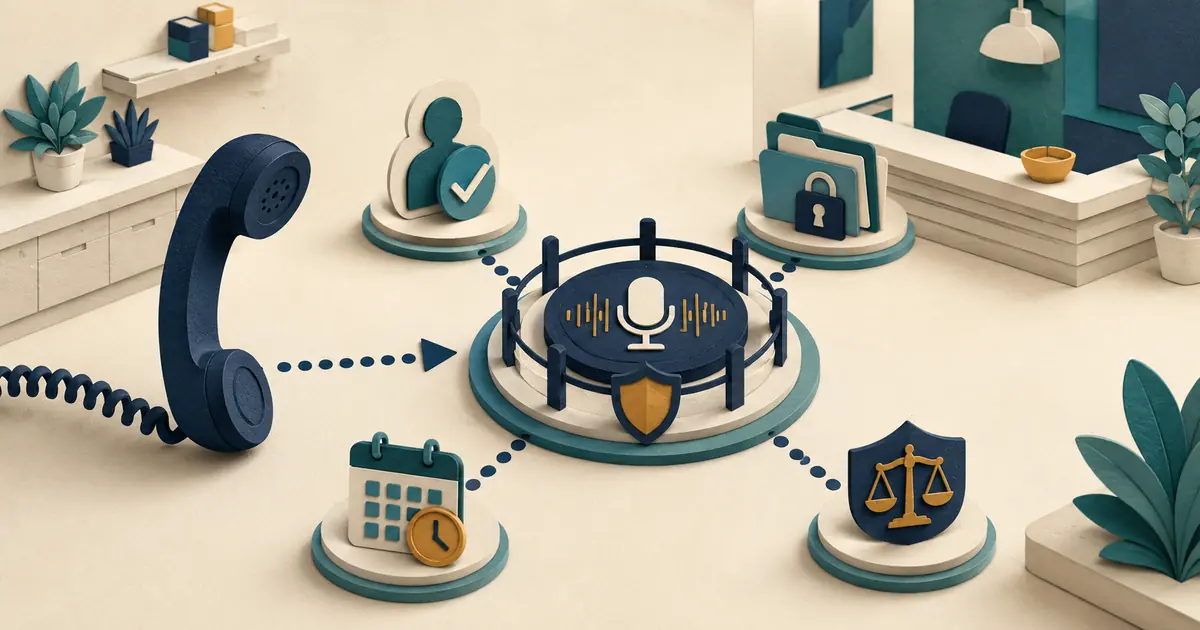
A HIPAA-compliant dental answering service cannot be evaluated from a badge or a yes-or-no sales answer. The owner needs to understand the actual relationship, the protected information created or received, every system and subcontractor involved, and the safeguards and duties that apply to that workflow.
This article provides an operational due-diligence structure, not legal advice. Use qualified legal, privacy, and security professionals for the practice's specific arrangement.
Start with the real service relationship
Describe what the service does in concrete verbs: receives forwarded calls, records audio, transcribes speech, answers approved questions, captures a callback request, sends a notification, stores a summary, offers support access, or exports records.
Then determine which organizations perform each step. A phone carrier, answering vendor, cloud host, messaging provider, analytics tool, support contractor, and integration vendor may each touch different information.
HHS explains that a business associate is a person or organization performing certain functions or services involving protected health information for a covered entity. The facts of the relationship matter. The BAA checklist for dental answering services gives a contract-focused review; this article expands the technical and operational questions.
Draw the data flow
For every call path, document:
- where the call begins and how it is routed;
- what audio, transcript, metadata, and structured fields are created;
- where each copy is transmitted and stored;
- which people and systems can access it;
- whether data is used for support, analytics, product improvement, or model training;
- how long each copy remains;
- how correction, export, deletion, and termination work.
Include logs, backups, test environments, notifications, email, mobile devices, and downloaded files. A statement that data is encrypted does not answer who can decrypt it, why support can access it, or where a copy persists.
Missed Calls Dental provides backup answering for eligible forwarded missed calls and captures requests for staff follow-up. The practice must still evaluate its own configuration, data, policies, and legal obligations.
Apply minimum-necessary reasoning
HHS describes minimum necessary as a reasonableness standard implemented through a covered entity's policies and procedures. Use that reasoning at the field level.
An hours question may require no patient identity. A callback request might need a name, number, reason in the caller's words, and contact preference. A referral or existing-patient request may need more, but “collect everything just in case” is not a defensible workflow design.
Ask:
- Which field serves the defined purpose?
- Can the task work with less detail?
- Is a free-text transcript necessary after structured capture?
- Who needs the complete record versus a limited notification?
- When should the record be deleted or archived under policy?
- How are callers discouraged from leaving unnecessary sensitive detail?
The patient privacy on phone calls and voicemail guide provides front-desk examples of limiting disclosure.
Review the business associate agreement
Confirm that the agreement matches the service and addresses permitted uses and disclosures, safeguards, reporting, subcontractors, access and amendment support where applicable, return or destruction, termination, and other required provisions. Do not accept a generic contract that describes a different product.
Ask for the subcontractor list and change-notification process. Determine whether each relevant subcontractor is bound to appropriate obligations. Identify who coordinates incident investigation and who supplies the evidence the practice needs.
A BAA does not certify every configuration. It does not replace correct access, retention, staff training, secure devices, or testing.
Verify security controls with evidence
Map controls to the actual risk:
| Area | Buyer question | Evidence to request |
|---|---|---|
| Identity | Are accounts individual and strongly authenticated? | Configuration, access report, revocation test |
| Authorization | Can roles be limited by location and function? | Role matrix and test account |
| Transmission | How are calls, messages, and exports protected? | Architecture and configuration evidence |
| Storage | Where are records, logs, and backups kept? | Data inventory and retention schedule |
| Logging | Who viewed, changed, exported, or deleted a record? | Sample audit event and retention period |
| Support | When may vendor personnel access data? | Approval workflow and support logs |
| Resilience | What happens during outages or recovery? | Tested continuity and reconciliation plan |
| Exit | How are access and data removed? | Export format, deletion procedure, confirmation |
Ask about independent assessments, but read their scope and date. A report may exclude the exact service, location, or subcontractor the practice uses.
Define incident duties
Create a contact and decision path before an incident. Require the vendor to preserve evidence, contain exposure, identify affected systems and records, communicate on an agreed timeline, support risk assessment, correct weaknesses, and document closure.
Test the operational path with a fictional incident: a notification sent to the wrong recipient, a compromised user account, an exported file left on an unmanaged device, or support access that remains active after termination.
The practice needs to know who can disable forwarding, revoke accounts, isolate an integration, recover pending requests, and communicate with affected people and authorities when required. The secure messaging guide can help separate channel controls from message policy.
Test patient-facing privacy
Security controls do not prevent a conversational disclosure error. Test callers who ask whether another person is a patient, request an appointment time for a family member, give an incorrect phone number, or call from a shared device.
Define what the service may reveal before identity is verified. Use cautious callbacks and notifications that do not expose treatment or sensitive request details. Test name collisions, dependents, guardians, personal representatives, and changed contact preferences under the practice's approved policy.
If calls are recorded or transcribed, evaluate applicable law, notice, consent, purpose, access, and retention with counsel. The call recording and transcription questions guide separates those issues from general HIPAA review.
Control change over time
Inventory the approved configuration: routing, data fields, knowledge sources, roles, retention, integrations, subcontractors, model or automation functions, and notifications. Assign owners and review dates.
Require notice for material changes and decide which tests must be repeated. A service that was acceptable in one configuration may present different risks after adding recording, analytics, a new integration, or broader support access.
Review active users, permissions, exports, failed logins, incidents, pending deletions, and subcontractors on a defined cadence. Sample real records for minimum-necessary collection and appropriate disclosure.
Use a buyer decision record
Before signing, record the intended purpose, covered workflows, data map, roles, contract review, safeguards, evidence, open risks, compensating controls, launch conditions, monitoring owner, and exit plan. State what the approval does not cover.
Avoid guarantees. HIPAA compliance is an ongoing responsibility shared across the real arrangement; it is not transferred by buying software or signing a BAA.
The useful buyer question is not “Are you HIPAA compliant?” It is “Show us how this exact dental call workflow limits information, controls access, handles incidents, and remains accountable from setup through deletion.”
Verify the operational owner
Assign a named practice role for the vendor relationship. That owner should maintain the data map, approved use cases, current contacts, access list, risk decisions, incidents, change notices, review dates, and termination checklist. Legal, privacy, security, clinical, and operations advisers may contribute, but an unowned contract will not keep the workflow current.
Require periodic evidence that controls still work: remove a test user, retrieve an audit event, export an approved record, confirm a retention action, and exercise the incident contact path. Record gaps and due dates. The phrase “HIPAA compliant” should never end the review; it should begin a traceable set of responsibilities.