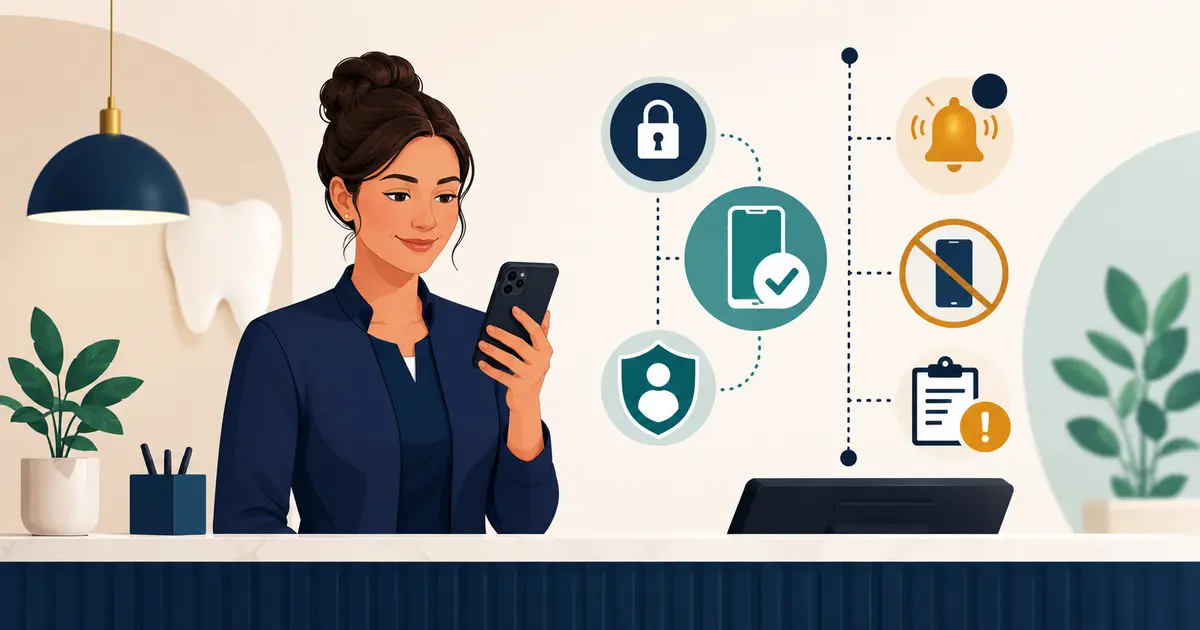
A dental front desk personal device policy should begin with a clear decision: which patient-call tasks, if any, may occur on a personally owned phone, tablet, or computer? Convenience is not enough. The practice needs enforceable controls, a support model, and a way to remove access when the device or employee changes.
Define permitted and prohibited uses
List approved tasks narrowly. Examples might include receiving a shift alert or using an approved managed softphone. Separate them from prohibited uses such as:
- saving patient contact details in the native address book;
- taking screenshots of request or call information;
- recording calls with a personal app;
- copying details into personal notes, email, cloud storage, or messaging;
- forwarding office calls through a personal number without approval;
- allowing family members or other apps to see notification content.
If the practice cannot enforce the controls required for a task, do not allow that task on a personal device. NIST's BYOD guidance emphasizes that personally owned devices create distinct remote-access and security considerations.
Require device and account controls
The policy should address supported operating-system versions, updates, screen lock, encryption where available, approved app source, unique employee sign-in, multifactor authentication, session timeout, remote sign-out, and removal of access. CISA recommends MFA for remote and administrative access, with stronger phishing-resistant methods where practical.
Shared passwords and group recovery emails make offboarding hard to prove. The phone-system access audit can verify accounts, roles, active sessions, support access, and stale users quarterly.
Minimize what appears on the device
Disable detailed lock-screen previews. Avoid local downloads and automatic backup to personal cloud services. Keep call notes in the approved practice system instead of device storage. Use headphones and a private environment; do not use speakerphone where others can hear.
The phone and voicemail privacy guide can inform approved locations, minimum disclosure, voicemail content, and physical safeguards. Personal ownership does not remove the practice's responsibility for information created, received, maintained, or transmitted through its workflow.
Make support and failure visible
Tell employees whom to contact when the app fails, notifications stop, the phone changes, or an update breaks calling. Staff should never install an unapproved workaround to restore service. Provide a safe office fallback and record the failure.
Test one fictional call under normal Wi-Fi, cellular data, a locked screen, an expired session, and a disabled device. Confirm the caller ID, route, audio, note placement, and sign-out behavior. Provider and device behavior must be verified; do not assume all softphone apps work alike.
Treat loss as an incident
The policy should require immediate reporting of a missing device without blaming the employee. The practice can then disable sessions, revoke tokens, change exposed credentials, preserve access evidence, and conduct the appropriate privacy and security assessment. Do not ask staff to delay reporting while they search privately.
Maintain a device register with employee, device class, approved apps, enrollment date, last review, and removal date—without collecting unnecessary personal content.
Offboard the device, not only the employee
When a role ends or a device is replaced, remove app access, sign out active sessions, revoke device registration, remove work data under the approved method, and verify the account no longer connects. Record the check. A verbal promise that the app was deleted is not sufficient evidence.
Missed Calls Dental boundary
Missed Calls Dental does not authorize personal-device use for a dental practice or manage the practice's phone, device, or mobile-security policy. It can provide approved requests and summaries in Workspace for authorized users. The practice owns access, device controls, privacy review, staff action, and incident response. SMS is separate and readiness-gated.
Noah Carter is an editorial pen name. This article was reviewed for accuracy and alignment with Missed Calls Dental product information.