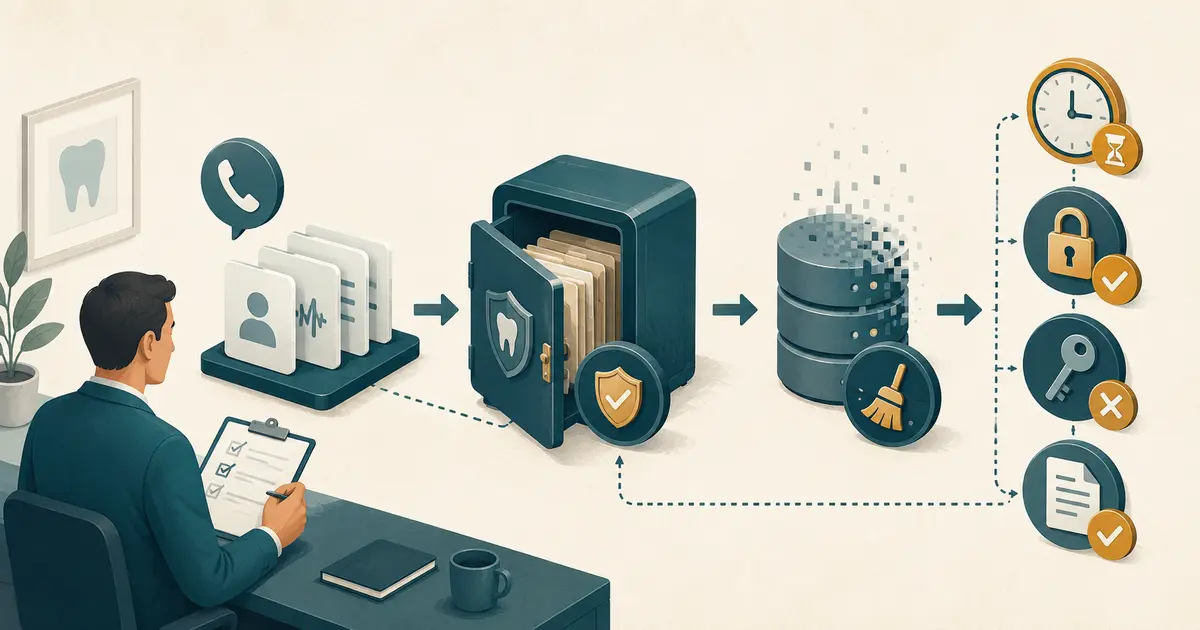
Dental phone vendor data deletion verification confirms what a departing provider returned, deleted, retained temporarily, or could not remove. It is an evidence step after the exit plan—not a checkbox based only on account cancellation.
Inventory the data before requesting deletion
List what the vendor may hold:
- call metadata and caller identifiers;
- audio recordings, voicemail, transcripts, and summaries;
- routing configuration, greetings, users, roles, and audit logs;
- support tickets, attachments, exports, and administrator communications;
- backups, disaster-recovery copies, logs, and subprocessor copies;
- billing, contract, security, and legal records.
Map each record class to its owner, business purpose, retention requirement, export need, deletion method, backup behavior, and verification source. Reconcile this inventory with the contract, phone-provider switching checklist, and dental record-retention policy.
Preserve required records before destruction
Export records the practice is authorized and required to retain, and verify that the files are complete, readable, protected, and linked to an accountable destination. Do not download everything “just in case.” Uncontrolled copies can create new privacy and security exposure.
Confirm which records must remain with the vendor for billing, dispute, legal, security, or regulatory reasons and for how long. Qualified privacy, records, and legal owners should decide these requirements.
Send a scoped, traceable request
Reference the account, service, termination date, data categories, systems, subprocessors, and requested outcome. Ask the vendor to identify:
- active systems from which data was deleted;
- backups or immutable copies that will expire on schedule;
- legal holds or other exceptions;
- downstream providers involved;
- deletion date, method, approver, and evidence;
- residual account access or credentials that remain.
Avoid requesting a certificate so broad that it cannot be true. A precise statement of scope and exceptions is more useful than “all data deleted everywhere.”
Verify through multiple signals
Check that ordinary users and administrators can no longer access the account, application, recordings, exports, APIs, support portals, or single sign-on connection. Review invoices for unexpected continued service. Confirm forwarding and phone numbers moved or terminated according to plan.
Where vendor tools permit, sample a search or export after the deletion event. Preserve the closure evidence in the practice's vendor record. Do not ask staff to retain live credentials simply to prove the account is gone.
Track backup expiration and unresolved exceptions
HHS guidance for cloud service providers recognizes that return or destruction and retention after termination depend on the business associate agreement and circumstances. If deleted data remains in protected backups until normal expiration, record the schedule, access restriction, purpose, responsible vendor, and follow-up date.
Keep the exit item open until material exceptions have an owner and acceptance decision. Escalate discrepancies between the contract, vendor response, system behavior, and subprocessor list.
Missed Calls Dental boundary
Missed Calls Dental provides supported services under its current agreements and product controls. A practice must use current contract and vendor documentation for an actual deletion request. The practice owns its retention decisions, exports, legal holds, access closure, evidence review, and downstream records.