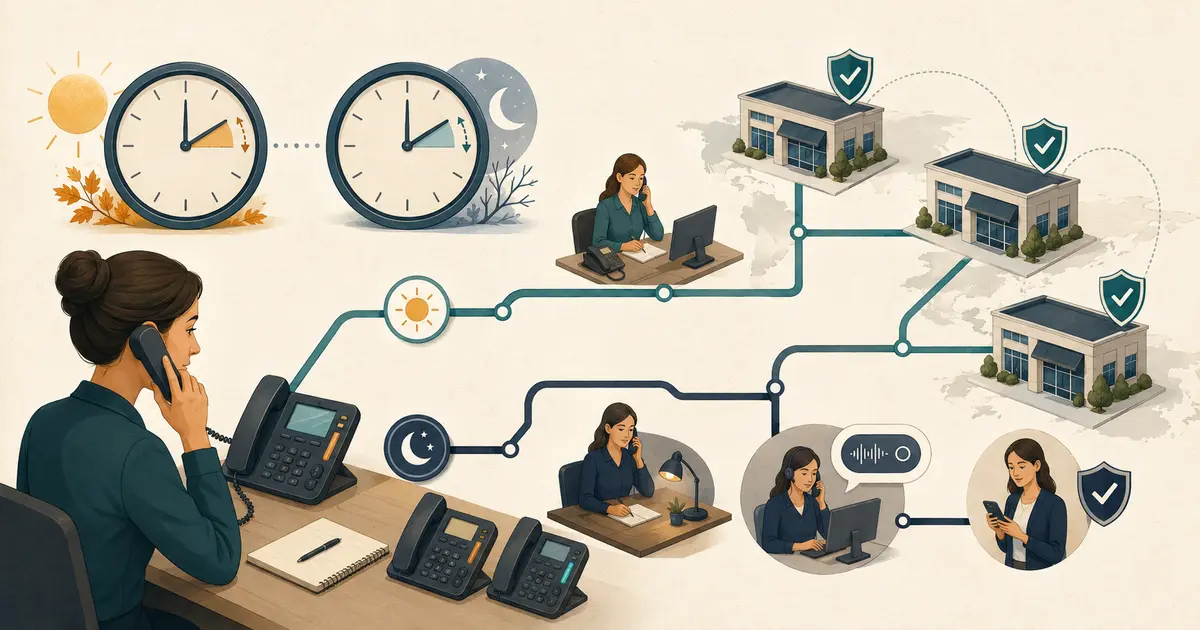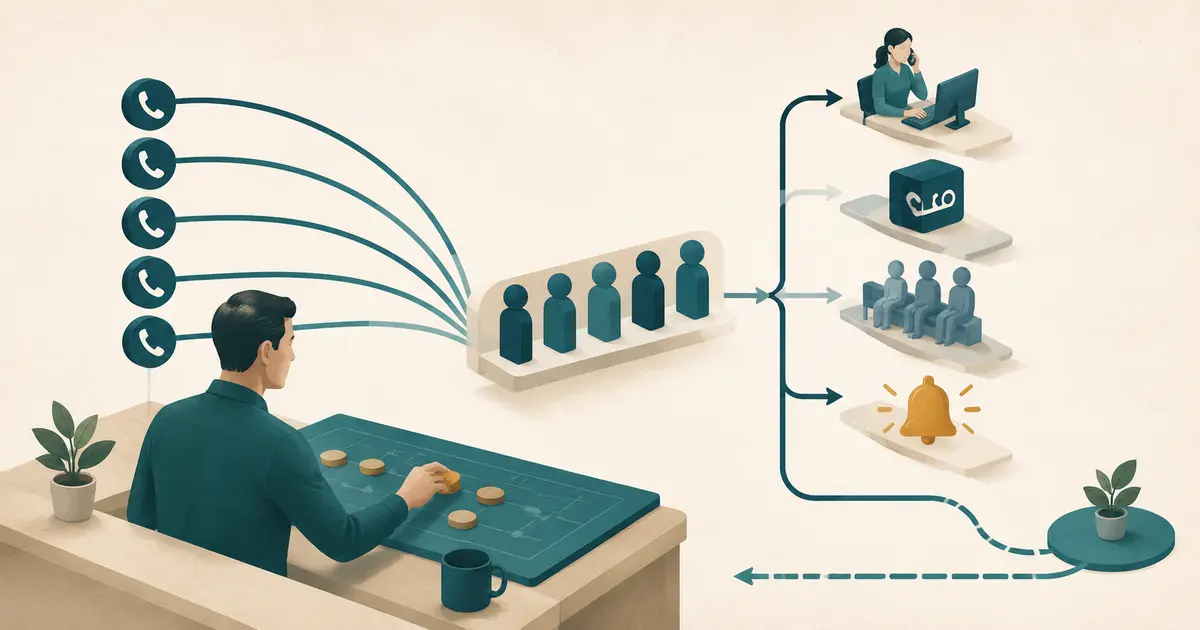
A dental phone capacity test checks how the planned call path behaves when several callers arrive at once. It is not a promise that the office can predict every peak. It is a controlled way to reveal limits, confusing caller experiences, unowned overflow, and failure behavior before real patients encounter them.
Define the service level you need to observe
Document the expected number of concurrent inbound calls, staff who can answer, queue or ring-group limits, maximum caller wait, overflow trigger, voicemail capacity, and after-hours behavior. Confirm which limits come from the carrier, phone platform, internet connection, devices, licenses, or staffing model.
Avoid inventing a universal target. A small startup, multi-location group, specialty office, and centralized call team need different assumptions. Use planned staffing, marketing events, opening-week demand, and provider documentation to create plausible scenarios.
Build a capacity test matrix
Run fictional calls in increasing groups and record:
- the number of simultaneous calls placed and connected;
- ring delay, audio quality, queue message, and wait behavior;
- which staff devices rang and in what order;
- busy, no-answer, overflow, and voicemail outcomes;
- whether caller ID, timestamps, recordings, summaries, and alerts appeared correctly;
- what happened when an agent became free;
- whether abandoned or failed calls created visible follow-up work.
Include calls to each public number and location. Test internal transfers and outbound callbacks while inbound demand is present. Pair the exercise with the phone-system acceptance test and busy-line coverage plan, but keep this test focused on concurrent load.
Observe graceful degradation
A well-understood limit is safer than silent failure. When capacity is reached, callers should encounter an approved fallback such as a queue message, voicemail, eligible forwarding, or clear instruction—not indefinite ringing, a dead end, or an unintended personal number.
Check whether staff can see the degraded state and whether a named owner receives the alert. Record the first failed scenario and the exact dependency that reached its limit. Do not label every call “passed” merely because some destination rang.
Test recovery and reconciliation
After the peak, verify that routes return to normal, agents rejoin the queue, voicemail remains accessible, and missed or abandoned calls are reconciled. A capacity event is not closed until every captured request has an owner or an approved closure reason.
Repeat after changing licenses, internet service, devices, office hours, vendors, locations, or staffing. Keep the test accounts and scenarios fictional. Do not use real patient data to simulate load.
Turn results into a launch decision
Summarize tested capacity, first observed degradation, fallback success, unresolved risks, and business owner acceptance. If the provider publishes theoretical limits, separate them from what the practice actually tested. Build corrective actions for configuration, staffing, connectivity, licensing, or caller communication and retest the affected scenario.
NIST's Cybersecurity Framework 2.0 includes resilience and recovery outcomes that support this operational approach: understand critical services, test protective and recovery arrangements, and manage discovered risk.
Missed Calls Dental boundary
Missed Calls Dental can answer eligible calls forwarded under a supported configuration. It does not control the practice's carrier capacity, PBX queue, internet service, handsets, or staffing. The practice must verify provider-specific limits, configure forwarding, run test calls, and own follow-up.