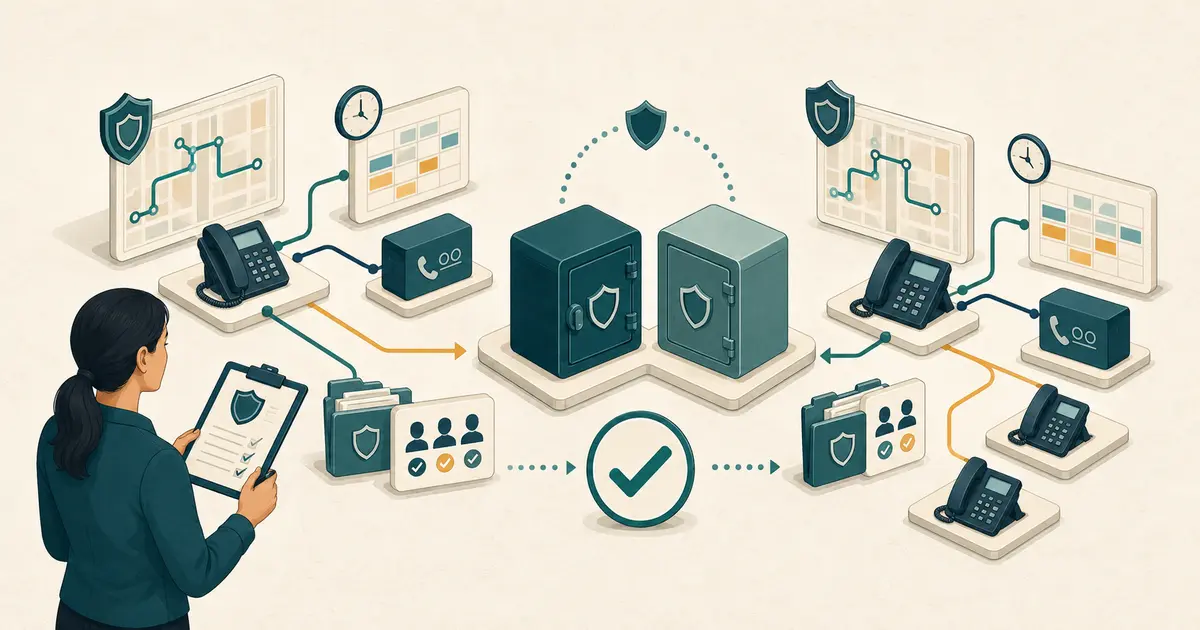
Dental voicemail transcription QA compares fictional voicemail audio with generated text to identify omissions, substitutions, wrong numbers, speaker confusion, and privacy or access problems before opening. A transcript can support review, but staff should not assume it is exact.
Define the role of transcription
Decide whether the transcript is used for notification, search, queue triage, callback preparation, or a temporary summary. Identify the authoritative source for each purpose. If the audio is retained and lawful, it may remain the source for what was said; if audio is unavailable, the practice needs a cautious fallback.
Keep transcription separate from the AI call quality scorecard. Transcription aims to represent words; a summary selects and reorganizes information.
Build a fictional test set
Use no real patient data. Include:
- common and uncommon names;
- phone numbers spoken quickly, repeated, and corrected;
- dates and times with ambiguous phrasing;
- background noise, speakerphone, weak signal, and pauses;
- different accents, speech rates, and communication styles;
- two speakers or a relay introduction;
- dental terms that the system may confuse;
- a caller who leaves an incomplete or silent message.
Do not use the test to evaluate clinical accuracy or urgency. The front desk and transcription system should not diagnose or triage.
Score errors by operational consequence
Track deletion, insertion, substitution, speaker attribution, punctuation, and formatting, but prioritize errors that change the next action: wrong callback digit, reversed date, missing negation, incorrect location, omitted request, or a statement assigned to the wrong speaker.
For each scenario, record expected text elements, actual transcript, critical errors, staff detection path, correction, and whether fallback worked. Avoid one universal accuracy percentage when the test set is small or unrepresentative.
Test the staff workflow
Confirm who receives the transcript, whether they can reach the source voicemail, how they mark uncertainty, and how a correction reaches downstream work. A low-confidence transcript should not quietly create a confident callback note.
Use the minimum-necessary call notes template for the operational handoff and the phone-system access review for permissions. Test exports, notifications, mobile previews, retention, and deletion as well as visible text.
Establish safe fallback language
When a number or request is unclear, staff can say:
“I am returning a message received by the office. Before we discuss the request, may I confirm the best callback number and what you would like the team to review?”
Do not disclose the uncertain transcript to whoever answers. Reverify identity and the request under office policy.
NIST's AI RMF emphasizes context-specific measurement, monitoring, and risk management. HHS minimum-necessary guidance supports limiting unnecessary information. Together, those principles favor a representative fictional test, controlled access, visible uncertainty, and human review.