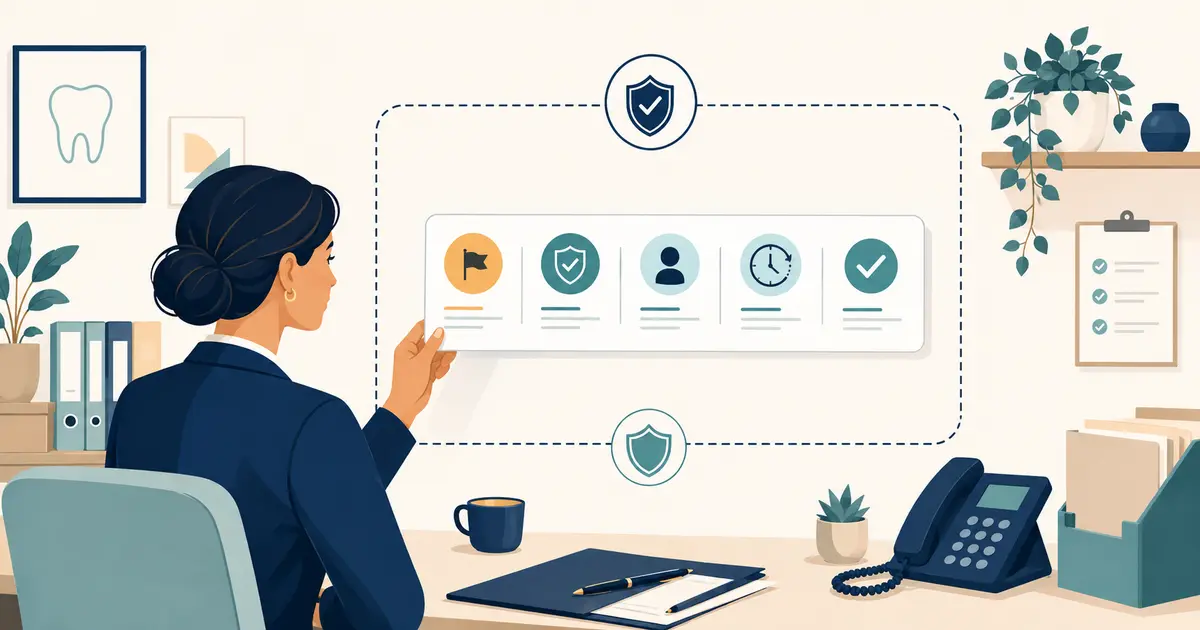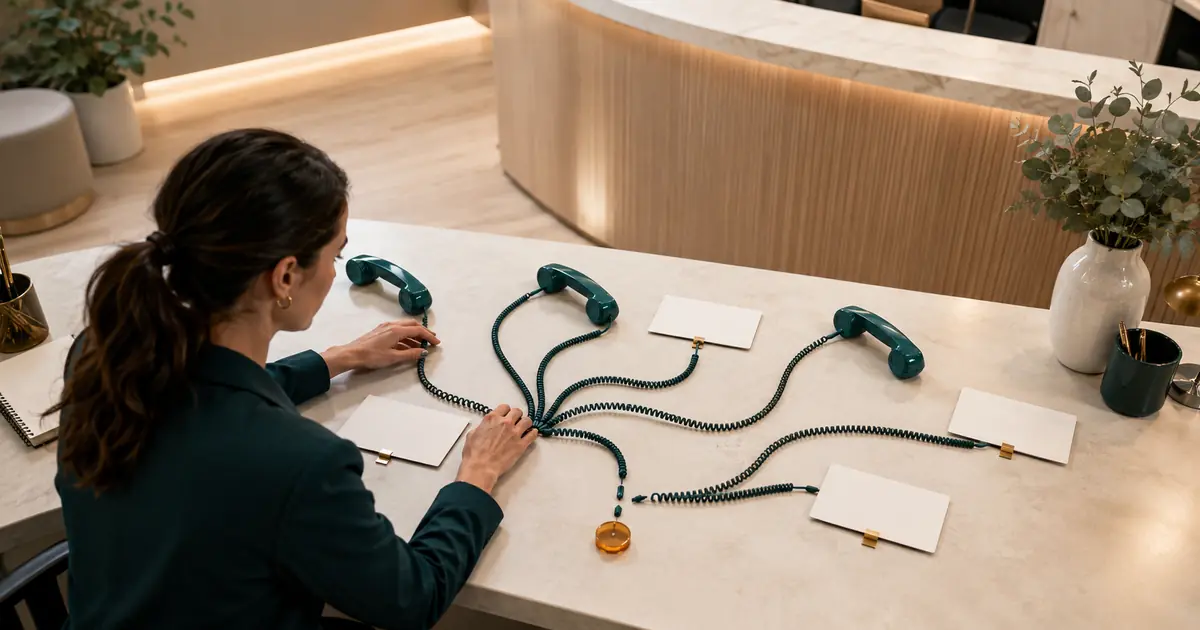
Dental office call forwarding after hours should be configured separately from busy-line and no-answer overflow. Each rule needs a defined trigger, ring or time threshold, destination, caller-ID requirement, voicemail order, response expectation, failure path, and owner-controlled rollback. Do not use one permanent forwarding setting for every call condition.
The phone provider controls which forwarding modes are available and how they behave. Verify the exact service before changing a live office number.
Separate the forwarding conditions
Create a route for each operating condition:
| Condition | Typical trigger | Intended outcome |
|---|---|---|
| After hours | Scheduled office closure | Caller reaches the approved closed-office coverage path |
| Busy line | All available lines or agents are occupied | Additional caller reaches overflow instead of a busy signal |
| No answer | Staff do not answer within a set ring or time threshold | Caller reaches backup coverage before voicemail |
| Unavailable | Phone device, user, or service is unavailable | Caller follows a controlled continuity route |
| Manual incident route | Manager activates during outage or closure | Temporary destination and message replace ordinary routing |
Some providers use different names, codes, portals, or licensing for these features. Ask whether the rules can run together and which one wins when more than one condition applies.
The call-forwarding setup guide covers the initial provider conversation. This guide focuses on the operating rules a manager should document.
Define the staff-first threshold
For no-answer overflow, choose how long the front desk gets before the call forwards.
Consider:
- the number of staffed lines or call appearances;
- average time needed to finish an in-person interaction;
- whether another employee can see and answer the call;
- the caller experience during ringing;
- the answering destination's pickup time;
- the office voicemail threshold;
- whether a queue or hunt group already runs first.
If forwarding starts too early, coverage may take calls the front desk could have answered. If it starts after voicemail, the destination may never receive the call.
Test the full sequence with a timer. Do not rely on a portal label such as “after four rings,” because ring cadence and downstream pickup can vary.
The simultaneous-call queue rules can help align the forwarding threshold with hold and callback ownership.
Keep caller ID usable
The destination should receive the original caller's number when the workflow depends on returning the call, matching the request, or sending an approved follow-up.
Test:
- what appears as
Fromat the destination; - whether the practice's main number replaces the caller number;
- whether transferred calls preserve the same identity;
- how blocked or private numbers appear;
- what staff see in notifications and request records;
- whether a callback reaches the expected person.
Do not build an automated callback or text workflow until caller identity is reliable. If forwarding presents the practice number instead of the caller, stop and resolve the route with the provider.
Control voicemail order
Map every voicemail system in the path:
- office handset or PBX voicemail;
- carrier voicemail;
- answering-service or AI destination;
- fallback voicemail at the destination.
Decide which system should answer for each condition. Verify that the intended destination answers before an earlier voicemail captures the call.
Avoid two competing greetings. A caller should not hear the office's after-hours message, wait through another ring sequence, and then hear an unrelated generic mailbox.
For life-threatening emergencies and the practice's approved dental-emergency path, align the closed-office message with current office policy. The ADA recommends that closed-office messages direct life-threatening emergencies to 911 or the nearest emergency department and explain the approved path for dental emergencies. Review the ADA emergency-treatment guidance.
Build the after-hours schedule
List ordinary hours, early closures, holidays, training days, weather closures, and temporary changes.
For each schedule:
- start and end time;
- time zone;
- destination;
- greeting or script version;
- staff review expectation;
- on-call instruction when applicable;
- owner who approves the change;
- date the ordinary route returns.
Use exact dates in holiday messages. “We reopen tomorrow” can become wrong when a schedule is left active.
Keep a change log. A manager should be able to answer who changed the route, when it took effect, what was tested, and when it will be restored.
Set busy-line and overflow rules
Busy forwarding may activate only when the carrier considers the line busy. In a cloud phone system, a call queue may keep accepting calls even when every employee is occupied, so the busy condition may never occur.
Ask the provider:
- What produces a busy state?
- Does call waiting prevent busy forwarding?
- Does the queue have a maximum length or wait time?
- Can unanswered queued calls forward to another number?
- Are simultaneous-call limits per number, user, device, or account?
- Does overflow happen before or after an announcement?
- Can different locations use different rules?
Use observed call behavior, not assumptions from traditional phone lines.
The busy-line coverage plan explains how to assign answer, hold, callback, and overflow ownership around the route.
Define what the destination may do
Forwarding is only transport. The answering destination still needs a call scope.
Document whether it may:
- identify the practice;
- share approved hours and location;
- collect caller and callback information;
- capture a general request;
- create an appointment request;
- transfer under defined conditions;
- follow an approved after-hours instruction.
Also document that it may not diagnose, provide treatment advice, make clinical triage decisions without proper authority, promise appointment availability, confirm individual benefits, or claim a schedule change that did not occur.
An accurate route to an overpowered script is still a bad workflow.
Create failure and rollback paths
Ask what happens when:
- the destination is busy or unavailable;
- forwarding is rejected;
- caller ID is lost;
- the office internet fails;
- the carrier has an outage;
- the destination answers too slowly;
- a holiday rule remains active;
- the manager cannot access the phone portal.
Define:
- a fallback destination or controlled voicemail;
- the caller message;
- provider and manager alerts;
- a request-recovery process;
- the exact rollback code or portal action;
- who has permission to make the change;
- a second authorized administrator;
- a restoration test.
Store provider support details and account-verification steps in the office runbook without exposing passwords.
Connect these rules to the dental phone outage plan.
Test every route with a matrix
Use outside phones and fictional information.
| Test | Expected result |
|---|---|
| Open, staff available | Front desk gets the first answer opportunity |
| Open, no answer | Call forwards at the approved threshold |
| Open, all staff occupied | Busy or queue-overflow rule activates as designed |
| Closed | After-hours destination and correct script answer |
| Scheduled holiday | Exact holiday message and return date appear |
| Blocked caller ID | Safe handling without an automated callback |
| Destination unavailable | Caller reaches controlled fallback and manager is alerted |
| Voicemail competition | Only the intended mailbox answers |
| Rollback | Ordinary office route returns and passes a fresh call |
Test inbound caller ID, audio, transfer, request delivery, and the staff-visible record. Repeat after a provider change, office-hours change, number change, or phone-system update.
Assign route ownership
Maintain one forwarding register:
- main number and location;
- provider and service type;
- rule name;
- trigger and threshold;
- destination;
- schedule and time zone;
- caller-ID result;
- voicemail order;
- fallback;
- primary and backup administrators;
- last test date;
- next review date.
The manager owns the operational result even when a vendor configures the route. Require confirmation and a test for every change.
Dental call-forwarding checklist
- [ ] After-hours, busy, no-answer, unavailable, and incident routes are separate.
- [ ] The actual provider supports the required rules.
- [ ] Staff-first thresholds are timed and tested.
- [ ] Original caller ID reaches the destination.
- [ ] Voicemail systems answer in the intended order.
- [ ] Ordinary, holiday, and temporary schedules have owners and return dates.
- [ ] The destination's call authority is documented.
- [ ] Failure and rollback paths are written.
- [ ] A second administrator can restore the route.
- [ ] Outside test calls passed every condition.
- [ ] The forwarding register and review date are current.
Dental office call forwarding works when every condition has one deliberate route and one accountable owner. Separate the rules, verify the provider behavior, preserve caller identity, and test the failure path before patients depend on it.