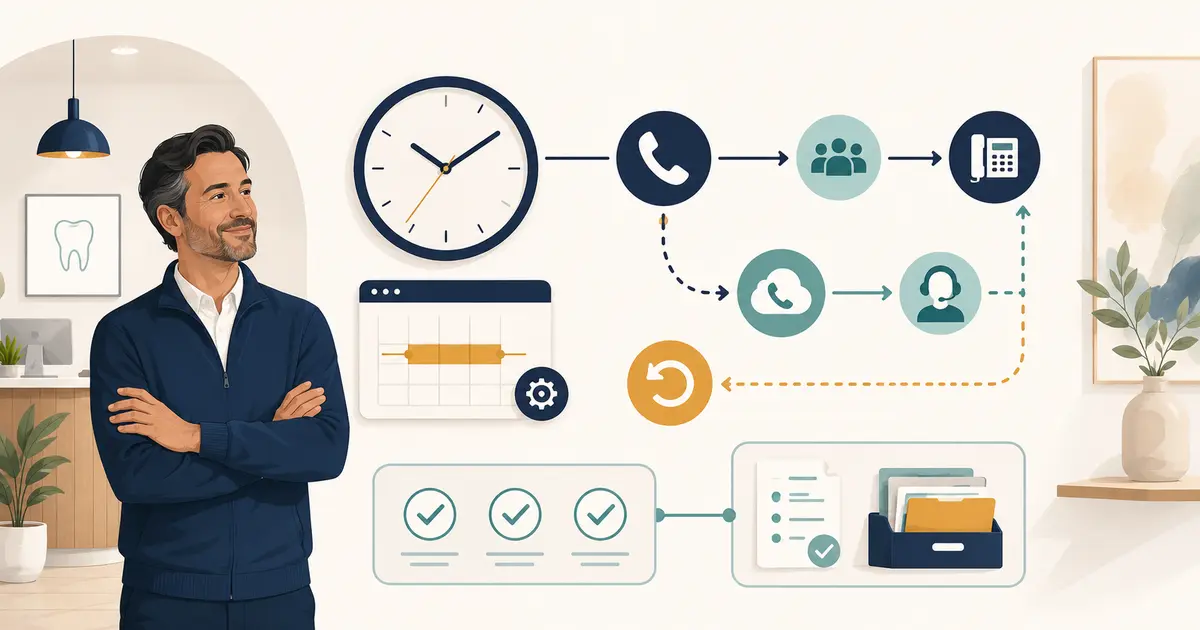
A dental phone system admin succession plan prevents one employee, owner, consultant, or vendor from becoming the only person who can change routes, open a support case, recover an account, or protect the practice's number. Create the plan while the current administrator is available—not during a departure or outage.
Map authority, not just logins
List every administrative function: user access, routing, schedules, voicemail, recordings, numbers, billing, support, exports, integrations, emergency-calling settings, and security events. For each, name the primary role, backup role, approver, and external provider contact.
Run the dental phone system access audit to find shared accounts, former staff, excessive privileges, unknown recovery addresses, and unmanaged vendor access. Replace shared sign-ins with individual accounts wherever the platform supports them.
Protect recovery and provider identity
Record the legal business name, account number, authorized contacts, billing evidence, support PIN process, and provider's identity-verification procedure in an approved secure location. Do not place passwords, one-time codes, or complete recovery secrets in the succession checklist.
Use multifactor authentication and maintain more than one properly authorized administrator. CISA recommends MFA because a stolen password alone is then insufficient to access the account. Avoid tying recovery solely to one person's private email or personal phone.
Number ownership deserves separate attention. Align authorized contacts and transfer locks with the phone-number port-out fraud checklist.
Verify the backup administrator
The backup should sign in with their own account, reach the provider's support channel, locate current configuration documentation, and complete a safe read-only review. Use a controlled test to prove they can perform an approved change and reverse it without exposing patient information.
Confirm that required exports are accessible and understandable through the call data portability plan. A backup account that cannot retrieve evidence or identify the current route is not operationally ready.
Run a succession drill
Use a fictional scenario: the primary administrator is unavailable and the office must correct an after-hours route. The backup should identify the approval path, access the service, capture the prior state, make or simulate the change, validate it, record evidence, and notify the team.
Log gaps as corrective actions with owners and dates. The drill should not involve disabling the primary administrator or making an unnecessary live change.
Offboard without creating an outage
Before a planned departure, transfer provider authority, billing ownership, documentation, open cases, integration ownership, and recovery methods. Then remove the departing person's access, revoke sessions and tokens, rotate shared secrets that cannot yet be eliminated, and review recent changes.
For an unexpected departure, activate the incident and continuity paths. Preserve evidence and avoid destructive cleanup before the practice understands what the account controls.
Missed Calls Dental boundary
Missed Calls Dental manages access to its own supported product environment, not the practice's carrier, phone platform, domain, email, billing, or public-number accounts. The practice owns its authorized contacts, administrative succession, access reviews, provider relationships, and offboarding. SMS is separate and readiness-gated.
Sophia Bennett is an editorial pen name. This article was reviewed for accuracy and alignment with Missed Calls Dental product information.