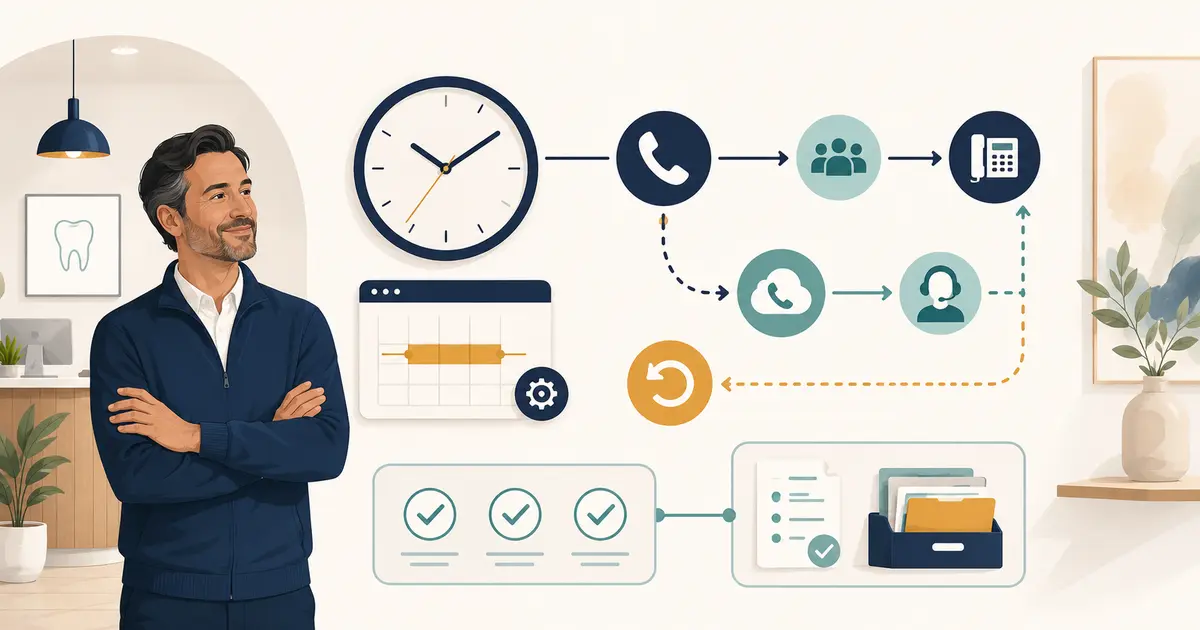
A dental phone maintenance window plan should make planned technical work boring: the change has a bounded scope, callers retain a tested path, rollback is ready, and the practice knows exactly how it will prove service is restored.
Define scope and success
Record the change owner, business approver, vendor contact, affected numbers, locations, devices, routes, integrations, start time, maximum duration, and reason for the work. State what is deliberately out of scope.
Translate success into observable checks. “Upgrade completed” is not enough. Better criteria include inbound calls reaching the expected destination, outbound caller identity displaying correctly, transfers working, voicemail available, emergency-calling configuration unchanged or revalidated, and reporting events appearing as expected.
Use the dental phone routing change process when the work changes destinations or schedules.
Protect caller continuity
Choose a window based on actual call patterns, staff coverage, vendor availability, and the time needed to reverse the work. Low volume does not mean zero patient need. Prepare a fallback route, monitored voicemail, alternate published instruction, or staffed number appropriate to the scope.
The dental phone outage plan should remain usable if planned work becomes an incident. Assign someone other than the technician to watch caller access and open requests during the window.
Set stop and rollback conditions
Document the last known good configuration and export settings where supported. Name the person authorized to stop the change. Define thresholds such as failed primary-number tests, incorrect routing, loss of transfer capability, emergency-location uncertainty, or elapsed time beyond the window.
Rollback must include a method, owner, estimated duration, and verification set. “Call the vendor” is an escalation step, not a complete rollback plan.
Run a timed test script
Before work begins, capture baseline tests. After the change, repeat the same script from external and internal paths. Include open and closed hours when schedules are affected, direct and forwarded calls, hold and transfer, voicemail, and representative devices.
Reuse the dental phone system acceptance test rather than inventing success criteria during the window. Preserve timestamps, test origins, destinations, results, and provider case identifiers without including unnecessary patient information.
Close with reconciliation
Tell staff when the window begins, when fallback is active, when normal service is verified, and what behavior still needs attention. Reconcile every voicemail, captured request, abandoned path, and staff note generated during the change. Assign owners and due times.
If the window exceeds its boundary or creates an unplanned loss of service, transition to incident handling. NIST guidance connects preparation, detection, response, recovery, and improvement; record the facts and review corrective actions after stability returns.
Missed Calls Dental boundary
Missed Calls Dental may be one configured destination included in a practice's maintenance test. It does not control the practice's carrier, network, devices, public numbers, emergency calling, or unrelated routes. The practice and its providers own change approval, fallback, rollback, technical validation, and request reconciliation. SMS is separate and readiness-gated.
Natalie Chen is an editorial pen name. This article was reviewed for accuracy and alignment with Missed Calls Dental product information.