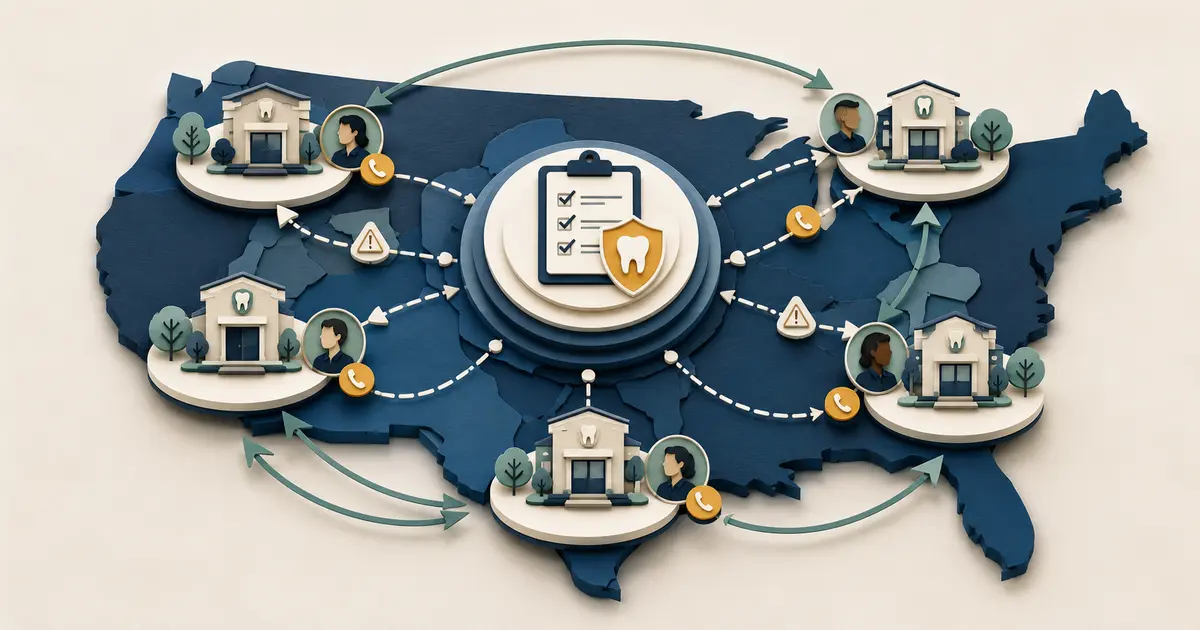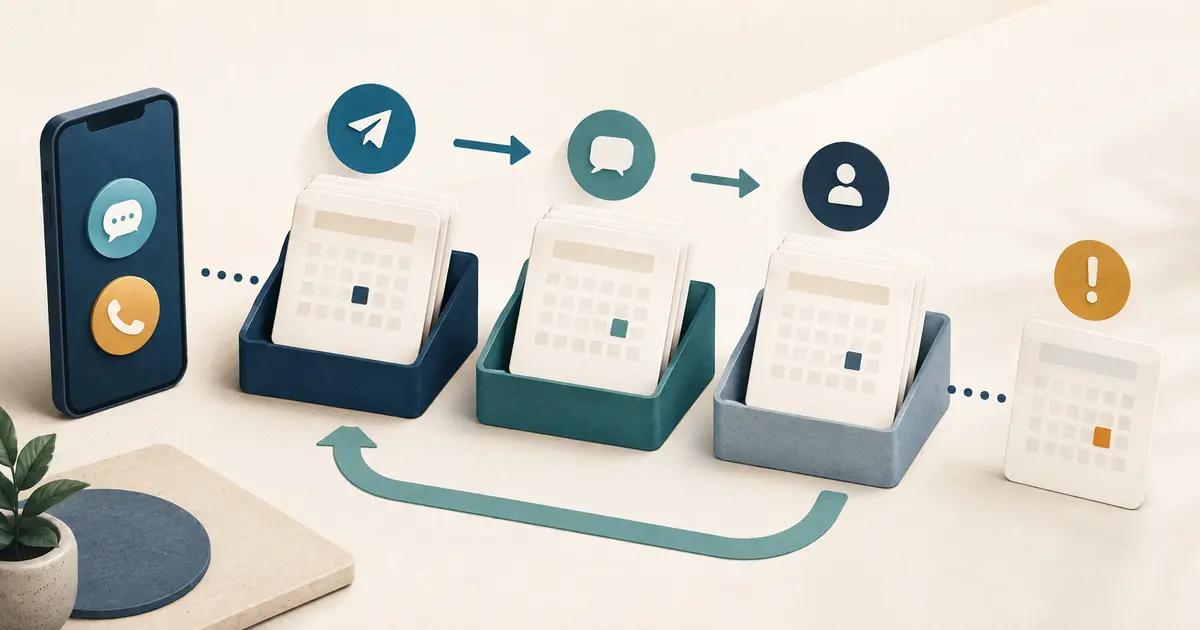
Dental answering services for DSOs should create a consistent caller experience without pretending every location is identical. The central team can define the call scope, required fields, privacy controls, service levels, and reporting. Each practice still needs accurate local facts, named follow-up owners, provider-specific escalation instructions, and a tested path back to the correct front desk.
The design challenge is not simply answering more calls. It is turning calls from many locations into accurate, location-aware requests that someone owns.
Separate the central standard from local facts
Start with two layers.
The central standard should define:
- which call conditions use outside or automated coverage;
- the approved greeting structure;
- information every request must contain;
- tasks the answering role may and may not perform;
- privacy, access, retention, and incident requirements;
- request statuses and escalation triggers;
- testing and reporting methods;
- who can approve a workflow change.
The location record should define:
- practice name and public phone number;
- physical address and directions;
- current hours and closure dates;
- services approved for public description;
- languages and accessibility resources;
- general insurance-participation wording;
- new- and existing-patient instructions;
- on-call and urgent-concern paths;
- primary and backup front desk owners;
- local exceptions to the central standard.
Keep the local facts in a controlled source with an owner and review date. A standardized answer using the wrong location hours is still wrong.
The multi-location answering-service guide explains the basic routing problem. A DSO plan adds central governance, comparable measures, and change control across a larger network.
Define one bounded answering role
Write an authority matrix before selecting a service.
| Call task | Central rule | Local decision |
|---|---|---|
| Identify the practice | Required on every call | Exact location name |
| Share office facts | Approved facts only | Hours, services, address, policies |
| Capture a request | Required fields and status | Local queue and owner |
| Scheduling | Never imply completion without verified authority | Whether an authorized local workflow exists |
| Insurance | No individual benefit confirmation | Approved general participation language |
| Clinical statements | No diagnosis or treatment advice | Practice-approved operational handoff |
| Urgent concerns | Follow a documented non-clinical path | On-call contacts and fallback |
| Completion | Accurate expectation and request status | Local response ownership |
Do not expand authority merely to make the service appear more capable. A request captured accurately is more useful than a confident promise that the practice cannot keep.
Build location-aware routing
Use information the caller or phone route can reliably establish. Do not infer a location from an area code, a prior visit, or the nearest office unless the caller confirms it.
A routing sequence can be:
- identify the brand and the location reached;
- ask which location the caller needs when it is not known;
- confirm the location before sharing hours or policies;
- record the caller's general request;
- apply the correct location's escalation or closure instruction;
- create a request in that location's owned queue;
- alert a central monitor only when a defined exception occurs.
Test transfers between locations. Confirm that the destination receives caller information and that the originating request is not left open as a duplicate.
The practice-size AI receptionist comparison covers why multi-location routing, access, and fact ownership require more structure than a single-office rollout.
Standardize the handoff record
Every DSO location should receive the same minimum handoff structure:
- call date, time, and time zone;
- brand and location;
- incoming route or number;
- caller-provided name and callback number;
- new or existing patient status when known;
- general reason for contact;
- preferred callback window;
- facts already shared;
- transfer or escalation result;
- assigned location and employee;
- current status and next action.
Keep local free-text additions short. If one location records a complete request while another receives only a transcript link, the central team cannot compare workflow quality or identify unresolved work consistently.
Use one status vocabulary, such as new, acknowledged, assigned, waiting, completed, and blocked. Define exactly who may change each status and what evidence marks completion.
Preserve local ownership
Central coverage does not remove the need for a local owner. Assign:
- one primary opening-shift reviewer;
- one backup for absence or workload;
- a manager for aging or blocked requests;
- a central operator for cross-location and system failures.
Set expectations by workflow and location rather than advertising one universal response time. A specialty location, holiday schedule, or provider absence may require a different process.
The central team should see unassigned and aging work, but local staff should not wait for headquarters to resolve ordinary callbacks. The phone-responsibility guide can help divide answering, documentation, escalation, and return-call duties.
Review privacy, contracts, and access
Map every entity that creates, receives, maintains, or transmits caller information: the phone carrier, answering provider, AI vendor, hosting service, notification tool, support team, analytics platform, and subcontractors.
HHS explains that a vendor performing services for a covered entity that involve protected health information may be a business associate, and required assurances generally belong in a written arrangement. HHS also lists third-party AI chatbots and cloud providers as examples when they handle PHI on behalf of a provider. Review the current HHS business-associate guidance with qualified advisors for the actual DSO structure.
Verify:
- which legal entity contracts for each location;
- whether agreements cover all participating practices;
- role- and location-based access;
- central support and vendor support access;
- recording and transcript settings;
- retention, export, deletion, and backup behavior;
- incident notification and investigation;
- employee onboarding, transfer, and removal;
- what appears in email, text, and push notifications.
Do not give every central employee access to every request merely because the platform makes that easy.
Include accessibility in the phone design
Centralization should not remove an accessible contact path. The ADA notes that automated-attendant and interactive voice response systems used by covered practices may need to support effective communication through approved relay and auxiliary services. Review the ADA guidance on auxiliary aids and telecommunications for applicability and qualified advice.
Test relay calls, language-assistance handoffs, slow speech, keypad failure, and callers who cannot use a menu. Give staff a documented alternative when the ordinary route does not work.
Pilot representative locations
Do not choose only the easiest office. Include a small but representative group:
- one single-provider location;
- one higher-volume location;
- one location with extended or unusual hours;
- one multi-specialty location when applicable;
- one location with a known routing or staffing challenge.
Run fictional calls for new patients, existing patients, wrong locations, insurance questions, urgent language, transfers, duplicate calls, closures, inaccessible menu paths, and service outages.
Inspect the entire chain: what the caller hears, what the system records, who receives the request, whether the employee can act, and whether the final status is accurate.
Measure comparable outcomes
Useful DSO measures include:
- eligible calls offered to coverage by location;
- requests captured with all required fields;
- time to acknowledgment and completed follow-up;
- unassigned and aging requests;
- wrong-location and transfer errors;
- duplicate requests prevented;
- incorrect office-fact answers;
- escalation and fallback frequency;
- staff corrections after review;
- requests closed without a documented outcome.
Compare rates using the same definitions. A location should not appear stronger because it labels an attempted callback as completed while another waits for the caller's issue to be resolved.
Use the call-tracking metrics guide to establish a small, auditable measurement set.
DSO answering-service checklist
- [ ] Central standards and local facts are separate.
- [ ] Every local fact has an owner and review date.
- [ ] The answering role has explicit authority limits.
- [ ] Location selection is confirmed rather than inferred.
- [ ] Every request uses one standard handoff format.
- [ ] Local primary and backup owners are named.
- [ ] Central monitoring focuses on exceptions and aging work.
- [ ] Privacy, contracts, access, retention, and incidents are reviewed.
- [ ] Accessibility and relay paths are tested.
- [ ] The pilot includes representative locations and failure cases.
- [ ] Metrics use the same definitions across the DSO.
- [ ] Rollback and change approval are documented.
Dental answering services for DSOs work best when centralization creates discipline, not distance. Standardize the role, data, testing, and measures; preserve accurate local facts and named local ownership for every caller request.