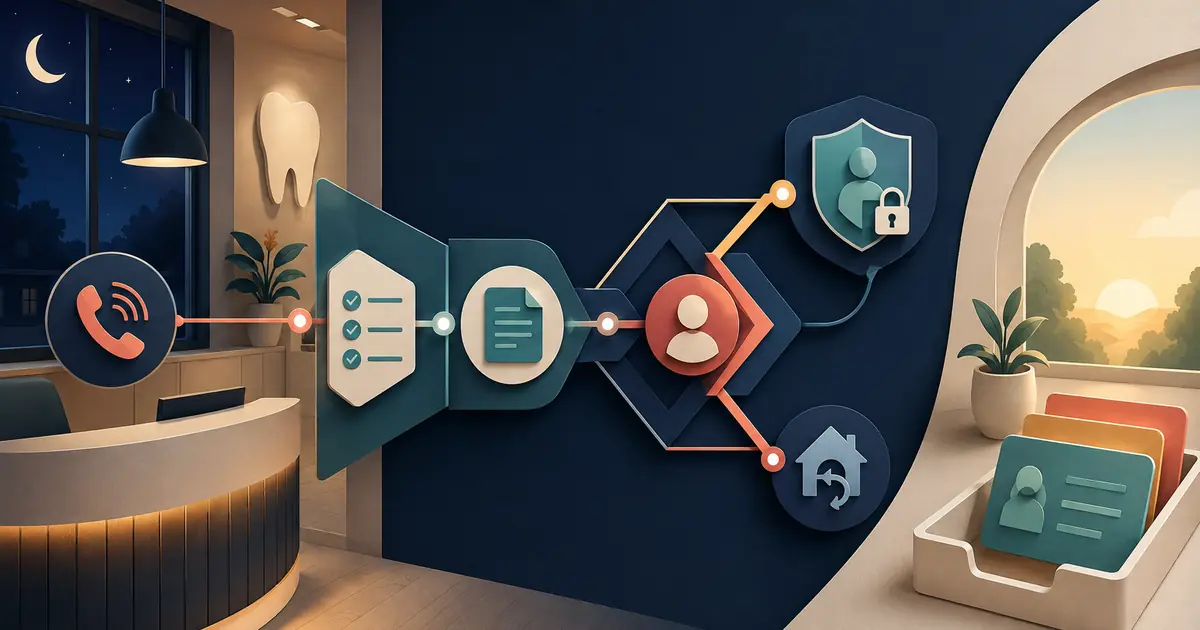
An after-hours AI receptionist for dentists should have a smaller job than the daytime front desk. It can explain approved practice facts, capture a request, repeat back key details, and route the request according to documented rules. It should not diagnose a condition, decide how urgent a symptom is, promise treatment, quote an unapproved fee, or imply that an appointment is confirmed when the schedule has not accepted it.
That boundary makes 24/7 coverage more useful. A caller receives a clear next step while the practice keeps clinical and operational decisions with qualified people.
Define the after-hours job in one page
Write a scope statement before selecting a script or vendor. A practical scope might allow the receptionist to:
- state the practice name, address, regular hours, and current closure notice;
- describe services only with language the practice has approved;
- capture a new- or existing-patient request;
- collect a callback number and preferred contact method;
- explain when the office is expected to review routine requests;
- follow a practice-approved escalation path;
- transfer or forward a request when a defined condition is met.
The same statement should explicitly prohibit:
- diagnosis, clinical advice, or treatment recommendations;
- independent symptom classification or urgency decisions;
- promises about insurance coverage, fees, or patient responsibility;
- prescribing, refills, or medication instructions;
- appointment confirmation without a completed scheduling action;
- disclosure of patient information without the approved identity process;
- improvising when practice information is missing or contradictory.
Use the after-hours dental office call guide to map the broader workflow around that scope.
Give the system an approved source of truth
An AI receptionist should not assemble answers from the public internet or from old documents. Maintain a controlled practice record containing:
- public location and contact details;
- current regular and holiday hours;
- approved service descriptions;
- accepted languages and accessibility resources;
- general insurance-participation wording;
- routine request response expectations;
- exact transfer and escalation instructions;
- owners and expiration dates for every time-sensitive fact.
Make one employee responsible for each category. A holiday-hours record without an owner will eventually become stale. A service description without an approval date may overstate what a provider currently offers.
The receptionist needs a safe response when a fact is unavailable:
“I don't have an approved answer for that question. I can record your request for the office team to review when it reopens.”
That is better than a confident invention.
Separate an urgent concern from clinical triage
The practice must decide what the after-hours system can say when a caller raises a health concern. The safest design uses language approved by the practice and its qualified advisors. It does not ask the AI to determine a diagnosis or severity.
A bounded pattern is:
- state that the automated receptionist cannot provide clinical advice;
- play the practice-approved instructions exactly;
- present any defined on-call or transfer option;
- direct callers to emergency services when the approved script requires it;
- record only the information needed for the authorized handoff;
- log whether the transfer or notification succeeded.
The dental emergency voicemail script explains how to write clear closed-office language without presenting voicemail or automation as a clinician.
Do not rely on a model-generated statement that “sounds medically reasonable.” A safe workflow is determined by the practice, reviewed by qualified people, and tested with realistic scenarios.
Capture requests without implying a booking
After-hours appointment interest often begins as a request. Unless the system has completed a verified scheduling transaction under practice rules, use language such as:
“I can send your requested day and time to the office. Your appointment is not confirmed until the practice accepts the request and sends a confirmation.”
Capture only what the next owner needs:
- caller name under the approved process;
- callback number and contact preference;
- new or established patient status;
- general reason for the request using approved categories;
- preferred dates or windows;
- location or provider preference, if applicable;
- consent or communication preference required by practice policy.
The after-hours appointment request workflow provides a fuller request-to-confirmation pattern.
Design privacy and vendor controls around the data path
Map where call data goes: audio, transcript, extracted fields, notifications, integrations, analytics, support access, backups, and deletion. Determine which parties create, receive, maintain, or transmit protected health information on behalf of the practice.
HHS explains that a person or entity performing certain functions involving protected health information for a covered entity may be a business associate, and its 2026 guidance includes cloud and AI-service examples. Review the HHS business-associate guidance with qualified privacy and legal advisors.
The owner should be able to answer:
- What data is collected during the call?
- Which vendors and subprocessors receive it?
- Which employees can access it?
- How is access logged and reviewed?
- How long are audio, transcripts, and request records retained?
- How are corrections, deletion, incidents, and contract termination handled?
- Does the practice have the agreements its situation requires?
Apply role-based access. A reporting user may need counts and outcomes, not full call content. Send sensitive details only through approved systems rather than ordinary email or consumer messaging.
Make failure visible
Twenty-four-hour availability does not guarantee twenty-four-hour success. Internet service, carriers, integrations, credentials, and vendor systems can fail. Define:
- what callers hear when the primary path is unavailable;
- where calls go if the AI cannot answer or complete a transfer;
- how failed notifications are retried;
- who receives an alert;
- how the team reconciles calls after service is restored;
- how quickly the practice can disable the automation or restore the previous route.
The weekend and holiday coverage guide can help the practice test closure-specific exceptions.
Monitor the full request path, not only whether a call connected. A successful call with a lost handoff is still an operational failure.
Test with a fixed scenario set
Before launch, run fictional calls covering:
- a routine new-patient request;
- an established patient asking for a callback;
- a request for a specific date that is unavailable;
- an insurance or fee question beyond approved wording;
- a clinical concern that triggers the approved boundary;
- a caller who asks whether a request is confirmed;
- a caller using a relay service or other accessibility path;
- a caller who provides incomplete or conflicting information;
- a transfer failure and notification failure;
- a holiday closure with special instructions.
Score factual accuracy, prohibited promises, required disclosures, handoff completeness, transfer outcome, and fallback behavior. NIST's voluntary AI Risk Management Framework offers a useful structure for governing, mapping, measuring, and managing AI risks.
Repeat the tests after script, model, integration, routing, or practice-information changes. Version the test set so the team can compare results.
Measure useful outcomes
Avoid treating “calls answered” as the whole result. Review:
- eligible after-hours calls and answer rate;
- routine requests captured completely;
- requests delivered to the correct queue;
- transfers attempted and completed;
- time from reopening to staff review;
- corrections caused by inaccurate information;
- callers who believed a request was a booking;
- duplicate or missing request records;
- fallback events and recovery time;
- staff minutes spent resolving exceptions.
Listen to a small, authorized sample under practice policy and review unusual outcomes. Counts show where to look; case review shows what to improve.
Launch in a reversible sequence
Start with a narrow window or one location. Keep the old route available. Assign a daily reviewer during the pilot and reconcile every request against the destination queue. Expand only after the practice sees consistent accuracy, handoff, and recovery.
Use this owner checklist:
- [ ] Allowed and prohibited tasks are written.
- [ ] Practice facts have owners and review dates.
- [ ] Clinical-boundary language is approved.
- [ ] Appointment requests cannot be mistaken for confirmations.
- [ ] Privacy, vendors, access, retention, and incidents are reviewed.
- [ ] Transfers, alerts, fallback, and rollback are tested.
- [ ] Accessibility paths are included.
- [ ] A fixed scenario set passes before expansion.
- [ ] Managers review outcomes and exceptions.
An after-hours AI receptionist for dentists is safest when it has narrow authority, current facts, explicit escalation, visible failure, and a human-owned follow-up queue. The goal is not autonomous dentistry. It is a dependable bridge between a closed office and the team that can act.