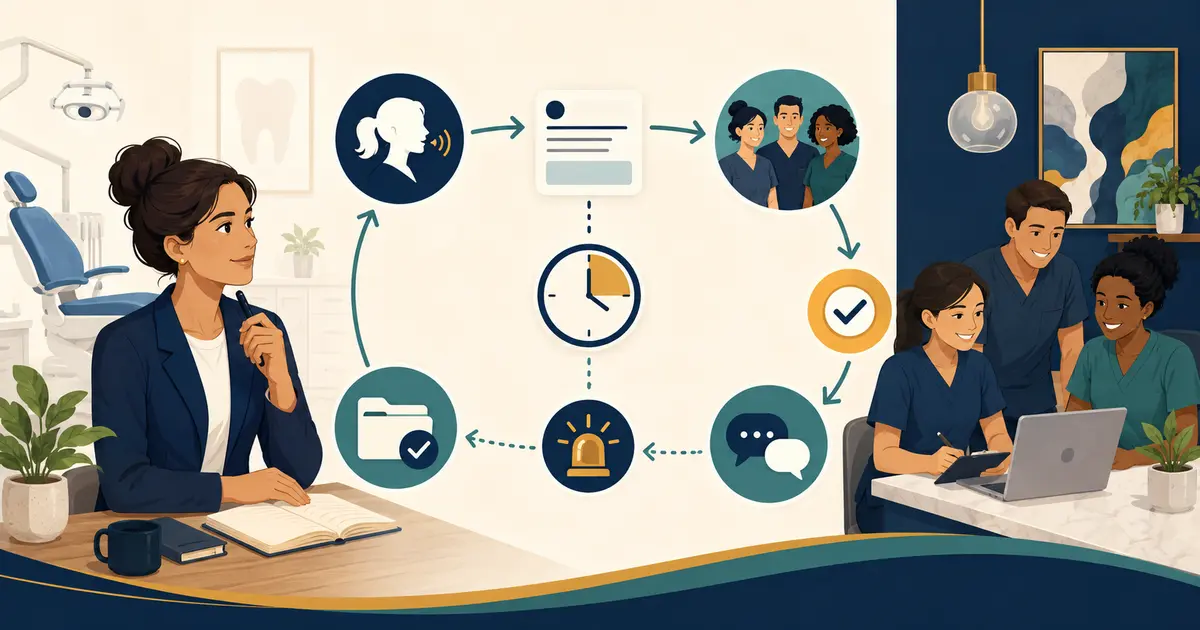
A virtual receptionist for a dental office is a service model, not one standard feature set. The person or system may answer calls remotely, automate selected conversations, or combine both. A future practice should define the work first and then choose the model that can perform it with visible controls.
Start with the gap you need to cover. Is the problem lunch, evenings, simultaneous calls, staff absence, or every inbound call? The answer changes routing, staffing, cost, data exposure, and the patient experience.
Separate the three common models
“Virtual dental receptionist” can describe several arrangements:
| Model | Typical strength | Main control question |
|---|---|---|
| Remote human | Judgment within training and escalation rules | Who employs, supervises, and updates the person? |
| Automated voice system | Consistent repeatable capture at variable times | Which decisions are prohibited and how are failures surfaced? |
| Hybrid | Automation for routine work plus human exceptions | Where does responsibility transfer and who watches the queue? |
Do not compare labels. Compare the actual call path, approved tasks, operating hours, staffing, escalation, records, and failure handling. The remote, automated, and outsourced answering comparison offers a deeper model-by-model view.
Missed Calls Dental provides AI answering for eligible forwarded missed calls and saves requests for front-desk follow-up. It does not replace the practice's team, book or change appointments, make clinical decisions, or verify insurance benefits.
Write the job before buying the service
List each call type expected before opening: new-patient inquiries, existing-patient questions, referrals, appointment requests, changes, billing questions, insurance questions, records requests, vendors, complaints, and possible emergencies.
For each, specify:
- information the receptionist may state;
- information it may collect;
- source of every approved fact;
- action it may take;
- action requiring office staff;
- escalation destination and hours;
- record created and required fields;
- expected next step and owner.
This is the virtual role's job description. It should be narrower than the dental office phone responsibilities plan because the practice still owns clinical, financial, scheduling, and relationship decisions.
Build an approved information source
A receptionist cannot be more reliable than its source material. Create one approved office profile containing name, locations, hours, holiday exceptions, parking, accessibility contacts, languages, services described at a general level, accepted inquiry channels, and escalation instructions.
Assign an owner for every field. Decide how a temporary closure, provider absence, or changed phone number becomes effective. Keep an audit trail of who approved changes and when. A copied website page is not enough if it is stale or omits exceptions.
For AI, test how it handles a question outside the approved profile. The right behavior may be to say that the office team will follow up, not to infer an answer. NIST's AI Risk Management Framework emphasizes managing risks across design, deployment, use, and evaluation rather than trusting a model label.
Define request states
Avoid a single status called “handled.” A caller can be heard without the request being resolved. Use states that staff can interpret:
- captured;
- review required;
- callback assigned;
- contact attempted;
- caller connected;
- appointment request reviewed;
- confirmed by authorized staff;
- closed with a documented reason.
If the virtual receptionist offers a time, determine whether it is merely a preference, a temporary hold, or a confirmed appointment. Those states must not share the same wording. The appointment request call workflow shows a safe handoff pattern.
Plan routing and continuity
Confirm how the existing phone number will route calls. Test ring-no-answer, busy, closed-hours, simultaneous calls, voicemail order, caller ID, transfers, and recovery after forwarding is disabled. Phone-provider behavior is provider-specific.
Create a manual fallback. The office should be able to post a verified message, receive urgent escalations through its approved process, recover undelivered requests, and resume normal routing. Keep vendor support contacts outside the failed system.
Do not let a virtual service become the only holder of office facts or pending requests. Define export, retention, deletion, access removal, and termination procedures before launch.
Review privacy and access
Map the information collected for each task. A routine hours question should not require a full patient profile. A callback request may need a name, number, reason, and preference, but the practice should decide what is reasonably necessary.
Identify every party receiving data, including phone, answering, hosting, messaging, analytics, and support vendors. Determine business associate responsibilities and contractual needs from the actual relationship. HHS guidance explains that covered entities and business associates must define permitted uses and safeguards; seek qualified advice for the practice's arrangement.
Use individual accounts where practical, least privilege, secure authentication, access logs, retention rules, and a tested incident process. A remote worker should not share credentials or download patient details to an unmanaged device.
Test the real patient experience
Use fictional or approved test cases before opening:
- a caller who speaks quickly, quietly, or with background noise;
- a name or number correction;
- a question with an outdated office answer;
- a new patient asking about price or insurance;
- an existing patient requesting a change;
- a referral office with specific documentation needs;
- a caller asking for clinical advice;
- a possible emergency under the approved policy;
- a caller who needs language or accessibility support;
- silence, disconnection, duplicate calls, and vendor outage.
Evaluate accuracy, clarity, transparency, correction handling, respectful tone, prohibited decisions, complete handoff, and whether the caller understands the next step. Do not score only voice naturalness.
The AI receptionist pros and cons guide can help structure the broader adoption discussion.
Plan staffing around the handoff
A virtual receptionist changes work; it does not remove ownership. Estimate how many captured requests may arrive by time of day, how quickly staff can review them, and which role covers breaks, absences, and days off.
Create queue rules for duplicates, spam, wrong locations, incomplete numbers, complaints, urgent escalations, and records that arrive near closing. Give managers a way to see aging and reassign work. Train staff to compare the handoff with the caller's actual statement rather than assuming an automated summary is complete.
Run a staged launch
Begin with a narrow condition and approved call categories. Observe calls, correct the knowledge source, and review exceptions daily. Expand only after the practice can prove that records arrive, owners act, and callers receive accurate next steps.
Track eligible calls, answered calls, complete requests, correction rate, escalation rate, delivery failures, callback time distribution, connected callers, final outcomes, complaints, and unresolved aging. Use the practice's own baseline; do not borrow unsupported benchmarks.
A successful setup gives the future practice control. The service model is clear, callers know what happens next, the team owns every handoff, and the practice can test, pause, or remove the system without losing operational knowledge.
Keep a launch decision log
Record the initial problem, selected coverage hours, excluded tasks, approved office-profile version, routing tests, privacy review, queue owner, defects, and launch date. For every change, note who requested it, what caller behavior may change, which scenarios were retested, and who approved expansion.
This log prevents the practice from gradually turning a narrow virtual role into an undefined front desk. It also helps new staff understand why the service gives a particular answer or transfers a particular call. Review the log alongside real exceptions, not only vendor release notes. If the practice cannot explain a change or reverse it safely, keep the prior scope until the evidence is complete.