A pediatric dental answering service should capture the caller's relationship to the child, provide only approved office information, and follow clinician-designed escalation instructions. It should not diagnose, triage, promise treatment, or assume that the caller has authority to receive protected information.
Design the workflow before the practice opens so staff, the answering provider, and on-call clinicians share the same boundaries.
Define the caller and patient fields
For a pediatric inquiry, the caller and patient are often different people. The message should preserve:
- caller name and relationship as stated;
- child or patient name as stated;
- callback number and alternate number when approved;
- claimed location or provider;
- general request in the caller's words;
- time received;
- language or accessibility request;
- whether the caller reports being a current patient family;
- owner and delivery status.
Do not infer guardianship or disclosure authority from a shared surname. Staff should apply the practice's approved identity and authorization process before discussing protected details.
Build a controlled knowledge source
Approve the facts the service may state:
- practice and location names;
- posted hours and closure dates;
- general age or referral policies only when final;
- directions and accessibility information;
- public payment and benefits wording;
- new-patient request process;
- after-hours contact process;
- approved urgent-care instructions;
- communication channels and monitored hours.
Give each fact an owner, effective date, and review date. A pre-opening draft website should not automatically become the call script.
Separate request capture from clinical decisions
Parents and caregivers may describe pain, swelling, trauma, bleeding, fever, behavior, medication, or an appliance problem. The answering service may capture the caller's words and activate the practice's approved route. It should not decide urgency or recommend treatment.
The American Academy of Pediatric Dentistry states that emergency care and after-hours access are important parts of continuous care and encourages practices to educate families on how to access emergency care. The clinician must convert that responsibility into approved office-specific instructions.
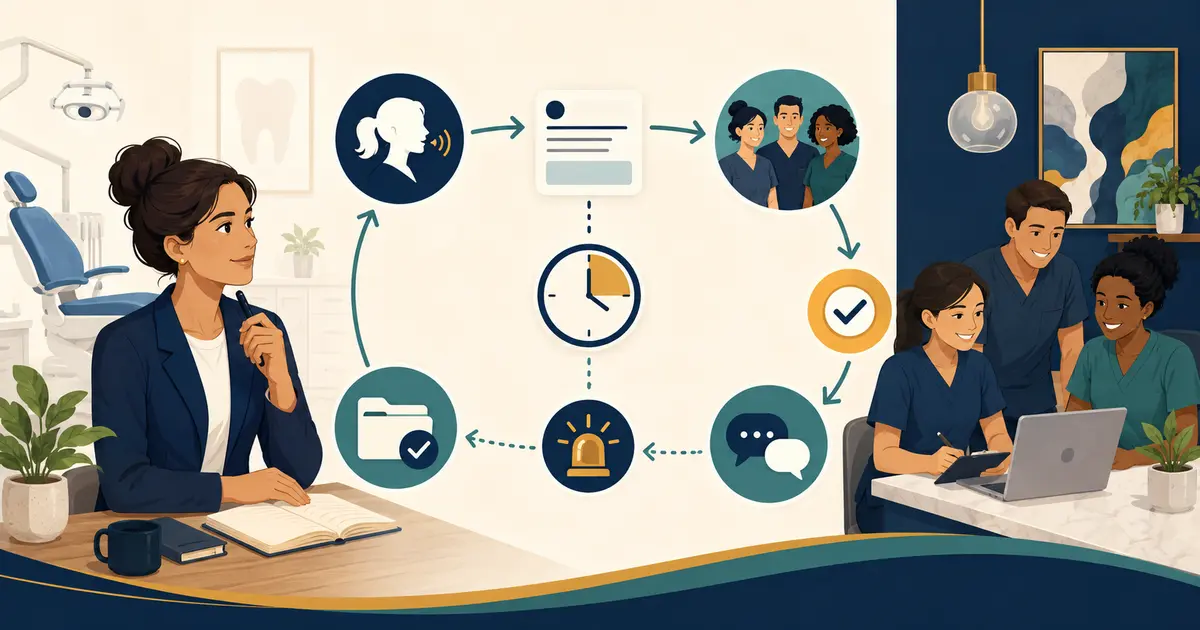
Use the non-clinical urgent-call workflow to define message and escalation states.
Design the on-call chain
For every trigger in the clinician-approved script, document:
- primary contact;
- backup contact;
- notification channel;
- acknowledgment rule;
- retry interval;
- final fallback wording;
- record location;
- next-day reconciliation.
Test failed delivery and no acknowledgment. “Message sent” is not proof that a clinician received or accepted it.
Do not describe an answering service as “24/7 pediatric emergency care” unless the full clinical service and availability claim is accurate and approved.
Plan language and disability access
Families may need interpreters, relay calls, or other communication aids. Record the preferred method without making a clinical employee or a child the default interpreter.
ADA.gov explains that businesses serving the public must communicate effectively with people who have communication disabilities and should consider the nature, length, complexity, context, and person's usual method of communication. HHS provides separate language-access guidance for covered organizations.
The accessible dental phone plan provides a detailed operational checklist.
Review privacy and recording choices
Map what the service stores: audio, transcript, summary, caller number, notifications, and support records. Decide whether recording is needed, who may access it, how corrections work, and when records are deleted. Recording and transcription add consent and state-law questions beyond HIPAA.
If the vendor handles protected health information on behalf of the practice, determine its business associate role and contract requirements. HHS sample provisions address safeguards, incidents, subcontractors, access, and termination.
Limit text and voicemail previews. A message such as “call about your child's emergency” may reveal more than needed on a shared device.
Test family-call scenarios
Before launch, test with fictional information:
- parent of a prospective patient;
- guardian of an existing patient;
- relative whose authority is unknown;
- parent calling from a number not in the record;
- after-hours trauma description;
- appliance concern;
- request to change an appointment;
- benefits question;
- interpreter request;
- relay-service call;
- duplicate call by two caregivers;
- failed on-call notification.
Score accurate capture, guardian context, prohibited advice, escalation, privacy, accessibility, and staff usability.
The AI demo test plan supplies a reusable acceptance-test structure.
Establish morning reconciliation
At opening, one staff owner should review all after-hours records, confirm receipt, merge duplicates, correct routing, verify patient identity through the approved process, and assign the next step. Preserve the original wording and any translated or machine-generated summary separately.
Track missing callback numbers, wrong locations, failed notifications, staff corrections, unresolved items, and caller misunderstandings. Do not measure success only by calls answered.
Keep Missed Calls Dental accurate
Missed Calls Dental can answer eligible forwarded missed calls and capture caller requests for front desk follow-up. It does not access pediatric patient records, verify guardianship, book appointments, diagnose, triage, or give clinical instructions. The future practice must own the knowledge source, phone routing, review, callback, and clinician escalation.
A safe pediatric answering plan gives families a clear next step while preserving the practice's clinical and privacy authority. Build that handoff first; then evaluate which service can follow it reliably.
Add a guardian-and-companion decision tree
The answering service should not determine legal authority, but it can preserve the facts staff need for review. Document whether the caller says they are a parent, guardian, family member, school representative, referring professional, or another person. Record the relationship as stated, not verified.
Define what public information can be shared before identity review and which requests require staff to verify the caller's authority. Include shared custody, foster care, grandparents, adult siblings, and a minor calling without an adult in the test set. Qualified advisers should approve the practice's actual authorization rules.
Create one escalation branch for communication access. A caregiver may need an interpreter while the child or another companion has a different need. Preserve each person's role and requested method without adding unnecessary disability or language detail to general notes.
For post-launch review, sample messages for correct caller-patient separation, limited disclosure, accurate location, and clinician escalation. Compare the source call with the handoff and record whether staff had to call back merely to recover missing basics. Missing information should improve the approved intake fields; it should not encourage the answering service to collect a full clinical history.
Review the plan before holidays, school breaks, location changes, and on-call rotation changes. Pediatric demand and caregiver availability may shift while the clinical authority boundaries remain the same. Test the current contact chain and retire obsolete versions.
The service is ready when staff can receive a complex family call, understand who said what, and move it to the correct next owner without the answering layer deciding guardianship, urgency, treatment, or schedule.
Approve the launch packet
Require sign-off on the caller-patient fields, public office facts, guardian uncertainty path, interpreter and relay support, urgent-call language, on-call contacts, privacy controls, retention, morning reconciliation, and rollback. State which call types are approved and which return to voicemail or staff.
Give the answering provider a change request form rather than accepting informal script edits. Every change should show the reason, owner, approver, effective date, affected scenarios, and test result. This prevents a well-meant request from adding clinical or disclosure authority without review.
During the first 30 days, meet weekly with front desk and clinical owners. Review failed or delayed escalations, incomplete caregiver context, wrong-location calls, accessibility issues, and staff corrections. Narrow the scope when severe errors recur; do not compensate by asking the answering service to collect more sensitive detail.