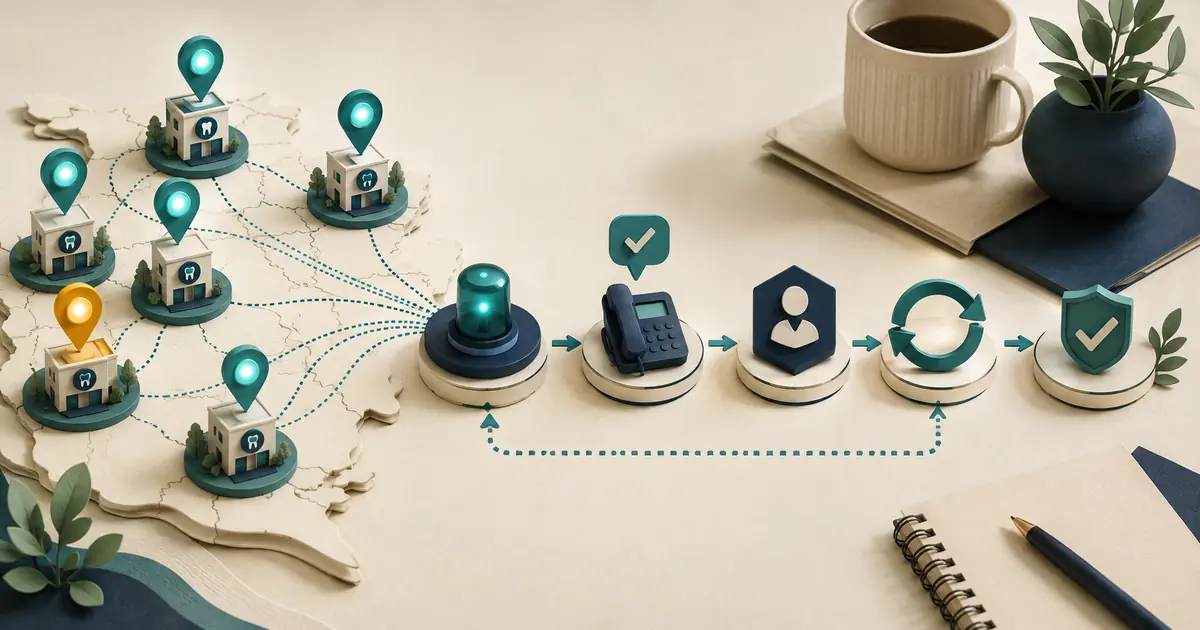
A dental phone provider concentration risk review asks whether apparently separate call paths depend on the same carrier, cloud region, internet circuit, identity service, administrator, billing account, or support organization. Two vendors do not create resilience when both rely on one hidden failure point.
Start with critical caller outcomes
List the services the practice needs to preserve: receiving the public number, forwarding, answering, voicemail, internal transfers, outbound callbacks, emergency calling, administrative access, notifications, and call-work visibility.
Use the routing change-management map as the component inventory. This review adds a different question: which components are correlated and may fail together?
Trace every service to underlying dependencies
For each critical outcome, record:
- carrier and upstream carrier when known;
- number owner and porting authority;
- cloud service, region, and identity provider;
- primary and backup internet or power path;
- phone platform, answering vendor, and subprocessor;
- messaging, email, and alerting dependency;
- administrator, recovery mailbox, and billing owner;
- support desk, contract, and escalation path.
Ask vendors to identify material subprocessors and resilience assumptions without demanding sensitive architecture. Compare the result with the HIPAA answering-service review and number-ownership safeguards.
Separate acceptable concentration from hidden concentration
Concentration is not automatically wrong. A small practice may deliberately accept one provider to reduce complexity. The decision should name the affected services, maximum tolerable impact, monitoring, recovery plan, and reason the risk is acceptable.
Hidden concentration is the problem. Examples include a “backup” number on the same carrier account, an alternate softphone using the same office internet, a second vendor in the same cloud region, or every recovery code going to one administrator's mailbox.
Test the common-mode failure
Run tabletop scenarios before technical drills:
- the carrier account is locked;
- the identity provider is unavailable;
- the office internet fails;
- the cloud region has an incident;
- the only administrator is unreachable;
- a downstream voice supplier disrupts both vendors.
For each, identify what still works, how staff detect the failure, which fallback is independent, and who owns caller requests during recovery. Then test selected paths with fictional calls under the phone outage plan.
Decide whether to reduce, transfer, or accept the risk
Options include an independent connectivity path, separate recovery identity, tested alternate number, diversified alert channel, stronger contract commitments, offline contact records, or a documented manual process. More vendors can also add security and operational complexity, so record the tradeoff.
NIST supply-chain guidance encourages organizations to understand suppliers, supply-chain tiers, resilience, and risk treatment. The practical outcome is not a perfect multi-vendor architecture; it is a truthful picture of what can fail together and a tested response.