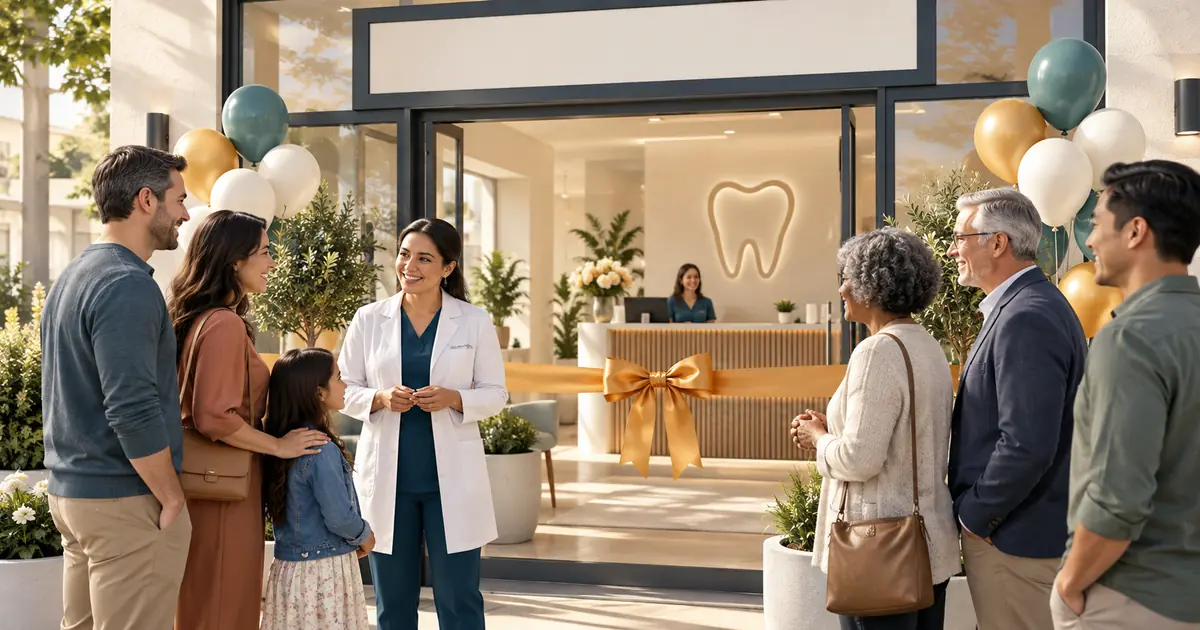
A dental office grand opening should help neighbors find the practice, meet the team, and understand how to contact the office. Choose one community purpose, verify that the space and staff are ready, and build a short event around that purpose. Decorations and publicity can follow those decisions.
For many new practices, a nonclinical open house is a manageable format: guests visit approved areas, ask general questions, and leave with accurate contact information. Offering examinations or other clinical services would require a separate, fully prepared clinical workflow.
Define what guests should gain
Write a one-sentence purpose before setting a budget. For example: “Help nearby residents learn where to park, see the entrance and reception area, meet the team, and understand how to request a first visit.”
That purpose suggests a different event from a professional networking reception or an educational session with a community organization. Choose the audience and format together. A practice trying to serve every group in one evening may struggle to give anyone a useful experience.
Decide how this event fits the practice's broader marketing plan. It may support familiarity and local relationships, but attendance is not a guaranteed source of appointments. Set a spending limit the opening budget can support without relying on assumed treatment revenue.
Include staff preparation and event time, refreshments, accessible materials, rentals, printing, cleaning, and any outside support. Identify deposits and cancellation terms before making commitments.
Choose a date the practice can support
Keep the community event date separate from the first patient-care date. A ribbon cutting does not establish that all professional, premises, equipment, and operating requirements for patient care have been satisfied.
Before announcing a date, confirm the space can lawfully host the proposed gathering and obtain the applicable approvals from the landlord and responsible local authorities. Check the intended occupancy, event insurance, food arrangements, and any outside-use or signage questions with the appropriate advisers. Requirements depend on the actual location and activities.
Walk the guest route from parking or drop-off through the entrance, event area, restroom, and exit. Check whether temporary tables, cords, signs, or chairs create barriers even if the underlying office layout is accessible.
The Justice Department identifies accessibility and effective communication among the obligations of businesses open to the public, including medical offices. Use its Title III guidance with qualified advice for the actual space and event.
Give guests a clear way to request accessibility or communication assistance. Assign someone to respond before the event, and prepare useful alternatives such as large-print information or a quieter conversation area when appropriate.
Build a short program with named hosts
Keep the run of show simple enough that a guest arriving halfway through can still participate. Here is a hypothetical 90-minute open house; the times illustrate one format, not an attendance benchmark.
| Time | Activity | Team responsibility |
|---|---|---|
| 5:30–5:45 p.m. | Arrival and welcome | Greeter explains the route and photo choices |
| 5:45–6:00 p.m. | Brief introduction and optional ribbon cutting | Owner introduces the practice and team accurately |
| 6:00–6:40 p.m. | Small guided tours and general questions | Hosts manage groups and keep restricted areas closed |
| 6:40–7:00 p.m. | Final conversations and departure | Coordinator records only requested follow-up |
The four blocks total 15 + 15 + 40 + 20 = 90 minutes. Add preparation and cleanup to the staff plan; they are not included in the public program.
Assign a floating event lead to handle unexpected arrivals, an accessibility request, a spill, or a host who needs relief. Tour guides should know which rooms are open, which equipment may be shown without operation, and when a question belongs with a clinician privately.
Avoid discussing an individual's symptoms, records, treatment needs, or insurance benefits during a group tour. Give personal questions a clear route into the practice's normal process.
Invite people with useful details
Use channels that fit the intended audience: accurate office information pages, local business contacts, community partners who agree to participate, and the practice's approved email or social channels. Obtain permission before using a partner's name or logo in a way that suggests endorsement.
An original invitation outline might read:
Join [practice] for a community open house on [date] from [time] at [address and suite]. Meet the team, tour designated office areas, and learn how to contact us about a first visit. No examinations or treatment will take place at this event. For directions or accessibility assistance, contact [office contact].
Add parking, transit, registration, and capacity information when relevant. If plans are provisional, resolve them before publishing an invitation that sounds definite. Have qualified reviewers check any proposed discount, giveaway, or promotional claim before including it.
For commercial email, follow applicable requirements for truthful sender and subject information, required identification and postal address, and a working opt-out that is honored on time. The FTC's CAN-SPAM guide explains these rules. An event invitation is not automatically exempt because the gathering is local or free to attend.
Decide photography before guests arrive
Choose a designated photo area and a practical way for people to decline photographs. Brief the photographer and hosts, and obtain appropriate permission for planned images of identifiable guests and staff. Route questions involving minors or patient information to the responsible reviewer.
For a HIPAA-covered practice, media access to areas where protected health information is available generally requires prior patient authorization. HHS explains that blurring identifying details later does not repair unauthorized media access. HHS guidance on filming and patient information.
Prepare rooms before any photography: lock screens, remove schedules and labels, secure records, and check reflections and background audio. Guest photo preferences and HIPAA authorization are different issues; one general event sign does not resolve both.
Use the dental social-media planning guide to review the final images, captions, permissions, and practice facts before publication.
Follow through on what guests request
Offer a simple optional way to request information or a callback. Collect only the contact details and preferences needed for that request, and explain what will happen next. Keep clinical information and private account questions out of a public sign-in sheet.
Attendance alone should not become automatic enrollment in the practice's marketing list. Separate an event-information request from ongoing marketing preferences and have the office's reviewer approve the channels and process.
Afterward, assign each promised response and record its completion. A guest asking about becoming a patient should enter the new-patient experience workflow, where scheduling, forms, costs, and clinical questions receive the appropriate attention.
Review actual spending, attendance, requested follow-ups, and recurring questions with the team. Record what helped guests navigate the office and what created confusion. Keep appointment requests and completed visits distinct so the event report reflects what actually happened.