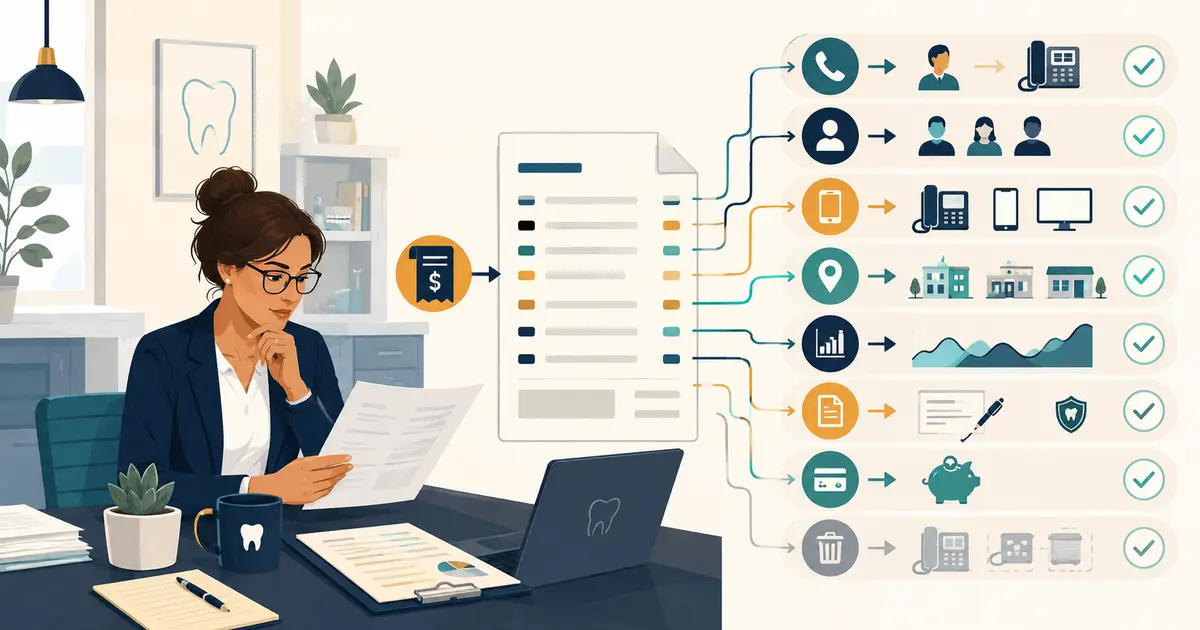
Dental marketing strategies work best as a connected system, not a collection of disconnected promotions. A useful plan helps the right local patients discover the practice, understand whether it fits their needs, make contact, and receive a consistent response. This guide covers 15 practical dental marketing ideas and shows how to choose a manageable mix instead of trying every channel at once.
Marketing a healthcare practice also carries responsibilities. Claims should be accurate, patient information must stay private, and state dental-board rules may affect advertising, testimonials, incentives, and professional designations. Treat this as an operating framework, then have qualified advisers review campaigns that raise legal or regulatory questions.
Score every idea before funding it
Start with a one-page channel scorecard. Rate each proposed activity from 1 to 5 on five questions:
| Question | What a high score means |
|---|---|
| Audience fit | It reaches patients the practice genuinely wants and can serve |
| Intent | People using the channel are close to choosing or contacting a dentist |
| Operational readiness | The team can answer, schedule, and follow up reliably |
| Evidence | Calls, forms, bookings, or referrals can be attributed without exposing patient data |
| Sustainability | The practice can maintain the channel for at least one planning cycle |
Add the five numbers. The total is a decision aid, not a benchmark. Write one sentence explaining every score. A campaign may have strong intent but weak readiness if calls routinely go unanswered.
Choose one demand-capture activity, one trust-building activity, and one follow-up improvement for the next 90 days. Give each an owner, budget, launch date, and primary measure. That limited portfolio produces cleaner learning than launching 15 experiments together.
15 dental marketing strategies to consider
1. Complete the Google Business Profile
Confirm the practice name, address, main phone, website, primary category, hours, holiday hours, accessibility details, and services. Use real, current office photos. Google says complete and accurate information helps it understand relevance, while local results are primarily influenced by relevance, distance, and prominence. No vendor can buy or guarantee a particular local position.
Assign a staff member to check the profile monthly and whenever hours, providers, or contact details change.
2. Build useful service-and-location pages
Create a clear page for each meaningful service patients search for and each legitimate location the practice operates. Explain who the service may help, what an evaluation involves, common questions, next steps, and how to contact the office. Avoid near-duplicate city pages that merely swap place names.
3. Publish question-led educational content
Use questions heard at the front desk, in consultations, and during financial conversations as an editorial backlog. Separate informational topics from clinical advice that requires an examination. Review clinical content with an appropriately qualified dentist and show when the article was updated.
One strong article can support search, patient emails, social posts, and call follow-up. Build internal paths to your dental practice management guide.
4. Improve call capture before buying more traffic
Marketing does not create value when inquiries reach a full voicemail box, encounter confusing prompts, or receive no follow-up. Test the main number from a new caller's perspective. Document who answers during office hours, what happens during lunch, how overflow is handled, and how missed calls enter a visible work queue.
Track contact attempts and outcomes without placing unnecessary health details in general analytics tools. A reliable intake process may improve results across every paid and organic channel.
5. Ask for genuine reviews consistently
Create a neutral, repeatable request after appropriate encounters. Google allows a Business Profile owner to share a review link or QR code. Do not have employees post patient reviews, buy reviews, or condition a reward on positive sentiment. Review platform rules, the FTC's Consumer Reviews and Testimonials Rule, and applicable dental-board guidance before using any incentive.
Monitor responses carefully. A reviewer who identifies themselves has not necessarily waived privacy protections. Keep public replies general and move service recovery to an approved private channel.
6. Create a patient referral workflow
Make it easy for established patients to share accurate office information: a simple practice card, a mobile-friendly page, or a contact link. Train staff to thank the referring person without confirming another individual's patient status. If any reward is contemplated, obtain a legal and compliance review first; healthcare referral arrangements may implicate rules beyond ordinary retail promotions.
Measure referral source at intake with a short, optional question rather than asking for a public endorsement.
7. Re-engage inactive patients thoughtfully
Define who is eligible for outreach, which channel they authorized, what message can be sent, and when outreach stops. A useful message identifies the practice, gives a simple way to contact the team, and respects opt-out preferences. It should not reveal sensitive treatment information on a shared device.
Segment by operational need instead of sending the same offer to the entire database. Coordinate the campaign with schedule capacity.
8. Strengthen the new-patient landing path
Visit the website on a phone and try to complete the intended action. A prospective patient should quickly find the location, hours, phone number, accepted payment or insurance information where appropriate, accessibility details, and what happens after submitting a request.
Use a focused call to action. Do not imply that a form submission is a confirmed appointment unless the scheduling system actually confirms it.
9. Run intent-based search advertising
Paid search can capture people actively looking for care, but the ad, landing page, geography, and schedule capacity must agree. Group campaigns by meaningful service intent. Add exclusions for irrelevant employment, training, wholesale, or do-it-yourself searches when appropriate.
Compare qualified inquiries and scheduled appointments with spend; clicks alone do not show business value.
10. Use social media to answer and reassure
Choose a narrow editorial role for social channels: introducing the environment, explaining administrative processes, answering general questions, or showing community involvement. Obtain appropriate written authorization before sharing any identifiable patient photo, story, audio, or video. The ADA notes that even an image of someone in a waiting room may raise privacy concerns.
Create content in batches, but review every item before publication for accuracy, permissions, dates, and platform-specific display.
11. Build local relationships
Participate in genuine community activities that fit the practice: oral-health education, local business groups, schools when appropriate, or nonprofit events. Focus on useful participation rather than a link exchange. Create an event page only when it helps attendees with real details such as time, location, accessibility, and registration.
Keep sponsorship and charitable claims precise. Do not imply an endorsement that the partner has not approved.
12. Improve patient experience communications
Clear directions, parking details, pre-visit instructions, financial expectations, and post-contact follow-up can reduce friction before the clinical visit begins. Audit each message for one job and one next action. Confirm that links work and that staff know what the patient sees.
Use feedback from calls and surveys to find recurring confusion. The ADA recommends patient surveys as one way to learn what patients value and where the experience needs attention.
13. Develop clinician and team bios
Prospective patients often want to know who will care for them. Publish accurate credentials, professional interests, languages, and care philosophy. Explain roles without inflating titles or making superiority claims. Update bios when team membership or licensing information changes.
Connect each bio to relevant services and the actual location where that person practices.
14. Create short educational videos
Record concise answers to common, general questions or a guided office tour without patients in view. Add captions and a written summary so the information remains accessible and searchable. Avoid diagnosing viewers or promising outcomes. The ADA recommends educational, patient-centered video and cautions practices to review advertising and privacy obligations.
15. Build a measurement and learning rhythm
Use a small funnel: impressions or reach, meaningful visits, calls/forms, qualified inquiries, scheduled appointments, and kept first visits. Define each term. Separate new from returning patients and avoid double-counting one person who called and submitted a form.
Review results monthly with the person who manages scheduling. A channel may appear weak because the audience is wrong, the page is unclear, calls are missed, or appointments are unavailable. Marketing and operations must diagnose the same funnel.
Turn the list into a 90-day plan
Use three phases:
Days 1–30: establish the baseline. Verify profiles, website contact paths, phone routing, and measurement definitions. Record current results without treating a short period as a durable trend.
Days 31–60: launch three coordinated changes. For example, improve one service page, begin a neutral review-request workflow, and fix missed-inquiry ownership. Document the exact launch date so before-and-after comparisons are possible.
Days 61–90: review quality, not just volume. Sample inquiries. Which questions recur? Which leads fit the services and geography? Where do people abandon the process? Keep, adjust, or stop each activity based on evidence and operational capacity.
Assign one accountable owner. The practice must approve claims, protect patient information, and connect campaigns to schedule reality.
A practical marketing dashboard
Limit the main view to decisions:
- spending by channel;
- qualified new-patient inquiries;
- scheduled new-patient appointments;
- kept new-patient appointments after the reporting window matures;
- cost per qualified inquiry and per kept appointment when attribution is reliable;
- unanswered calls and response time by coverage period;
- top questions or objections heard by the team.
Add notes for holidays, provider absence, weather, campaign changes, or tracking outages. Do not compare incomplete recent cohorts with older cohorts that had more time to schedule and arrive.
For an operational view beyond marketing, use a defined set of dental office KPIs. For retention work, connect acquisition with dental patient retention strategies so the practice does not continually replace avoidable patient loss.
Common mistakes to avoid
- Chasing every channel without a clear patient or service objective.
- Buying traffic before fixing missed calls and slow follow-up.
- Publishing generic pages for dozens of cities where the practice has no legitimate presence.
- Using fabricated, employee-written, or sentiment-conditioned reviews.
- Sharing identifiable patient content without appropriate authorization.
- Reporting clicks as patients or leads as completed appointments.
- Making clinical, cost, insurance, or outcome claims that the practice cannot support.
- Letting old hours, provider details, and offers remain online.
The strongest plan is usually not the longest list. It is a small set of dental marketing strategies tied to real patient questions, clear ownership, responsible communication, and a team capable of handling the demand created.