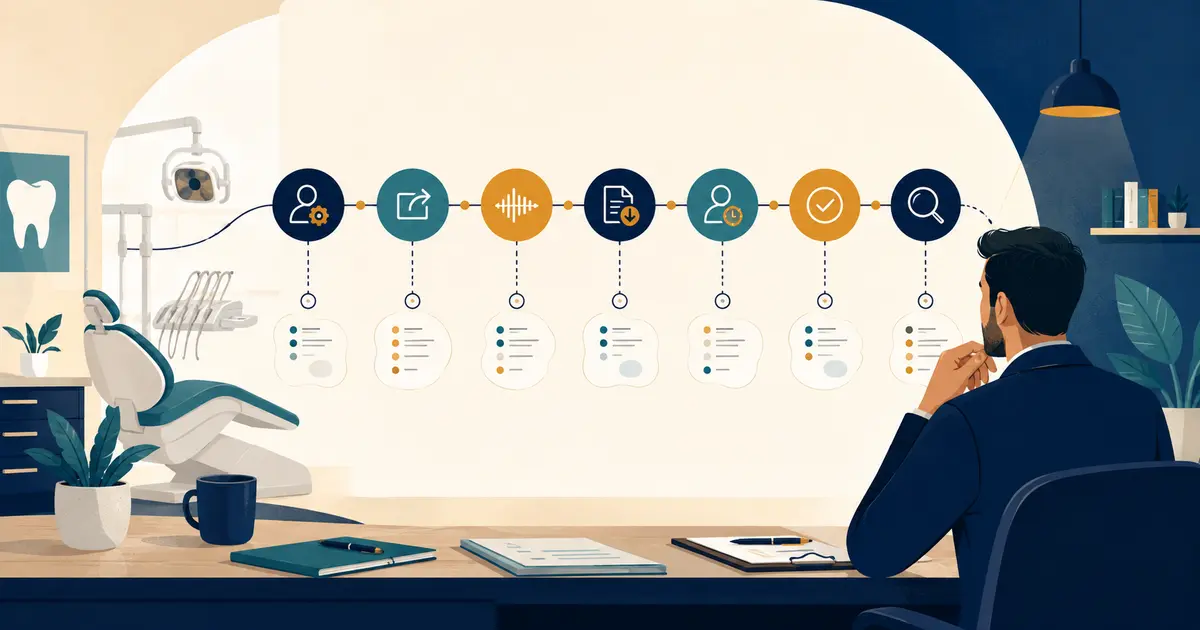
A dental employee performance review template should make a difficult conversation more specific, fair, and useful. It should not be a surprise list of everything that went wrong during the year. The better approach is to compare documented work with known job expectations, recognize contributions, identify one or two priorities, and agree on follow-up.
The template below is designed for dental office managers reviewing administrative or support-team performance. Adapt it to the employee's job description, the practice's policies, applicable employment laws, and qualified HR guidance. Do not use a generic form to evaluate clinical judgment, impose discipline, or make compensation decisions outside your authority.
Copy this dental employee performance review template
Use one form per employee and review period. Keep completed records only in the practice's authorized employment-record system.
Employee: Role: Reviewer: Review period: Meeting date: Job description version/date:
Results and expectations
For each area, record the applicable expectation, evidence from the review period, and the next action. Use the practice's rating scale only if its meaning has been defined and managers have been trained to apply it consistently.
| Review area | Role expectation | Evidence or example | Assessment | Next action |
|---|---|---|---|---|
| Reliability and attendance | ||||
| Patient communication | ||||
| Scheduling or workflow accuracy | ||||
| Documentation and handoffs | ||||
| Privacy and security practices | ||||
| Teamwork and communication | ||||
| Role-specific skills | ||||
| Training completed |
Contributions to recognize: Employee's perspective: Support or resources requested: Priority goal 1: Priority goal 2: Owner and due date for each action: Follow-up meeting: Reviewer comments: Employee comments: Acknowledgment method required by policy:
An acknowledgment generally confirms that the conversation occurred; it should not be worded to force agreement with every statement. Have HR or counsel approve the language used by your practice.
Prepare with evidence, not impressions
Start with the current role description and the expectations communicated at onboarding. A review cannot be consistent if one employee is assessed against written duties while another is assessed against the manager's unwritten preferences. If the job has changed, update the role through the proper process rather than quietly moving the standard during the meeting. The dental office manager job description and dental office onboarding checklist can help align responsibilities and training.
Collect a balanced set of work-related examples from the review period:
- completed responsibilities and measurable results;
- documented coaching and prior follow-up;
- training, certifications, or new responsibilities;
- patient compliments or service recoveries that the practice is permitted to use;
- recurring workflow errors, with dates and operational impact;
- attendance or conduct records maintained under policy;
- employee suggestions that improved a process;
- progress on the previous review's goals.
Avoid personality labels such as “not committed” or “bad attitude.” Describe observable work instead: “The closing checklist was incomplete on three reviewed dates,” or “The employee trained two new team members on the updated handoff.” Distinguish a documented pattern from one incident.
Do not include protected health information unless it is genuinely necessary and handled under approved policy. A patient case should usually be de-identified in an employment discussion. Likewise, do not repeat rumors or anonymous complaints as established fact.
Evaluate the role in clear categories
A dental staff evaluation form works best when each category connects to the job. A scheduling coordinator might be reviewed on accurate appointment entry, approved communication procedures, handoffs, and escalation. A dental assistant's form will need different, properly authorized clinical and infection-control criteria.
For a front-office role, consider these categories:
Reliability and ownership
Does the employee complete assigned opening, closing, follow-up, and handoff tasks? When something cannot be completed, do they raise it early enough for the team to respond? Review reliability under the practice's attendance and leave policies, not personal assumptions about why an absence occurred.
Patient communication
Look for accurate, respectful explanations within the employee's role. This includes confirming the caller's need, avoiding unsupported promises, documenting next steps, and escalating clinical, financial, or privacy questions to the right owner.
Workflow quality
Review the tasks the employee can control: correct data entry, scheduling accuracy, work-queue completion, insurance intake, call notes, and timely routing. Use your dental office KPIs carefully. A metric is context, not a verdict; poor system design or inadequate staffing may affect results.
Team contribution
Consider dependable handoffs, respectful communication, problem-solving, cross-training, and willingness to raise safety concerns. “Team player” is too vague unless supported by examples.
Learning and development
Record training completed, skills practiced, and support still required. Development can include software competence, communication practice, leadership experience, or role-appropriate continuing education.
Run a two-way review meeting
Schedule private, uninterrupted time and share the review format in advance. Open by explaining the purpose and agenda. Then work through evidence, invite the employee's perspective, and clarify misunderstandings before moving to goals.
A practical sequence is:
- Restate the role and review period.
- Recognize specific contributions.
- Ask what helped or blocked the employee's work.
- Discuss each priority using dated examples.
- Confirm the expected behavior or result.
- Ask what training, tools, or decisions are needed.
- Agree on actions, owners, and dates.
- Summarize any points of disagreement accurately.
- Schedule follow-up before ending the meeting.
The American Dental Association recommends regular feedback and coaching rather than treating performance management as one uncomfortable annual event. That principle matters in a busy practice: prompt, specific feedback gives a team member a fair chance to adjust while the details are still clear.
Turn broad feedback into workable goals
“Improve communication” is not a usable goal. Define the situation, action, evidence, and review date.
Broad: Improve call notes. Specific: For the next four weeks, use the approved call-note fields on reviewed patient messages and route requests to the assigned owner before the end of the shift unless the escalation policy requires faster action. The manager will review a small, policy-approved sample each Friday and discuss results privately.
Broad: Be more organized. Specific: Complete the approved closing checklist on assigned days, record open items in the handoff queue, and alert the manager before leaving when an essential task is blocked.
Choose one or two priorities. A page of goals usually produces less focus, not more. Specify what the practice will provide—training time, a written procedure, system access, shadowing, or weekly coaching—so improvement is a shared operational plan.
Keep reviews separate from other decisions
Performance feedback, pay, promotion, accommodation, leave, investigation, and discipline can overlap, but they are not interchangeable. The ADA advises treating salary reviews and formal evaluations as separate discussions. Follow the practice's approved process and involve qualified HR or legal support when the review may affect employment status.
Apply standards consistently. The Equal Employment Opportunity Commission advises employers to investigate complaints that an evaluation was discriminatory promptly, thoroughly, and impartially. If an employee raises discrimination, retaliation, harassment, disability, leave, wage, or other legal concerns, stop improvising and route the issue according to policy.
Do not promise a raise, promotion, schedule change, or continued employment unless you are authorized to do so. Do not backdate a review or alter a completed form to make the record look more favorable.
Follow up while the plan is still active
The review meeting is a checkpoint, not the finish line. Put the next conversation on the calendar. A short follow-up should answer:
- What actions were completed?
- What evidence shows progress or a continuing gap?
- What support was provided?
- Has the role, workload, or system changed?
- What is the next action and date?
Document material coaching consistently. If a process problem affects several people, fix the process rather than placing identical failure on one employee. The dental office SOP template can help turn a recurring expectation into standard work.
Manager quality check
Before finalizing a dental employee evaluation, confirm that:
- every material statement is job-related and supported;
- the employee was told the relevant expectation;
- positive and corrective examples cover the review period;
- similar roles were assessed using consistent standards;
- legally sensitive concerns were routed correctly;
- goals identify actions, owners, support, and dates;
- the employee had room to comment;
- the follow-up is scheduled;
- the record is stored with appropriate access controls.
A strong review is clear enough that another authorized manager can understand what happened, what was expected, what support was offered, and what comes next.