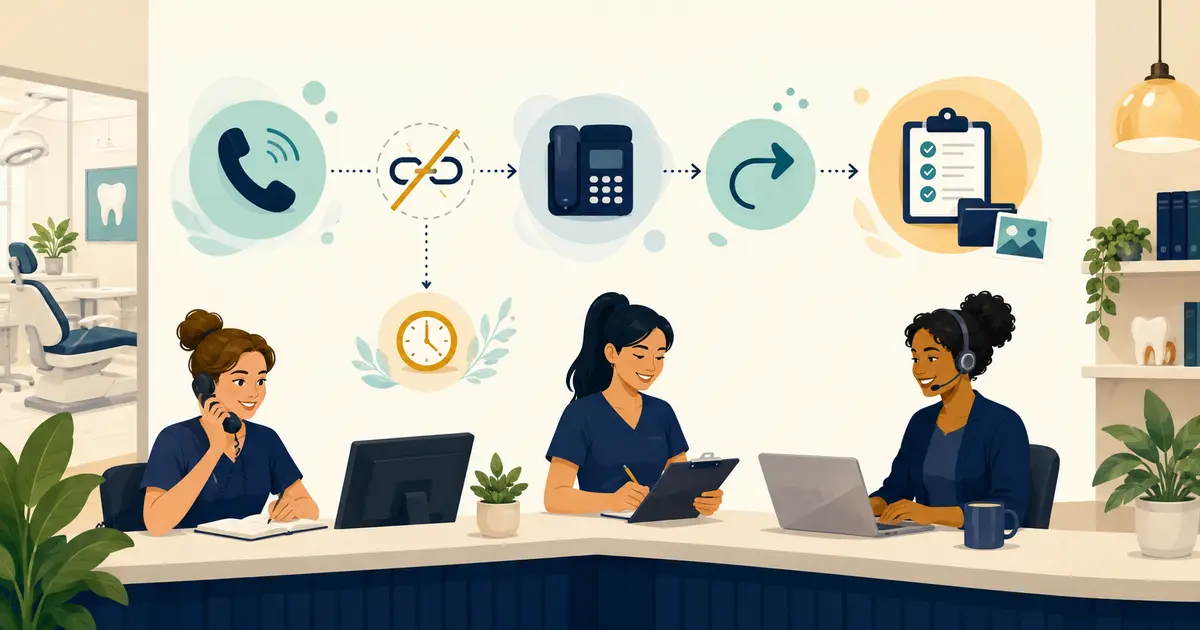
Missed new-patient calls at a dental office should enter a separate, time-stamped recovery queue with one callback owner. The return call should identify the practice, confirm that it is a good time to speak, collect only the information needed for the next step, and avoid promising availability, fees, benefits, or clinical conclusions that have not been verified.
The goal is not to turn every caller into an appointment during one callback. The goal is to give a prospective patient a clear, respectful path back into the practice.
Identify likely new-patient calls without guessing
A missed call record may contain only a phone number and time. Do not label the person a patient or prospect based on a reverse lookup, voicemail assumption, or marketing source alone.
Use reliable signals such as:
- the caller selected a new-patient option in the phone menu;
- the person left a voicemail identifying the purpose;
- an answering service captured new-patient status;
- the number is tied to a submitted web inquiry;
- a staff member spoke briefly before the call disconnected;
- the caller confirms their status when reached.
If status is unknown, keep the opening neutral. “We received a call from this number” is safer than “We are returning your new-patient call.”
The ADA notes that a phone call is often a prospective patient's first communication with a practice and recommends a consistent greeting, prepared scripts, and structured intake. Review the ADA guidance for calls from prospective patients when designing your office process.
Put recovery work in one queue
Do not leave new-patient callbacks scattered across desk notes, personal reminders, voicemail, and caller-ID history.
Each queue item should include:
- call date and time;
- number dialed and location reached;
- caller number as received;
- source, such as main line, campaign number, or forwarding route;
- voicemail or captured request when available;
- likely or confirmed new-patient status;
- assigned employee;
- callback attempt time;
- outcome and next action;
- wrong-number, opt-out, or contact-preference signal.
Use a clear status set such as new, assigned, attempted, waiting, completed, and blocked. A callback is not completed merely because someone dialed once.
If several calls came from the same number, link them before contacting the caller. This prevents two employees from returning the same inquiry with different answers.
Prioritize with office rules
Create a recovery order that staff can follow during a busy shift. For example:
- callers who reached the office but were disconnected;
- callers who left a clear request for a return call;
- likely new-patient inquiries;
- recent missed calls with no message;
- older attempts awaiting another approved contact step.
Your order may differ. What matters is that the practice defines it instead of relying on whoever notices the phone log first.
Do not create a clinical priority score from voicemail language. If a caller reports a concern, follow the practice's approved escalation process and have the appropriate professional make clinical decisions.
The missed-call callback script guide covers general callback timing. This workflow adds the new-patient intake boundary.
Use a short callback opening
Start with identity and permission:
“Hello, may I speak with Jordan? This is Maya calling from Green Valley Dental. We received a call from this number earlier today. Is now a good time to speak?”
If the person confirms they are looking for a new dentist:
“I'd be glad to help with the next step. May I ask what you would like the office to help with and how you prefer us to contact you?”
If no voicemail or context exists:
“We received a call from this number and wanted to make sure you reached the right place. How can our office help?”
Avoid:
- “We know you need an appointment.”
- “We can get you in today” before checking the schedule.
- “Your insurance covers this.”
- “That sounds like an emergency.”
- “We have the best dentist for your condition.”
If another person answers, do not explain the reason for the call. Leave only the minimal message allowed by the patient's preferences and office policy.
Collect the minimum useful intake
The callback should support the next office action, not recreate a full health history over an unexpected phone call.
Useful fields may include:
- caller's name and preferred name;
- callback number and contact preference;
- whether they are new to the practice;
- general reason for contacting the office;
- preferred days or times;
- location preference for multi-location practices;
- how they found the practice, when operationally useful;
- the next action the caller expects.
Move detailed health history, financial discussion, identity verification, and insurance information into the practice's approved secure process.
HHS says covered entities should take reasonable steps to limit protected information to what is necessary for the intended purpose. The HHS minimum-necessary guidance can help the practice review call fields and staff access.
Keep appointment language accurate
An inquiry, request, hold, and confirmed appointment are different states.
Use language that matches the actual state:
- Request received: “I have your preferred days and will check the office's current options.”
- Staff review needed: “The scheduling team will review the request and contact you.”
- Option offered: “I can offer Tuesday at 10 a.m. or Wednesday at 2 p.m.”
- Appointment confirmed: use only after the authorized scheduling process completes and the patient accepts.
If the callback is handled by someone without scheduling authority, do not imply that collecting a preferred time reserves it.
The new-patient call checklist provides a fuller intake pattern for calls that the front desk answers live.
Handle price and insurance questions without overpromising
Prospective patients often ask about cost or coverage early. Prepare a truthful response:
“I can share the office's general policy, but final fees and your individual benefits depend on the services involved and verification. I can note your question for the team.”
Do not quote a final patient responsibility from a general fee, assume a procedure, or guarantee coverage based on a carrier name.
Use the dental price-inquiry script to separate general information from a verified estimate.
Decide what happens when there is no answer
Set a consistent attempt policy. It should define:
- how soon staff make the first callback;
- whether a voicemail may be left;
- what the voicemail may contain;
- whether another call, text, or email is allowed;
- who verifies consent and contact preferences;
- when to stop;
- how wrong numbers and reassigned numbers are suppressed.
A conservative voicemail is:
“Hello, this is Maya from Green Valley Dental returning a call received at our office. Please call us at 312-555-0148 during office hours. Again, this is Green Valley Dental at 312-555-0148.”
Do not disclose treatment, insurance, or other sensitive details in a message that someone else may hear.
If the practice uses text, confirm the legal, consent, registration, opt-out, privacy, and monitoring requirements for the actual program. The ADA advises practices to obtain and maintain appropriate contact preferences and to stop when consent is revoked; review its guidance on calling and texting patients with qualified counsel.
Record the outcome
After the callback, document facts rather than impressions:
- reached caller or not;
- identity and contact method confirmed;
- general request;
- information provided;
- appointment state;
- questions assigned to another employee;
- contact preference, wrong-number, or opt-out signal;
- next owner and deadline;
- final outcome when known.
The ADA recommends recording relevant phone conversations in the patient record when appropriate and ensuring entries are accurate. Review the practice's documentation policy and the ADA patient-record guidance.
Do not write “patient declined treatment” when the person only decided not to schedule. Use language that reflects the actual conversation.
Review recovery quality
Track:
- missed calls identified as likely new-patient inquiries;
- time to first assigned review;
- time to first callback attempt;
- callers reached;
- duplicate callbacks prevented;
- requests left without an owner;
- appointments requested and later confirmed through the normal process;
- wrong-number and contact-preference corrections;
- recurring reasons calls were missed.
Use the data to fix the original call problem. If many calls arrive during a predictable checkout rush, improve staffing, routing, or overflow coverage instead of expanding the callback list indefinitely.
New-patient call recovery checklist
- [ ] Likely new-patient status comes from a reliable signal.
- [ ] Unknown callers receive a neutral opening.
- [ ] All missed inquiries enter one visible queue.
- [ ] Duplicate calls are linked before outreach.
- [ ] One employee owns each callback.
- [ ] The script confirms identity and permission to speak.
- [ ] Intake is limited to information needed for the next step.
- [ ] Scheduling, fees, benefits, and clinical boundaries are explicit.
- [ ] No-answer, voicemail, text, and stop rules are documented.
- [ ] Outcomes and next actions are recorded accurately.
- [ ] Managers review unresolved work and the reasons calls were missed.
Recovering missed new-patient calls is a front-desk discipline, not a single callback script. Identify the inquiry, assign it, respond clearly, collect only what the next step needs, and keep ownership until the caller receives an accurate resolution.