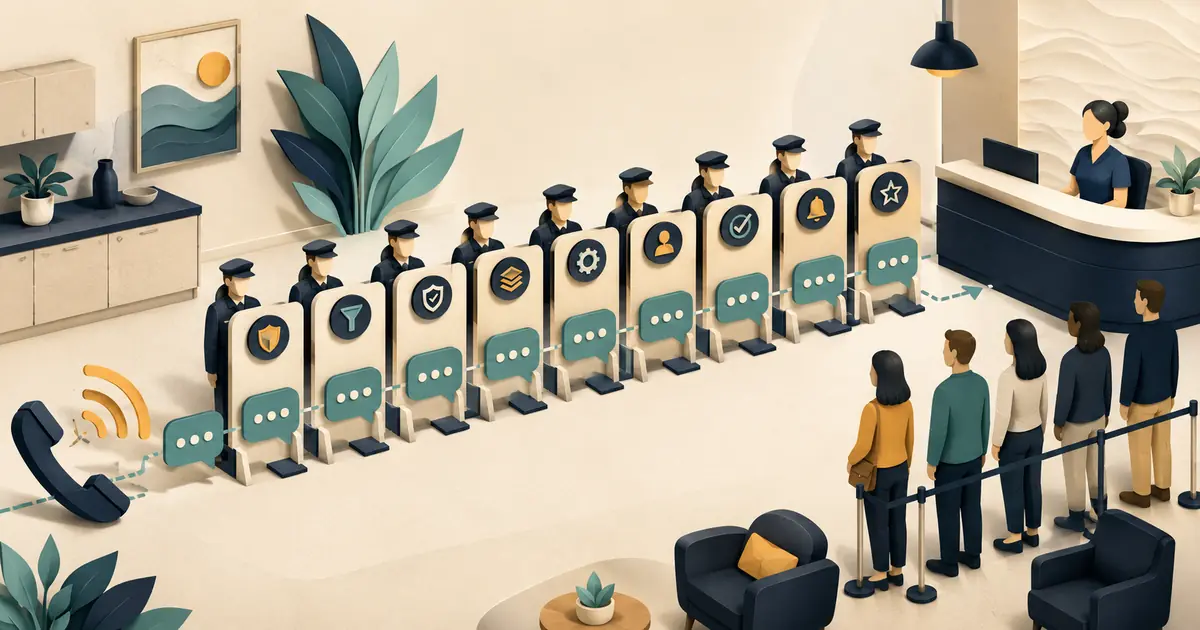
Patient expectations when calling a dentist are usually simple: reach the right office, understand what happens next, and avoid repeating the same story. The challenge is converting those expectations into standards a team can train, observe, and improve.
The goal is not to make every call identical. It is to make ownership, clarity, privacy, and closure dependable while allowing staff to respond like people.
The eight-part service standard
| Moment | Patient should experience | Observable team behavior |
|---|---|---|
| Greeting | Confidence that they reached the right place | State the practice or location and the representative's name |
| Listening | Space to explain the reason for calling | Confirm the core request before collecting details |
| Clarity | Plain language without unexplained office jargon | Give one next step at a time |
| Privacy | Appropriate handling of sensitive information | Verify identity when required and limit disclosure |
| Accessibility | A workable communication path | Follow office procedures for language or accessibility needs |
| Ownership | One person or queue responsible for the request | Name the owner instead of saying “someone will call” |
| Timing | A realistic response expectation | Give an office-approved window, not a false guarantee |
| Closure | Understanding of what is and is not complete | Recap the request, owner, channel, and next step |
Use the phone-experience guide to connect this standard to coaching and call review.
Translate vague promises into measures
“Answer quickly” is vague. “Measure median answer time and the share of calls abandoned before answer” can be managed.
“Return calls promptly” is vague. “Record when the request entered the queue, when staff accepted ownership, and when the patient received a response” reveals the actual delay.
“Be friendly” is subjective. A review can still check whether the representative introduced the office, allowed the caller to finish, confirmed the request, avoided blame, and explained the next step.
Do not turn a service standard into a speed contest. A short call that leaves the patient confused is not better than a slightly longer call with a correct handoff.
Use different standards for different call types
New-patient inquiry
Confirm what the person is seeking, collect only the information authorized by office policy, and explain the office-owned next step. Do not imply that a captured request is a confirmed appointment.
Existing-patient administrative request
Verify identity as required, restate the request, and route it to the correct owner. Avoid exposing schedule, billing, or treatment information to an unverified caller.
Clinical or urgent language
Follow the practice's approved escalation instructions. Front-desk staff and automated tools should not diagnose, triage, or invent clinical guidance.
Complaint or confused caller
Acknowledge the concern, avoid arguing, document the specific issue, and identify the responsible manager or team. Ownership matters more than a defensive explanation.
Create one communication policy across channels
A patient may call, receive voicemail, reply by text, and later speak with staff. The rules should remain coherent across those transitions. Define which information each channel may carry, how identity is verified, how preferences and opt-outs are honored, and which record is authoritative.
The patient texting guide and office communication policy provide a framework for those channel boundaries. SMS should never be treated as an automatic substitute for a missed call; it requires a ready, compliant workflow.
Review five calls without overcomplicating QA
Each week, sample calls from different times and intents. Score only whether the team:
- identified the office;
- confirmed the caller's request;
- protected private information;
- gave an accurate next step;
- assigned ownership;
- avoided unsupported promises;
- closed with a clear expectation.
Coach one behavior at a time and review the same behavior in the next sample. The purpose is a more reliable patient experience, not punishment.
Missed Calls Dental boundary
Missed Calls Dental can support consistent handling of approved administrative call workflows and human handoffs. It does not diagnose, replace clinical judgment, independently change appointments, verify insurance, or remove the practice's responsibility for callbacks and patient communication. SMS is separate and readiness-gated.
Ethan Collins is an editorial pen name. This article was reviewed for accuracy and alignment with Missed Calls Dental product information.