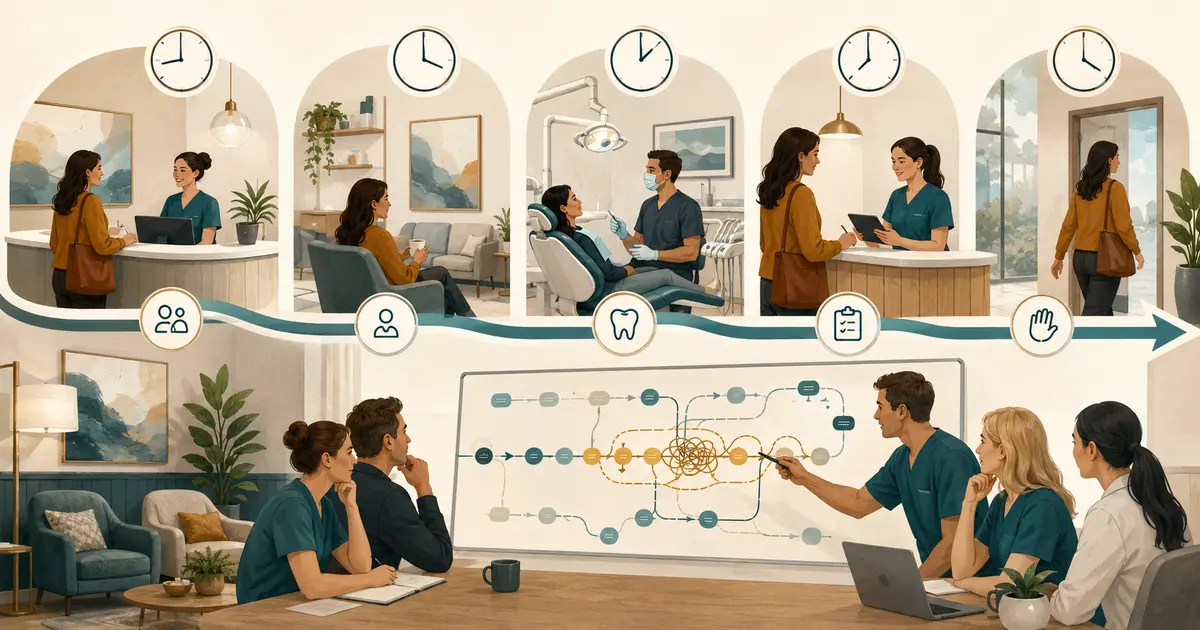
To improve the dental patient phone experience, manage the entire caller journey: reaching the right number, hearing a clear greeting, explaining the request, waiting or transferring safely, understanding the current status, receiving accessible communication, and seeing the request completed. Courtesy matters, but a friendly call with no owner is still a poor experience.
Map the caller journey
Test each stage:
- find the correct number;
- connect without technical failure;
- understand the greeting or menu;
- reach the right role;
- explain the purpose without unnecessary repetition;
- receive accurate information;
- understand hold, transfer, or callback status;
- know whether an appointment is requested or confirmed;
- access language or disability support;
- receive and complete follow-up.
The front desk workflow guide turns these stages into work states and owners.
Test access from outside
Call every published number from mobile and another network. Test open, lunch, after-hours, weekend, holiday, busy, no-answer, and outage conditions.
Check:
- correct location identity;
- ring duration;
- menu clarity;
- voicemail order;
- queue and hold behavior;
- transfer destinations;
- caller ID;
- overflow or AI route;
- fallback;
- website and listing accuracy.
Do not rely only on internal extension tests.
Standardize the opening
The American Dental Association recommends a standard greeting with the practice name, speaker, and invitation to share the reason for the call. Keep it brief.
Train for listening after the greeting. Employees should not force every caller through a long script before understanding the goal.
The live-call greeting examples provide state-specific language.
Reduce repetition
Record the minimum useful context once and pass it with authorized handoffs. Repetition often occurs when:
- transfer destinations lack context;
- verification is not documented;
- notes are stored in different channels;
- caller reaches the wrong location;
- request state is unclear;
- employee does not trust the prior record.
Fix the workflow instead of telling staff to apologize more gracefully.
Make holds and transfers visible
Before a hold, explain why and ask permission. Return at an approved interval with an update. Offer a callback only when someone owns it.
Before a transfer, name the destination and fallback. Use a warm transfer for complex or sensitive requests when feasible. Recover failed transfers rather than sending callers through repeated departments.
The call transfer guide defines acceptance and fallback.
State outcomes accurately
Use distinct words for message, request, transfer, callback, and confirmation. Do not say “all set” when work remains.
For an appointment request:
“I recorded your preferred dates for the scheduling team. The appointment is not confirmed until the team reviews availability and contacts you.”
For an insurance question:
“I recorded your plan question for the authorized team. Participation, benefit verification, an estimate, and final responsibility are different, so I do not want to promise coverage.”
For a clinical question, staff should follow approved routing and avoid diagnosis or triage.
Build effective communication paths
DOJ guidance says effective communication depends on the nature, length, complexity, context, and person's normal method. Plan for relay calls, slower pacing, qualified interpreters or other aids where required, alternate channels, and clear escalation.
Ask the caller what communication method is effective under the practice's process. Do not pretend understanding or default to a family member for complex information.
Protect privacy without becoming abrupt
Explain verification steps plainly. Move sensitive conversations away from public areas, avoid speakerphone, and limit voicemail details. Staff can protect privacy while remaining warm:
“Before I discuss appointment details, I need to complete our identity check. This protects your information.”
HHS allows oral communication with reasonable safeguards and advises limiting details in messages.
Recover service failures
Create an owner for:
- unanswered calls;
- abandoned holds;
- failed transfers;
- wrong location;
- incomplete request;
- delayed callback;
- inaccessible communication;
- inaccurate information;
- duplicate messages;
- complaint;
- outage.
Service recovery should acknowledge what happened, state the current owner and next step, correct the record, and prevent repetition. Do not promise an outcome before investigation.
Measure the journey
Use balanced measures:
- answer and abandonment states;
- hold distribution;
- transfer acceptance and failure;
- callback ownership and age;
- request completeness;
- repeated-contact rate;
- wrong-location rate;
- accessibility exceptions;
- correction and duplicate rates;
- unresolved work at closing;
- complaints by cause;
- successful recovery.
Pair metrics with call or request samples using approved privacy controls. Avoid a universal satisfaction or speed benchmark without comparable definitions.
Ask patients focused questions
If the practice collects feedback, keep it actionable:
- Did you reach the right office?
- Was the next step clear?
- Did you have to repeat information?
- Was your communication preference respected?
- Did you understand whether your request was confirmed?
- Did the promised follow-up occur?
Do not ask for protected details in an unsecured survey. Connect trends to specific workflow changes.
Improve one cause at a time
Prioritize problems by patient impact and frequency. Examples:
- correct a holiday route;
- shorten a confusing menu;
- assign lunch coverage;
- add failed-transfer recovery;
- standardize request states;
- create a monitored callback queue;
- update accessibility training;
- remove shared passwords;
- revise a stale source of truth.
Record the change date and compare the same measures afterward.
Build a practical quality review
Select a small, defined sample across new-patient calls, existing-patient requests, transfers, holds, after-hours contacts, failed paths, and recovery work. Review only through approved access and privacy controls. Score observable behaviors:
- correct practice identification;
- clear listening and confirmation;
- accurate approved information;
- appropriate identity verification before disclosure;
- truthful request state;
- successful owner handoff;
- accessibility and language path;
- concise close with the next step.
Use review findings for coaching and system repair. If several employees make the same error, investigate the script, source of truth, screen layout, staffing, or routing before treating it as an individual performance problem.
Plan for peaks and outages
Patient experience often fails when normal assumptions stop holding. Test lunch coverage, an absent employee, a carrier outage, a closed office, simultaneous calls, an unavailable transfer destination, and a stale holiday message. Define the overflow path, caller language, request record, owner, and recovery check for each condition.
During an incident, do not promise a callback time the team cannot meet. State the current limitation accurately, capture only what the approved workflow needs, and reconcile all open work after service resumes.
Keep improvements durable
Every change should have an owner, effective date, evidence, and review date. Update training and the source of truth together. Remove obsolete scripts and routing instructions so employees do not choose between conflicting versions. A monthly manager review can verify that the improvement still works after staffing, hours, or technology changes.
Record who accepted the review result.
Missed Calls Dental can support the journey by answering eligible missed calls and capturing requests for front desk follow-up. It does not book appointments, verify benefits, or make clinical decisions. The practice owns the caller's final resolution.
A better phone experience is not a single script or technology. It is a reachable, accurate, respectful, accessible, and owned process from the first ring through completion.