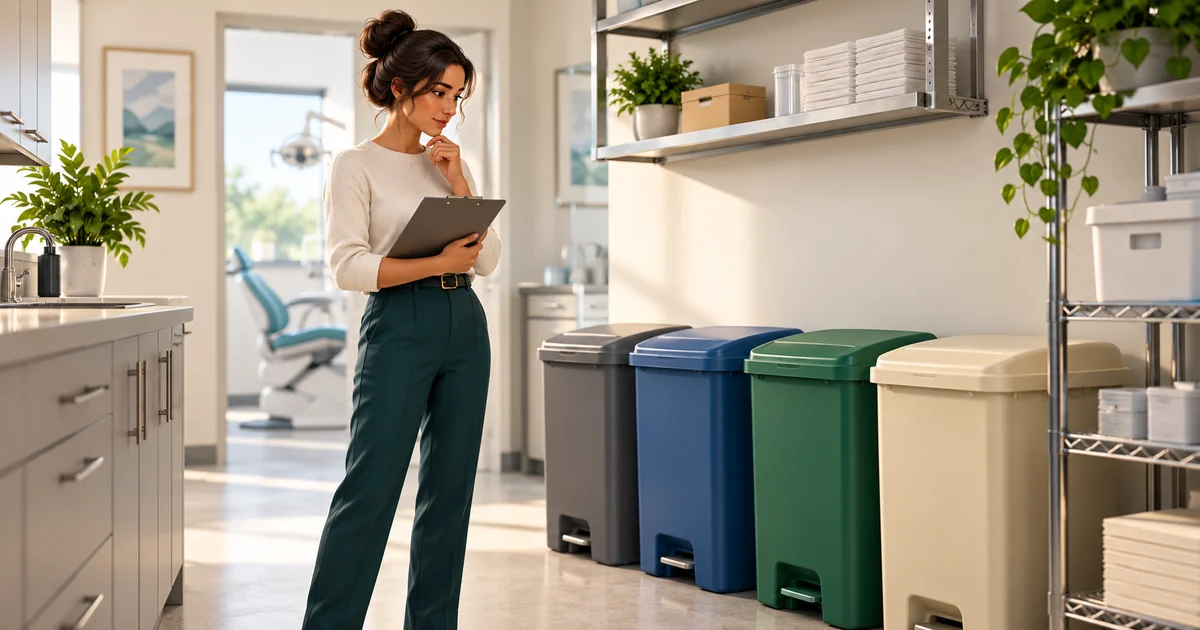
Plan dental office waste disposal by identifying what the practice will generate, separating each waste stream, and confirming its collection, storage, transport, and disposal requirements before opening. Then match every stream to a responsible employee and a vendor authorized for that work. A single “medical waste service” line in the opening budget leaves important questions unanswered.
Start with the state environmental and health agencies for the office's location. EPA explains that medical waste is primarily regulated at the state level and that state programs differ. Local requirements and other federal obligations may also apply. EPA explanation of medical-waste regulation
Walk the planned office with a waste inventory
Have the clinical lead, infection-prevention coordinator, equipment planner, and opening manager review the planned services and products. Walk operatories, instrument processing, the laboratory if present, utility rooms, storage, reception, and staff areas.
For each activity, identify the actual discarded material, its source, expected quantity, and the person qualified to determine its route. Use product information and applicable rules; a familiar container color is insufficient evidence of classification.
Begin with these separate review categories:
| Potential stream | Opening question |
|---|---|
| Ordinary trash and accepted recyclables | Which uncontaminated materials does the local service accept? |
| Sharps | Where are approved containers needed, and who replaces and transfers them? |
| Other regulated medical waste | Which materials meet the applicable definition and handling requirements? |
| Amalgam-related waste | What collection, separator, recycling, and wastewater obligations apply? |
| Chemical or potentially hazardous waste | What determination establishes the material's classification and destination? |
| Medication waste and other special items | Which additional review and specialized collection arrangements are necessary? |
The table is an inventory framework, not a disposal instruction for every material. Equipment choices can change the list. For example, ask whether any planned process will generate imaging chemicals, and review them individually if it will.
Connect required registrations, reports, or approvals to the opening permit register. Keep the evidence tied to the exact site and planned activity.
Design collection points around the work
Place the appropriate collection equipment in the floor plan before cabinetry and workstations become fixed. Staff should be able to identify the correct destination during the task without carrying an exposed item through unrelated work areas.
CDC describes puncture-resistant containers at the point of use for sharps and distinguishes waste requiring special handling from the broader healthcare waste stream. Have the safety lead translate the applicable requirements into specific container locations and handling procedures. CDC guidance on regulated medical waste and containment
Record the approved container type, label, permitted contents, replacement trigger, trained handler, and route to interim storage. Match instructions to the selected equipment and vendor's acceptance requirements. Do not assign a universal fill percentage or bag color across all waste categories.
Review storage access, container integrity, separation from clean supplies, environmental conditions, spill response, and the path used for collection. Confirm the actual storage limits and pickup schedule with the responsible authorities and service provider.
Include these duties in the OSHA safety review. A vendor collecting sealed containers does not settle how employees safely handle waste inside the practice.
Give amalgam a separate planning decision
Ask the dentist whether the practice will place or remove amalgam, and identify where its wastewater goes. EPA's dental effluent framework concerns discharges to publicly owned treatment works. For covered offices, its requirements address amalgam separation and maintenance, prohibited discharges or line cleaners, and reporting to a pretreatment Control Authority. EPA dental effluent guidelines
Confirm applicability and any exemption with that authority using the actual practice profile. Do not infer an exemption solely because the office plans to place only non-amalgam restorations; removal work also matters to the inquiry.
Coordinate the equipment installer, clinical lead, and waste vendor. Determine who maintains the separator, orders compatible replacement components, collects captured material, supplies required records, and tracks the relevant instructions. Ask which materials the vendor accepts and which require a different arrangement.
Keep wastewater obligations and collected-waste handling connected in the register. A separator invoice proves a purchase; the opening team still needs evidence that the applicable system, reporting, maintenance, and collection arrangements are ready.
Classify chemical waste before agreeing to its route
Maintain a product and process list for materials that may become hazardous waste. Give the qualified environmental reviewer the product identity, safety information, process description, and expected waste composition. The waste's properties may differ from those of an unused product.
EPA explains that hazardous-waste determinations occur at the point of generation, before dilution, mixing, or other alteration. The determination can require reliable knowledge of the material or appropriate testing. EPA guidance on hazardous-waste determinations
Have the reviewer establish the applicable generator requirements and state conditions rather than assuming a small dental office has no obligations. Record the classification basis and any remaining uncertainty. Obtain a reviewed interim handling instruction for unresolved material before staff generate or accumulate it.
Give medication waste its own assessment with the appropriate clinical, environmental, and legal advisers. Do not assume a chemical-waste contract, ordinary supplier return, or sharps collection automatically accepts every medication-related item.
Verify vendor scope one stream at a time
Request a written service scope that names the accepted materials, exclusions, containers, packaging, pickup arrangements, destination, and evidence returned to the practice. Check any licenses or authorizations required for the particular service and jurisdiction.
Ask who is responsible for transport documents, shipment preparation, signatures, staff training, rejected containers, and emergency contact. If a mail-back service is proposed, have the provider establish the requirements for that exact commercial shipment before adoption.
A hypothetical vendor quote might include sharps and specified regulated medical waste while excluding amalgam and chemical waste. The quote could be suitable for its stated scope, yet leave two opening arrangements unresolved. Mark those streams separately instead of labeling the whole office “waste service complete.”
Review charges for containers, pickups, extra collections, rejected loads, and contract changes. Keep an estimate of expected volume, then compare it with actual use after opening so collection capacity can be adjusted within applicable limits.
Rehearse collection and a missed pickup
Before the first patient day, use clean demonstration materials or labeled cards to walk through the approved routes. Ask each assigned employee to identify the correct container, explain the stop point for an unfamiliar material, and locate the current procedure.
Coordinate housekeeping handoffs with the cleaning checklist by zone. Outside cleaners need a defined scope and should know which containers they are authorized to handle.
Then test a missed collection: who contacts the vendor, checks remaining approved storage capacity, arranges an authorized alternative, and escalates an unresolved limit? Do not improvise overflow into another stream.
Retain the applicability decisions, vendor scope, training evidence, collection records, and outstanding corrections under a reviewed retention schedule. Opening readiness means each expected waste stream has an established route and accountable owner, with any unresolved item visible before the activity begins.