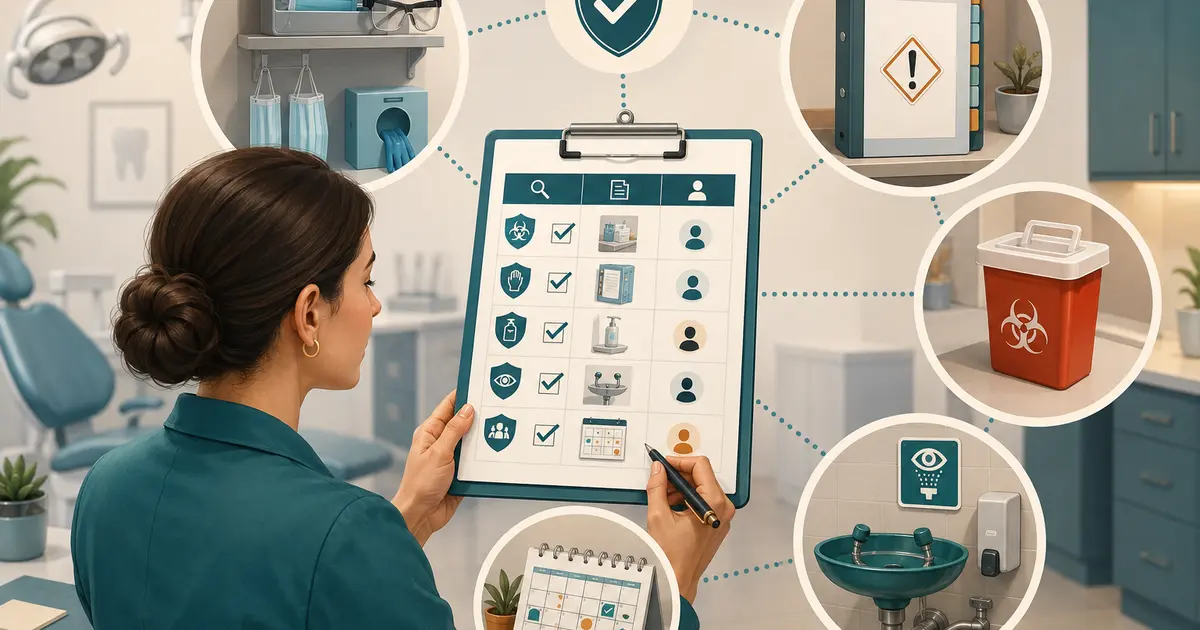
Dental office OSHA compliance is not one certificate or an annual form. It is an operating system for recognizing employee hazards, controlling exposure, training the people affected, and preserving evidence that the controls work. A dental practice may face federal OSHA rules, an OSHA-approved state plan, and state-specific requirements. Use this checklist to organize the review, then have a qualified safety professional or employment adviser confirm which standards apply to the office, workforce, and procedures.
OSHA has identified several standards relevant to dental offices, including Bloodborne Pathogens, Hazard Communication, personal protective equipment, eye and face protection, and electrical safety. The exact list depends on actual job tasks and hazards. Begin with an exposure-based assessment rather than assuming every office needs the same binder.
Identify the standards that apply to actual work
Walk through the practice while work is occurring. List tasks, equipment, chemicals, and credible exposure routes by job—not merely by job title. A dental assistant who sometimes handles contaminated instruments has a different exposure profile from an administrative employee who never enters a treatment or reprocessing area.
For each task, record four facts:
- the hazard and how an employee could encounter it;
- the engineering or work-practice control already in place;
- required protective equipment and training;
- the person responsible for checking that the control remains effective.
Review the practice's state-plan status on OSHA's website. An OSHA-approved state plan must be at least as effective as federal OSHA, but it may impose different or additional rules. Local fire, radiation, waste, and professional-board requirements are separate; do not label those obligations “OSHA” simply because they also concern safety.
Tie the assessment to the practice's broader dental office SOP system. The safety program should reference controlled procedures, not rely on a shelf of policies employees cannot use during work.
Control bloodborne-pathogen exposure
Dental procedures can create occupational exposure to blood and other potentially infectious materials. OSHA's Bloodborne Pathogens standard specifically includes saliva in dental procedures within its definition of other potentially infectious materials. A practice with occupational exposure needs a written exposure control plan that is accessible to affected employees and reviewed at least annually and when tasks or technology change.
Confirm that the plan covers:
- a task- and position-based exposure determination;
- universal precautions and hand hygiene;
- engineering controls such as appropriate sharps containers and safer devices;
- work-practice controls for passing, handling, transporting, and disposing of sharps;
- selection, use, removal, cleaning, and disposal of PPE;
- hepatitis B vaccination availability for eligible employees under the standard;
- immediate response, confidential medical evaluation, and follow-up after an exposure incident;
- labels, signs, regulated-waste handling, training, and required records.
Do not copy a generic exposure plan and call the job finished. Observe instrument transport and reprocessing, sharps disposal, operatory turnover, laboratory handling, and spill response. Compare the written steps with the way employees actually work. Record a correction owner and due date for every gap.
Review safer-device decisions with the employees who perform the affected tasks. Preserve documentation of the annual review and the practice's consideration and implementation of appropriate commercially available, effective safer devices.
Match chemicals with labels, data, and safe handling
Create a current chemical inventory by inspecting operatories, sterilization and laboratory areas, maintenance storage, and housekeeping supplies. Every hazardous chemical in the workplace should connect to an appropriate label, an accessible safety data sheet, employee information and training, and a written hazard communication program when the standard applies.
Check transferred or secondary containers. A bottle whose identity is known only to one employee is not a controlled system. Confirm that staff know where safety data sheets are located during every shift, including when the usual manager is absent or electronic systems are unavailable.
The inventory should include product name, manufacturer, work area, primary hazard, required PPE, storage limits, spill response, and the date the safety data sheet was verified. Reconcile the list after a product is introduced or retired. Never improvise dilution, contact time, chemical mixing, or disposal; follow the product label, safety data sheet, manufacturer instructions, and applicable rules.
Connect purchasing to review. No new chemical should appear in a cabinet before someone evaluates its hazards, storage, training, and disposal needs.
Verify PPE, respiratory, electrical, and ergonomic controls
PPE selection should follow the hazard assessment. Check that the practice has the right types and sizes, that employees know when each item is required, and that contaminated PPE is removed and handled correctly. Inspect eye and face protection, protective clothing, and utility gloves used for instrument cleaning or chemical handling.
A surgical mask is not automatically a respirator. If the practice requires respirator use for a task, evaluate whether OSHA's Respiratory Protection standard applies, including medical evaluation, fit testing, training, program administration, and seal checks. Voluntary use has its own conditions. Obtain competent advice before creating an informal respirator rule.
Inspect cords, outlets, power strips, equipment clearances, compressed-gas controls if present, emergency access, and manufacturer-required maintenance. Remove damaged equipment from service through a documented process instead of attaching an ambiguous note.
Ergonomic concerns should also be visible. Repetition, force, posture, and prolonged static positions can produce injury even when no single event occurs. Invite staff to identify difficult reaches, poorly placed monitors, heavy supply handling, and tasks that encourage unsafe shortcuts. Assign improvements through the same control process used for other hazards.
Make training and records auditable
Training should correspond to the employee's exposure and occur at the times required by the applicable standard. A signature alone does not show that an employee can perform the work. Use demonstrations, realistic questions, and observed practice to confirm understanding.
Keep a matrix showing employee, required topic, trigger, completion date, trainer, method, and next review. Distinguish OSHA training from clinical licensure or continuing education. Preserve bloodborne-pathogen training and medical records for the periods the standard requires, and restrict confidential medical information appropriately.
OSHA injury and illness recordkeeping obligations depend on factors that include industry classification and employer size, while reporting severe events has separate rules. Determine the practice's status rather than assuming a small office is exempt from every requirement. Post required notices and provide access to records as applicable.
New hires should receive the safety portion of the dental office onboarding checklist before independent work creates exposure. Retrain after a task, device, chemical, or policy changes—not only when the calendar reaches an anniversary.
Audit evidence and close corrective actions
Quarterly, select one work period and trace a small sample from hazard to evidence. For example, choose one chemical, one sharps container, one exposure-response kit, and one training record. Ask an employee to explain the safe process and locate the relevant information.
Use an audit record with these columns: requirement, observed condition, evidence, risk level, immediate containment, long-term correction, owner, due date, and verification date. Do not close an item because a purchase order was submitted. Close it after the correction is installed, communicated, and verified in normal work.
Review incidents, near misses, staff reports, equipment failures, and process changes together. A low incident count is not proof of compliance if hazards are not reported. Employees must be able to raise safety concerns without retaliation. Make the reporting path clear in the dental office employee handbook and in daily supervision.
The final management review should answer a practical question: can the practice show how it recognized each material employee hazard, selected controls, trained affected people, responded to failures, and checked the result? If the answer depends on one person's memory, the system is not ready.