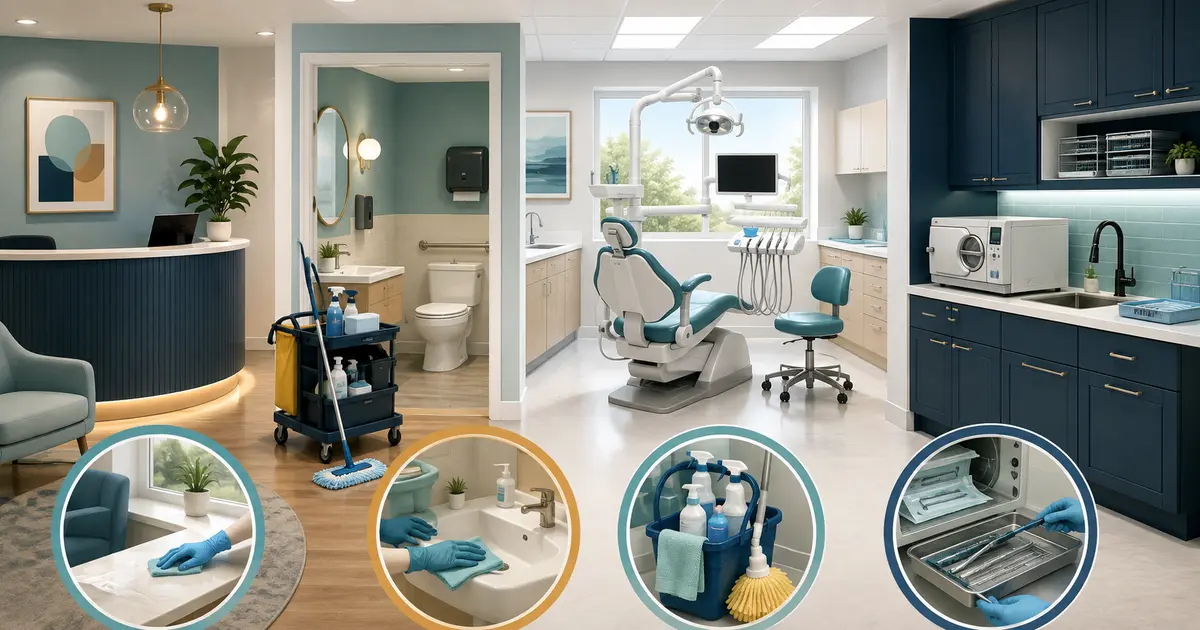
A dental office cleaning checklist should distinguish clinical contact surfaces, patient-care items, housekeeping surfaces, and administrative areas. They do not all receive the same process. Cleaning removes soil and must precede disinfection when disinfection is required; sterilization is a separate process for appropriate patient-care items. Use the zone plan below with the practice's infection-prevention coordinator, product labels, manufacturer instructions, OSHA controls, and applicable state and local rules.
Do not ask an outside janitorial service to decide clinical infection-prevention requirements. The practice remains responsible for defining scope, training, products, PPE, handoffs, and evidence.
Set the rules that apply in every zone
For each surface or item, record:
- classification and contamination risk;
- trigger and frequency;
- cleaning method;
- disinfectant and required contact time when applicable;
- surface and equipment compatibility;
- PPE and ventilation requirements;
- responsible role and trained backup;
- completion evidence;
- action after a spill, product failure, or missed step.
Use only products appropriate for the task. CDC recommends EPA-registered hospital disinfectants for relevant dental environmental surfaces and following label instructions for amount, dilution, contact time, safe use, and disposal. A disinfectant is not necessarily a cleaner unless its label says so.
Keep safety data sheets accessible and include cleaning chemicals in the practice's hazard communication program as applicable. Never mix chemicals or transfer them into an unlabeled container.
Operatory zone: reset between patients
Clinical contact surfaces are touched frequently or may be contaminated by touch, splash, or spatter. Examples include light handles, chair controls, unit switches, bracket trays, drawer handles, curing-light controls, and nearby computer equipment.
Between patients:
- remove and discard barriers without contaminating clean areas;
- inspect the protected surface;
- clean visible soil using the approved method;
- clean and disinfect unprotected clinical contact surfaces with the selected EPA-registered hospital product;
- use the required intermediate-level product when visibly contaminated with blood, consistent with CDC guidance and the product label;
- keep the surface wet for the full label contact time;
- replace barriers after hand hygiene and with clean hands or gloves as the procedure requires;
- document the turnover according to office policy.
Do not spray sensitive electronics or equipment unless manufacturer instructions allow it. Apply products in a way that protects employees and equipment. Keep clean supplies out of the contaminated workflow.
At closing, inspect less visible touch points, chair bases, hoses and lines handled externally, drawer fronts, storage handles, and floors. Follow separate manufacturer and clinical protocols for dental-unit waterlines, evacuation systems, and patient-care devices; they are not ordinary housekeeping tasks.
Reprocessing zone: preserve one-way movement
Instrument reprocessing requires a controlled sequence from receiving and cleaning through preparation, sterilization, storage, and distribution. The room layout and staff behavior should prevent contaminated items from moving backward into clean areas.
Define responsibility for receiving containers, utility gloves and other PPE, automated cleaning equipment, solution changes, inspection, packaging, sterilizer loading, cycle records, monitoring, release, and storage. Cleaning must remove debris before sterilization can be effective.
Environmental cleaning in the reprocessing room should follow surface classification without confusing it with instrument processing. Clean spills promptly through the exposure-control procedure. Do not reach into a sink or container holding unseen sharps. Use puncture-resistant utility gloves and work-practice controls required by the office plan.
At the end of the shift, reconcile instruments and cycle documentation, clean approved work surfaces, inspect sinks and equipment, remove waste correctly, and leave clean storage protected. Escalate a failed indicator, damaged package, interrupted cycle, or uncertain load; do not quietly re-label or return it to use.
Reception and administrative zone: protect high-touch surfaces
Reception desks, pens, tablets, payment terminals, phones, door handles, children's-area items, and shared keyboards can receive frequent contact. Set a routine based on touch and visible soil while protecting electronics and patient information.
Use products compatible with each device and do not allow liquid to enter openings. Lock screens and secure documents before cleaning. Use separate cloths and tools from clinical and restroom zones to reduce cross-contamination.
Clean shared items on the practice's schedule and when visibly dirty. Provide hand hygiene resources and remove items that cannot be cleaned reliably. Front desk cleaning should not expose appointment lists, payment information, or open patient records.
Coordinate the routine with the dental office manager daily checklist so completion and exceptions are visible without adding patient information to the cleaning log.
Restroom, break room, and utility zones
Assign separate, clearly identified tools for restrooms. Clean high-touch points, fixtures, dispensers, counters, and floors at the defined frequency and when visibly soiled. Post wet-floor controls and maintain ventilation. Restock soap and hand-drying supplies before they run out.
Break rooms must remain separated from areas where occupational exposure or hazardous chemicals make food and drink inappropriate. Define refrigerator, appliance, counter, sink, and waste schedules. Never store food with specimens, medications, chemicals, or contaminated items.
Utility and storage rooms need clear floors, accessible electrical panels and emergency equipment, secured chemicals, compatible storage, and clean tools allowed to dry before reuse. Record leaking containers, damaged labels, pests, moisture, or blocked access as corrective actions.
Housekeeping surfaces such as floors and walls generally carry lower transmission risk than clinical contact surfaces. CDC states they may be cleaned with soap and water, or cleaned and disinfected if visibly contaminated with blood. Apply the practice's spill procedure when blood or other potentially infectious material is involved.
Opening, closing, and periodic assignments
The opening check confirms that rooms are ready, supplies are available, logs from the prior shift are complete, and no unresolved contamination or equipment issue remains. Do not sign yesterday's missing work as complete; escalate and correct it before use.
The closing check covers zone completion, waste movement, laundry handoff where applicable, chemical storage, tool decontamination, floor safety, locked records, and unresolved issues. Weekly or monthly tasks can include vents, shelving, behind movable equipment, storage rotation, upholstered surfaces, refrigerator cleaning, and inspection of contractor work.
Create a master schedule with task, zone, trigger, frequency, method, product, responsible role, backup, completion record, and supervisor review. Avoid vague assignments such as “deep clean as needed.” Define the observable condition, timing, and response when a task is missed.
External cleaners should receive a written scope that distinguishes permitted housekeeping from clinical contact surfaces, regulated waste, instrument areas, and confidential spaces. Confirm training and contract terms; limit keys and system access to what the work requires.
Verify the system instead of collecting initials
Once a week, select a zone and observe the process. Check product label and expiration, dilution where relevant, surface wet time, PPE, cloth or tool separation, waste handling, and documentation. Ask the assigned employee to explain what changes after visible blood, a chemical spill, or equipment incompatibility.
Use the dental office SOP template to control revisions. When products or equipment change, update the procedure and retrain before the old method becomes habit.
Track missed tasks, product substitutions, spills, staff exposure, damaged surfaces, failed monitoring, complaints, and contractor exceptions. Close an item only after correction is verified. Periodically compare the office program with CDC's dental infection-prevention checklist and the safety controls in the dental office opening checklist.
A clean appearance is not the same as a controlled infection-prevention process. The goal is a repeatable system in which every zone has the correct method, employees know the boundaries, and the practice can show that required work was completed.
Review the zone map whenever rooms, equipment, products, staffing, or contracted services change.